
Category: Russia
Fake News as a Weapon: Trump, Russia and the World of Rumors
Have you heard the rumor that Donald Trump is mentally ill? Did you hear that President Obama wiretapped Trump Tower? With the help of British intelligence? Or that a child-sex ring connected to Democrats was being run out of a Washington, D.C. pizza restaurant?
via New England Historical Society
American society is being bombarded by rumors. Fake news websites push stories like the aforementioned “Pizzagate.” Russian has an army of Twitter trolls who blast out all sorts of wild rumors. Even Donald Trump’s own tweets deluge us with confusing and contradictory information.
It seems awful hard to know what’s true and what’s not these days. Where is the antidote for the epidemic of fake news? Many of us may feel like we can’t even trust our own judgment. And maybe, that’s the point.
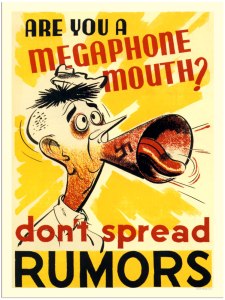
The post-truth era, as it’s been called, might feel very familiar to American spies operating behind enemy lines in World War II. Back then, U.S. operatives were coming up with creative ways to damage morale and divide the leadership of Nazi Germany. One of their best weapons was the use of carefully crafted, well-timed rumors.
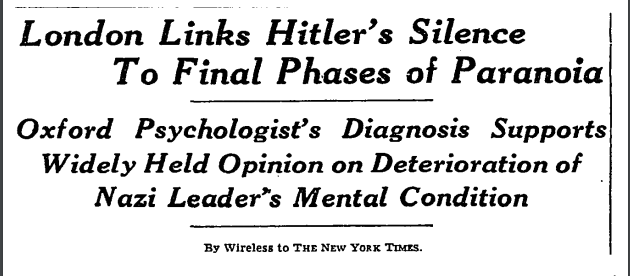
Rumors were a specialty of the Morale Operations Branch of the Office of Strategic Services (OSS), the predecessor of today’s CIA. One of the most famous of the OSS’ rumor campaigns was “Where Is Hitler?” The OSS would broadcast a fake report that Hitler was supposed to appear at an upcoming rally. When Hitler inevitably failed to show, the OSS would float rumors that Hitler was ill or suffering from a mental breakdown. These rumors spread so widely that they became the subject of articles in American newspapers, including The New York Times.
Creating a loss of confidence in leaders was just one was just one the tricks dreamed up by the OSS Morale Operations branch. Others are spelled out in a now declassified field manual, which is a guide on how to use rumors, forgeries, blackmail and bribery to destabilize a country. What the OSS called “subversive rumors” could be used to cause enemy populations to distrust their own news sources, create division among racial, political and religious lines, to create confusion and dismay with a welter of contradictory reports, and to tip the balance when public opinion was in a precarious state, among other things.
Viewed in this light, fake news seems less a nuisance and more like something that would trouble our intelligence community. And indeed, they do appear concerned. The U.S. intelligence community recently concluded that Russia mounted an “influence campaign” during the 2016 presidential election that blended covert intelligence operations with overt efforts by Russian Government agencies, state-funded media, third-party intermediaries, and paid social media users or “trolls.” Russia influence campaign sought to undermine faith in U.S. democracy and denigrate Hillary Clinton’s campaign.
In essence, Russia has created a modern version of the OSS Morale Operations branch. Social media gives the modern operative powers the likes of which his or her OSS forerunner could only have dreamed. Whereas the OSS had to send operatives into enemy territory to plant rumors, the modern influence campaign can without leaving home harness the power of social media sites. Facebook, Twitter and YouTube are machines for the rapid transmission of rumors.
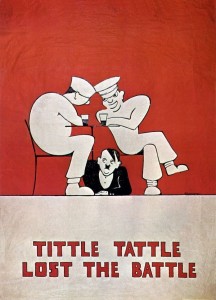
While the technology behind rumor campaigns has evolved, the nature of rumor itself hasn’t changed much in the 74 years since the OSS wrote its field manual. The OSS defined a rumor as “an unauthenticated, unofficial story or report, represented and transmitted as fact.” This distinguishes it from propaganda, which stamps its authorship on its message. Anybody can start a rumor. Crafting a good one is an art form.
via New England Historical Society
The old OSS characteristics of what makes a good rumor still hold true: A good rumor still must be simple, consisting of a single idea. It must be plausible. It is tied to some known facts, yet is impossible to completely verify. It frequently appears as an “inside” story. The best rumors to spread are existing ones. “In many cases, the most effective rumor policy will be to spread further rumors that have arisen spontaneously in enemy territory,” the field manual advises.
A good rumor must also be vivid. Rumors with “strong emotional content” are extremely effective. (Case in point: the unforgettable, unverifiable story of Trump cavorting in a Moscow hotel room with prostitutes.) A suggestive rumor was well adapted to spreading fear and doubt, by doling out limited but tantalizing bits of information that allow the audience to formulate conclusions (“FBI Director James Comey made an unexpected trip to the White House.”)
Robert Knapp, who developed the section of the OSS’ Field Manual on rumors and wrote academic papers on the subject, likened a rumor to a torpedo. “Once launched, it travels of its own power,” he wrote. Knapp had an insight into what gave rumors their power: They expressed and gratified the emotional needs of the community, just as daydreams and fantasies expressed the needs of the individual. Rumors gave sense and direction to fears, resentments or hopes. ”No rumor will travel far unless there is already a disposition among those who hear it to lend it credence,” he wrote in a 1944 paper.
Among the many coincidences involving Russia and Donald Trump, one that goes unnoticed is their mutual grasp of the power of rumor. Trump used rumors to stunning effect in his campaign, beginning with the suggestion that President Obama was born in Kenya. This rumor tapped into deeply-held beliefs about President Obama that many people were not comfortable expressing publicly. Outright racism is unacceptable to most Americans. However, many found the disguised racism of a rumor about the African-American president’s birthplace more palatable. There is frequently a racist undertone to many of Trump’s rumors: Muslims celebrating Sept. 11 in New Jersey, illegal immigrants voting, terrorist incidents that didn’t happen, and so on.
Rumors may also help explain Trump’s appeal. In a recent interview, Time magazine’s Michael Scherer pressed Trump on his use of rumors. “What am I going to tell you? I tend to be right,” the president told him. “I’m an instinctual person, I happen to be a person that knows how life works.” In other words, Trump’s rumors feel true to him, even if they can’t be verified. Trump’s words also feel true to his supporters, almost like an article of faith. He is making a connection on a deep emotional level that, once established, is difficult to break.
However, Trump’s predilection for rumors over facts is dangerous, for it leaves him wide open to manipulation. Unwittingly or not, Trump has spread rumors that originated in Russia. The story spread by the White House that President Obama used British intelligence to spy on Trump and his associates started as a story on RT, the Kremlin-backed propaganda outlet. On the campaign trail, Trump quoted a report that appeared to originate on Sputnik, another Kremlin-backed media outlet. At a March 30 Senate intelligence committee hearing, Clint Watts, a former FBI agent and an expert on Russian disinformation, explained in striking terms the problem with having a rumor-monger for a president:
Rumors do work on the campaign trail, but they are toxic to the presidency. Credibility is one of the president’s strongest assets, never more so than in moments of crisis. Trump seems not to understand that, as president, he is the authority, and the White House is the place where rumors end, not where they begin. If President Trump truly wants to make America great again, he must stop spreading rumors.
If Trump won’t quash rumors, others must do it for him. Many news organizations are now regularly refuting the president’s rumors. This effort harkens back to World War II, when rumors were an even bigger problem then they are now. Robert Knapp, the OSS’ rumor expert, founded a “rumor clinic” in Boston that collected rumors and sought to put and end to them. A column first published in the Boston Herald in 1943 quoted the rumor in italics followed by the word FACT. Rumor clinics opened in many cities, but quickly faded following a clash with the Roosevelt administration’s Office of War Information. Government bureaucrats wanted to smother rumors with facts, rather than call attention to them by singling them out for disproof. (For more on this click here.)
Knapp proposed that rumors could serve as an “index of morale.” They may be a better gauge of the true state of public opinion than any poll or survey. Rumors allow expression of the deeply held beliefs and fears that won’t be repeated to a stranger. A look at the rumors prevalent in American society show we are a deeply divided along racial, political, and religious lines. Many Americans have little or no confidence in our elected leaders. We distrust our own news sources.
In sum, American morale has been deeply wounded. We are much weaker than we think we are.
Obama and GCHQ tale is Russian disinformation
Note: This piece has been updated.
It anyone surprised that the allegation that President Obama used Britain’s GCHQ intelligence agency to eavesdrop on Donald Trump was first broadcast on RT, the Kremlin’s international propaganda outlet?
This allegation has gone in a few days from being a crackpot theory on social media to an international dispute. Britain was furious when White House spokesman Sean Spicer cited the GHCQ story as part of his defense of Trump’s claim that he was “wire tapped” by President Obama. The GHCQ, Britain’s version of the National Security Agency, issued a rare denial.
That this GHCQ allegation was first given life by RT shows the influence of the Kremlin-backed network, which has found a sympathetic ear in the White House. According to the U.S. intelligence community that Trump so openly distrusts, RT has the goal of undermining its viewers’ trust in US democratic procedures.
On March 5, the day after Trump tweeted that “Obama had my ‘wires tapped’ in Trump Tower,” RT broadcast an interview with Larry C. Johnson, once an analyst with the CIA.
In the clip, linked above, Johnson said “very good friends” had told him that information gathered by GHCQ on Donald Trump was illegally disseminated within the US government in an effort to destroy his candidacy. Obama, Johnson said, “gave the green light” to distribute the information from GHCQ in an improper way.
On his blog, Johnson goes into more detail about his sourcing. (Update: Johnson’s blog was taken off line shortly after this piece was published).
No one involved with the Trump campaign reached out to me and asked me to get involved with this. I spoke three months ago with a source that, if the source’s name was revealed, would be known and recognized as a reliable source of information. Based on that contact I reached out to friends in the intel community and asked them about the possibility that a back channel was used to get the Brits to collect on Trump associates. My sources said, “absolutely.” I later confirmed this via a cut out with a person who is a Senior Intelligence Service executive in the CIA.
Assuming that’s true, why would Johnson, a former CIA analyst, would go on a Russian propaganda network that presents anti-American views? CNN’s Brian Stelter put that question to Johnson on his show, Reliable Sources.
STELTER: Why is it appropriate for any American to appear on a Kremlin propaganda network?
JOHNSON: Well, it’s not a Kremlin propaganda network. … What I found the difference with Russia Today is they don’t do pre-interviews. I’ve done pre-interviews with your people. I’ve done pre-interviews in the past when I appeared on other networks.
Just two days ago, I did a pre-interview with BBC. They were going to have me on air. But once they heard what I had to say, they came back and said, oh, no, we don’t need to use you now. So, I’m —
Johnson’s point is that RT doesn’t censor its guests. Stelter’s point, which he presses later in the interview, is that anyone can go on RT and say whatever they want without bothering about details like sourcing and verification.
Johnson theories about GHCQ are likely to prove false: officials in Britain and Washington have called it ridiculous. For RT’s purposes it doesn’t matter whether Johnson is telling the truth, only that his information serves its broader goals.
RT’s GHCQ story is the textbook definition of disinformation:
false information deliberately and often covertly spread (as by the planting of rumors) in order to influence public opinion or obscure the truth.
So back on March 5, while former Director of National Intelligence James Clapper was knocking down Trump’s claims on Meet the Press, RT was quickly building a counter-narrative that besmirched the United States with Johnson’s help.
An outfit like Meet the Press needs a big audience to deliver ad dollars; since it strives to be objective, it has to present credible sources. That means it has guests like Clapper who as insiders know whether Obama really “wire tapped” Trump or not. If Meet the Press had people like Larry Johnson or RT’s Illuminati correspondent sitting around talking about what their friends supposedly told them, the audience would find something better to do and the ad dollars would dry up pretty quickly.
RT, on the other hand, is funded by the Russian government. It doesn’t need a big audience. So it can quickly disseminate poorly sourced, unverified information that drives home the message that Russia is not the bad guy and America isn’t so great, anyway.
Johnson sought to minimize his role in the GHCQ affair by telling Stelter that nobody watched RT.
STELTER: You’re saying Russia today is not that influential?
JOHNSON: I’m telling you that’s the truth. I mean, who watches it? The fact that I spoke about it two weeks ago and it didn’t even surface — it wasn’t even a blip anywhere in the U.S. news media. And so, I guarantee, if people like yourself who were very informed, very up to speed on things, don’t pick up on something like that, you expect a coal miner in Pennsylvania, an auto worker in Michigan, that they’re going to be on top of Russia Today?
But information warfare, as Johnson surely knows, doesn’t need a big audience to work.
It has just to plant a false idea that contradicts the conventional narrative. Johnson made a big fuss about how it took so long for his story to spread, but that’s how rumors work. And that’s what makes them so effective. They are spread person-to-person by social media and word-of-mouth until they reach a critical mass. If you wanted to drive a wedge between allies, there’s no way to do it better. It’s cheap, bloodless, and stunningly effective.
Johnson’s unsupported allegation was rebroadcast on right-wing Internet on blogs and websites until March 14 when it jumped into mainstream media. Fox contributor Andrew Napolitano repeated the allegation on the talk show “Outnumbered” and then repeated it again on Fox News. Johnson told The New York Times he was one of Napolitano’s sources.
On Friday, Trump refused to back down from the allegation, telling reporters, “All we did was quote a very talented legal mind.”
Did the president realize he was also quoting Johnson via Russian media?
Johnson, who is almost always referred to as a former CIA analyst, worked for the spy agency in the 1980s. After four years in the State Department’s Office of Counterterrorism, Johnson left government service in 1993.
Since then, he gotten embroiled in controversy such as his claim that Republican operatives possessed a tape of Michelle Obama railing against “whitey.” (Johnson claims he was manipulated by Clinton confidant Sidney Blumenthal.) Or that Bush White House advisor Karl Rove had been indicted.
Johnson has been a member of Veteran Intelligence Professionals for Sanity (VIPS), a group of intelligence professionals formed in 2003 to protest the use of faulty intelligence that was used as a grounds for the invasion of Iraq.
VIPS and Johnson have been critical of the US intelligence community’s findings that Russia hacked the U.S. election. On Dec. 15, Johnson co-signed a VIPS letter that stated the hacking allegations “have no basis in fact” and suggested an “inside leak,” not hacking, was behind the release of DNC emails. Not surprisingly, RT publicized the letter.
It’s worth noting here that Ray McGovern, a former CIA analyst and founding member of Veteran Intelligence Professionals for Sanity attended the now infamous 2015 RT 10th anniversary dinner in Moscow, where he sat at the same head table with President Vladimir Putin and former Gen. Michael Flynn. (link) It seems McGovern makes an annual pilgrimage to Moscow where we find him pontificating in RT’s studios.
Napolitano for his part has also peddled Kremlin disinformation before. On May 6, 2016, he reported that “there’s a debate going on in the Kremlin between the Foreign Ministry and the Intelligence Services about whether or not they should release the twenty thousand of Mrs. Clinton’s emails that they have hacked into and received and stored.” (archived link)
Now, mind you, this was days before hacked emails from the Clinton campaign began appearing on the Internet.
According to Malcolm Nance’s informative book, The Plot to Hack America, Napolitano’s source this go-around appeared to be a conspiracy website called Whatdoesitmean.com.
It appears that the source of the story emanated from a mythical figure, a journalist named Sorcha Faal. Sorcha Faal is widely believed to be a pseudonym for David Booth. Booth hosts a wild-eyed conspiracy theory website called Whatdoesitmean.com. Usually websites like this and the more popular and crazier Infowars.com are easily dismissed as tinfoil hat crowds who see government conspiracy everywhere. Yet in this case “Sorcha Faal” appears to be so well wired into the Kremlin that “her” work at this website was often copied by mainstream Russian information propaganda like Russia Insider’s Svobodnaya Pressa (“ Free Press”). This site pushes wild conspiracy theories such as the proposition that the US trains and directs ISIS, and writes op-eds about the dangers of European multiculturalism. It is a core component of the Russian propaganda system, and such news organs as Ren TV (a large, private, pro-Putin Russian television channel) and Sputnik News (a multinational propaganda organ of the Russian government)
We might as well learn the Russian word for this, folks.
Dezinformatsiya.
The Yuge Trump-Russia Timeline

Here it is: All the publicly-available evidence that suggests collusion between Trump, his campaign, and Russia.
It stretches over three years and comprises the contacts, meetings, tweets and revelations involving Christopher Steele, Michael Flynn, Jeff Sessions, Roger Stone, Paul Manafort, Sergei Kislyak, and others.
I’ve been working on this timeline for weeks and will continue to update it as more information becomes available.
If you know of something that should be in here but isn’t drop me an email.
The link below is an embedded Google sheet with sources hyperlinked. If anyone has a better idea how to display this in a form that is more easily accessible please let me know. I am not very handy with Google scripts.
Sergey Kislyak Timeline
Sergey Kislyak
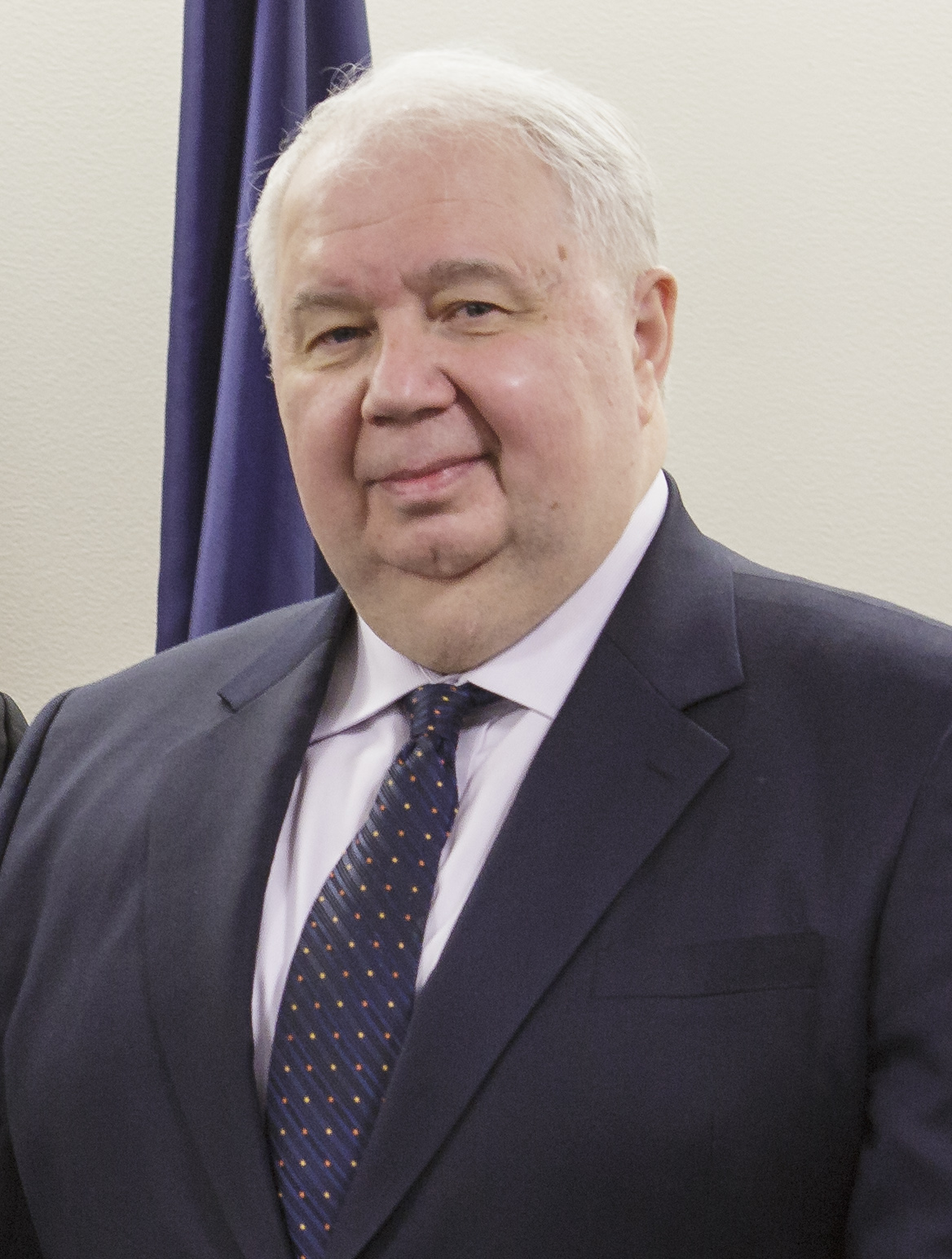
Sergey Kislyak, Russian ambassador to the United States, is emerging as a key point of contact for members for the Trump campaign and Russia, and a reminder of the president’s ties to Vladimir Putin.
CNN reports that Kislyak is known to US intelligence officials as a spy recruiter. And that’s why he’s a touchy subject for Trump’s people.
Here’s a timeline of what we know about contacts between the Trump campaign and Kislyak:
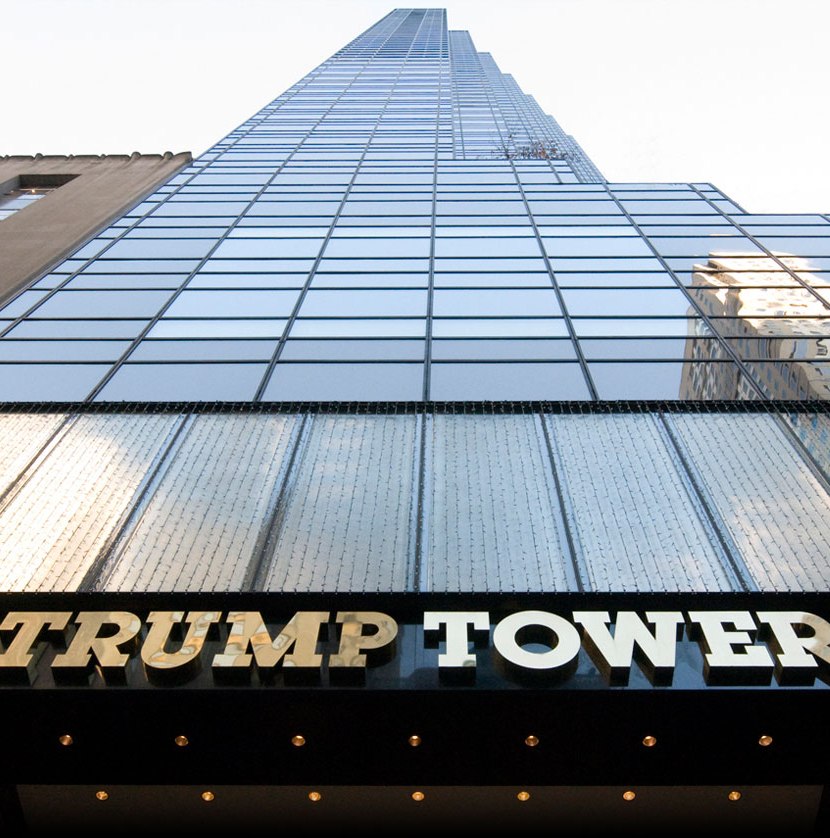
Russian Mafia in Trump Tower … and the Mogilevich connection
Since it opened in 1983, Trump Tower has been home to celebrities and billionaires, and the occasional Russian Mobster or those connected to them. And those Russian Mobsters were connected in some way to Semion Mogilevich, who is considered the most dangerous Mobster in the world.
Coincidence? Here’s a look:
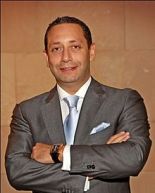
Felix Sater
Felix Henry Sater: Born in the Soviet Union in 1966, Felix H. Sater immigrated with his family to the US at age of 7. Felix became a Wall Street stock broker. Convicted of assault in 1991 for stabbing another broker in the face with a broken piece of a margarita glass. Spent a year in prison. Pleaded guilty in 1998 for his role in a $40 million “pump and dump” penny stock fraud at a Mafia-linked brokerage firm. Avoided prison by becoming a government informer. Provided U.S. federal authorities with “information crucial to national security and the conviction of over 20 individuals, including those responsible for committing massive financial fraud and members of La Cosa Nostra,” former U.S. Attorney General Loretta Lynch wrote during her Senate confirmation hearing. Permanently barred from trading stocks, Sater went into real estate. Began working in Trump Tower around 2002 for Bayrock (exact date is unclear). Tried to develop deals for Trump in Russia, where he watched Trump’s children during a 2006 visit. Under oath, Trump said he didn’t believe Sater was in the Mob. Recently involved in a Ukrainian “peace plan” with the help Trump’s personal lawyer, Michael Cohen that was delivered to the White House.
… the Mogilevich connection: Sater’s father, Mikhail, is a convicted criminal and, according to US Supreme Court petition, a “Mogilevich crime syndicate boss.” (Update: After further reporting for my book, I no longer believe there is any credible evidence to support the claim that Sater is connected to Mogilevich.)
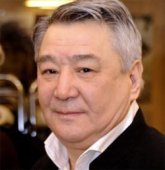
“Vor” Alimzhan Tokhtakhounov
Anatoly Golubchik and Vadim Trincher: Russians serving five years in prison for running an illegal sports betting ring in Trump Tower that catered primarily to Russian oligarchs. Trincher, a professional poker player, had a $5 million condo on the 63rd floor of Trump Tower. (A co-defendant of Golubchik and Trincher’s, Hillel (Helly) Nahmad, paid more than $21 million for the 51st floor of Trump Tower, where he ran a high stakes poker game that catered to millionaire and billionaire clients. Nahmad was sentenced to a year in prison.) According to an 84-page indictment, Trincher and Golubchik’s sports betting operated under the protection of “Vor” Alimzhan Tokhtakhounov, a Ukrainian-born Mafia Don who was a VIP guest at the 2013 Miss Universe pageant Trump hosted in Moscow. Tokhtakhounov,who lives in Russia, is also wanted for bribing Olympic officials in 2002 in Salt Lake City.
…the Mogilevich connection: Tokhatkhounov is described as close to Mogilevich by Interpol and other authorities.

Vyacheslav Ivankov
Vyacheslav Kirillovich Ivankov: Born in the Soviet Republic of Georgia, Ivankov was a top Russian mob boss who arrived in New York in 1992. According to the FBI, he became one of the most powerful Russian Mafia bosses in America. The FBI tracked him down in a luxury apartment in Trump Tower, according to journalist Robert I. Friedman’s expose Red Mafiya. Invakov disappeared and then turned up again in Trump’s New Jersey casino, the Taj Mahal. Ivankov’s phone book included a working number for the Trump Organization’s Trump Tower residence, and a Trump Organization fax machine, according to Friedman. Ivankov was arrested in 1995 and sent to prison for conspiring to extort $3.5 million from two Russian emigres who ran an investment advice company in lower Manhattan. After his release he returned to Russia where he was assassinated.
… the Mogilevich connection: Ivankov had a close relationship with Mogilevich, who paid a Russian judge for Ivankov’s early release from a Siberian prison where he was being held for robbery and torture, according to Alan A. Block’s study, All is Clouded by Desire.
David Bogatin: Russian native who was identified by law-enforcement officials as a member of Russian organized crime. In the early 1980s he ran a gasoline bootlegging scheme that was so lucrative that he spent nearly $6 million to buy five separate condos in Trump Tower. Trump personally sold him the condos, according to an investigation by journalist James S. Henry. Bogatin worked with members of the Colombo family, according to Senate testimony. Pleaded guilty to evading taxes on gasoline but jumped bail before he could be sentenced to prison. (Before he fled, he turned over the mortgages on his Trump Tower condos to a Genovese crime family associate, Friedman writes in Red Mafiya. The mortgages were liquidated and moved through a Mafia controlled bank in New York.) Bogatin surfaced in Poland as the owner of a bank and was extradited back to the United States. Sentenced to prison in 1992.
… the Mogilevich connection: the FBI considered Bogatin a key member of Mogilevich’s crime family.
 Trump / Russia