
Category: Russia
Why Putin Hates America
The New Tsar: The Rise and Reign of Vladimir Putin by Steven Lee Myers
Russia, as a country, punches far above its weight.
Its economy — kleptocracy, really — is smaller than that Italy, Korea or Brazil. And it is mired in a recession, dragged down by rampant corruption, and the imposition of sanctions by the European Union and the United States. And yet, rather than focus inward, reassess or attempt to rebuild, Russia focuses outward at its many perceived enemies — foremost among them the United States.
As everyone but President Trump acknowledges, Russia launched an audacious campaign to influence the 2016 U.S. presidential election. According to U.S. intelligence, that campaign was ordered by none other than Russia’s president, Vladimir Putin. And it succeeded beautifully. Russia managed to undermine faith American democracy, denigrate Hillary Clinton and diminish her chances of winning, all for virtually no cost at all.
And now we learn that Russia, to help its preferred candidate, Donald Trump, provided assistance that may have been even more direct. Top Trump campaign aides were in constant and repeated contact with Russian intelligence officials. A leaked dossier compiled by a former British spy suggests that Moscow has scandalous and compromising material on Trump (kompromat) that make him susceptible to blackmail. Trump’s own behavior — his blasé attitude about Russia’s meddling, his nonstop praise for Putin — lend credence to these allegations.
Trump denies all. “It’s all fake news,” Trump cried in his press conference Feb. 16. But worries are mounting in Congress and in the US intelligence community, and the president knows it.
The concern of this website and many others that Trump is not acting in the best interests of America when he says he wants to strike some kind of grand bargain with Russia, as he has signaled he intends to do. “I would love to be able to get along with Russia,” Trump said in his Feb. 16 news conference. “Now, you’ve had a lot of presidents that haven’t taken that tack. Look where we are now. Look where we are now.”
So let’s take a look at where we are now and how we got here. What drove Putin to meddle in the U.S. election? Why does Putin hate Hillary Clinton so much that he would hack a US election? Is this the action of a rational man?
In The Last Tsar, an excellent political biography of Putin by Steven Lee Myers, a veteran Moscow correspondent for The New York Times, we get an answer of sorts: Russia sees itself as a nation under siege from the West. After a quarter-century of relative openness since the collapse of the Soviet Union, since 2014, most Russians have once again to come to view the outside world as “an enemy at the gates, to be feared and resisted.”
Russia’s bellicose foreign policy is a reflection of the autocratic Putin himself, who has been fighting his whole life. As a youth growing up in a rough section of Leningrad (today’s St. Petersburg), he became (and remains) an accomplished judo practitioner. He brawled in the streets. “I was a real thug,” he once said, and he was unable to back down from a challenge, even when he knew better or should have. While attending a prestigious KGB academy, Putin got into a fight with some hooligans on the Metro. He returned with a broken arm, and his KGB career suffered for it. Putin never got a glamorous foreign posting in the United States or Western Europe, serving instead in dreary East Germany.
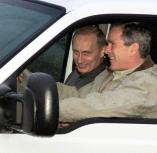
On the ranch
It’s easy to see the Russia-United States relationship as just another fight Putin won’t back down from, but things weren’t always this bad between the two former Cold War adversaries. It was a different Putin who was the first foreign leader to telephone Bush after the attacks of Sept. 11, 2001 and offer any assistance. Bush invited Putin to spend three days at his ranch in Crawford. The U.S. president famously said he looked Putin in the eye and got a sense of his soul. He liked what he saw: a man deeply committed to his country.
The 2003 invasion of Iraq was a turning point. For Putin, the Iraq war revealed the true intentions of the United States: it wanted to impose “freedom” on the rest of the world, with force if necessary. By the end of his presidency, Bush realized he had misjudged the man. “Vladimir,” Bush told him, “you’re cold-blooded.”
It sure seems that way. His critics have been silenced with blackmail, arrests, beatings and murder. And not just bullet-in-the-head-drop-the-gun-at-the-scene assassinations, but grotesque, baroque murders that seem to almost gleefully make a public example of the victim’s suffering. Poisoning seems to Russia’s signature style.
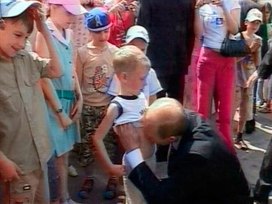 Alexander Litvinenko, a former Russian secret service operative who became a outspoken Putin, was famously poisoned in 2006 with radioactive Polonium 210, shortly after he had publicly accused Putin of being a pedophile shortly before his death.
Litvinenko’s interest was piqued by a photo of Putin kissing a boy’s stomach and a long-rumored videotape of Putin himself in a sexual tryst, Myers notes. (Litvinenko wrote that the tape showed Putin having sex with young boys.) If Putin didn’t order the murder of Litvinenko and many others, he, at the very least, “created a climate that made political murder grimly ordinary,” Myers writes.
Putin formally broke with the United States in 2007 in a speech at the Conference on Security Policy in Munich, Germany. He said the world was being plunged into “an abyss of permanent conflicts” because of one nation’s “almost uncontained hyper use of force — military force.” And in case anybody didn’t get the message, Putin went on to call out the United States by name:
“We are seeing a greater and greater disdain for the basic principles of international law. And independent legal norms are, as a matter of fact, coming increasingly closer to one state’s legal system. One state and, of course, first and foremost the United States, has overstepped its national borders in every way. This is visible in the economic, political, cultural and educational policies it imposes on other nations. Well, who likes this? Who is happy about this?
Putin gave up the presidency in 2008 to his long-time factotum Dmitry Medvedev, and took the post of prime minister. It was during the Medvedev era that the United States attempted to “reset” relations with Russia. The United States saw in Medvedev, a liberal reformer, an opportunity to build bridges.
At his Feb. 16 press conference, Trump brushed off this effort as a joke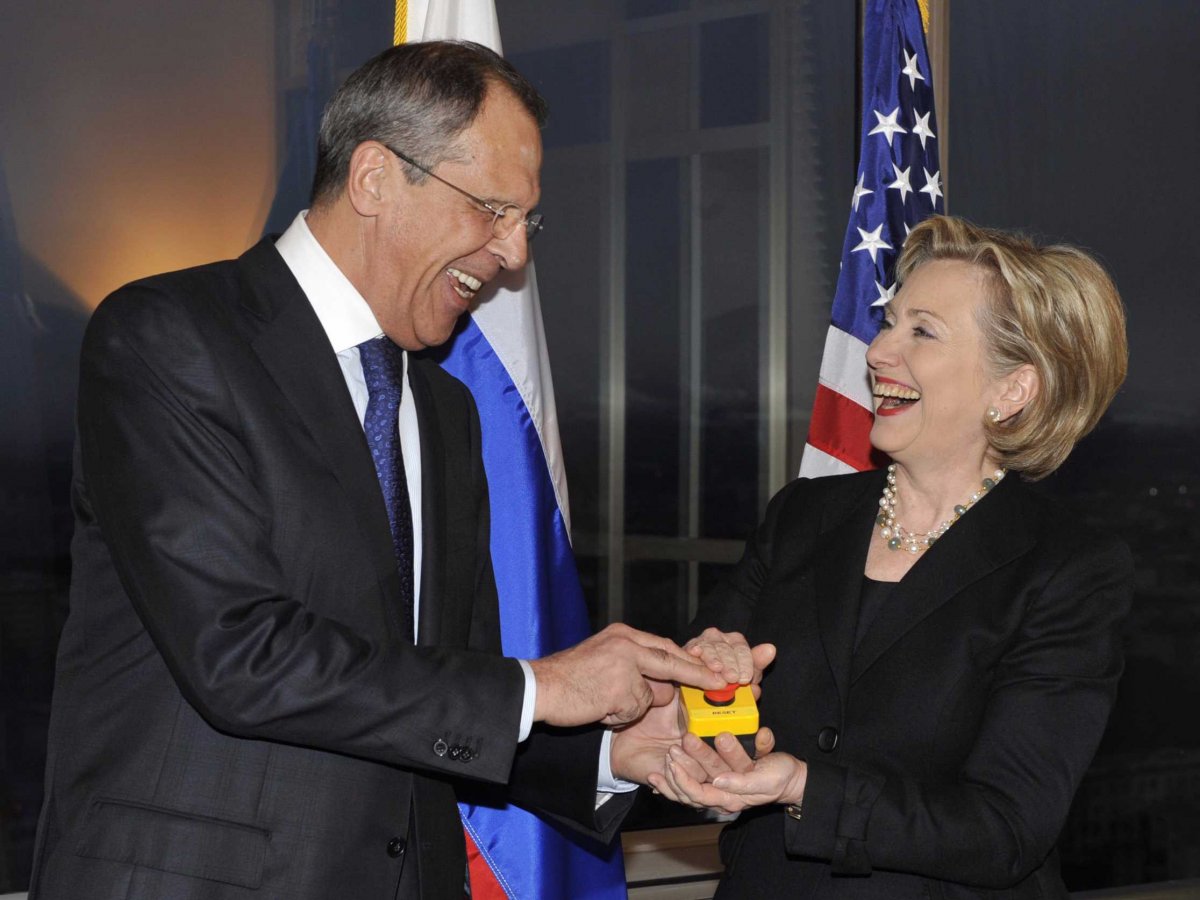 . “Hillary Clinton did a reset, remember? With the stupid plastic button that made us all look like a bunch of jerks. Here, take a look. He looked at her like, what the hell is she doing with that cheap plastic button?” Trump said.
But it wasn’t a joke. There was progress. Russia allowed U.S. forces to pass through Russian airspace on their way to Afghanistan and President Obama dropped plans to build a missile shield over Eastern Europe. In March 2010, the United States and Russia agreed to reduce their nuclear arsenals, which President Trump reportedly denounced as a bad deal during his phone conversation with Putin on January 28.
In 2011, the United States began pushing for a military intervention in Libya. Medvedev, at Secretary Clinton’s urging, agreed not to use Russia’s veto on the U.N. Security Council to thwart an intervention. Putin was furious. “The resolution is defective and flawed. It allows everything,” he said. “It resembles medieval calls for crusades.”
It was in 2012, when Putin returned to the presidency, that things really went downhill for the United States and Russia. He and Medvedev switched jobs in what became known as the rokirovka, the Russian word for castling in chess, where the castle and king exchange places to protect the king.
Mikhail Khodorkovsy, the former head of the Yukos oil company who had been thrown in jail and watched his company seized by the government, wrote in an open letter that Putin was dragging Russia down with him.
“[Putin] is incapable of tearing himself away from the already unliftable ‘oar’ of the monstrous ‘galley’ he himself has built. A galley that apathetically sails right over people’s destinies. A galley over which, more and more, the citizens of Russia seem to see a black pirate flag flying.”
Many Russians were furious over the rokirovka, which they saw as a cynical political manipulation. Thousands took the streets, chanting “Putin is a thief.” That the protests were peaceful made them even more terrifying to the Kremlin, Myers writes. Putin refused to see that protesters wanted a Russia without Putin; instead he blamed Secretary Clinton in language lifted out of the Cold War. “She set the tone for some actors in our country and gave them a signal,” Mr. Putin continued. “They heard the signal and with the support of the U.S. State Department began active work.” Putin cracked down hard on the opposition, and ramped up anti-American voices on state media. Any critic of Putin now risked being tarred as a US agent.
Things went from bad to worse later that year, when President Obama signed into law the Magnitsky Act, named for an auditor who was beaten to death in a Russian prison after investigating Russian tax officials. The law was intended to punish those responsible for Magnitsky’s death. The Russian Duma responded by, among other things, banning the adoption of Russian children by Americans, essentially punishing their own children out of spite.
Many in the US intelligence community saw it as no coincidence that Edward Snowden, the National Security Agency whistleblower, found refuge in Russia. Many in US intelligence are convinced that Snowden all along was a Russian spy. Putin called his arrival in the summer of 2013 a “Christmas present,” and he uses Snowden to mock and belittle the CIA.
In 2014, right after the Winter Olympics in Sochi, Russian forces invaded Ukraine and swiftly annexed Crimea. As Myers observes, the man who had once decried the United States’ “uncontained hyper use of force” now seemed to be saying, “Well, if you can do it, why can’t we?” The United States and the European Union responded by imposing ruinous economic sanctions on Russia. In response, Snowden was quickly granted him asylum, yet another act of Russian nose-thumbing.
And so, today, US-Russia relations have returned to their familiar Cold War roots, just as they were in Putin’s days as a young man in the KGB. Putin sees the influence of the United States everywhere — in Ukraine, in Georgia, in the Arab Spring, to name a few — and Russia sees NATO as an existential threat, just as it did in Soviet days. It’s siege mentality: enemies are closing in; we must fight back. And Russia has chosen to fight back, not with the awesome strength of the nuclear arsenal it possess, but in the more covert “active measures” it employed in Soviet days. Russia has cleverly exploited modern technology to use what are really old tricks of propaganda, subterfuge and funding of foreign pressure groups.
Domestically, Russia is a mess. The ruble has crashed. The price of oil, which accounts for nearly 70 percent of Russia’s exports, has fallen, which Putin blames on a conspiracy between Saudi Arabia and the United States. Russia plunged into an economic crisis. Despite all this, Putin remains enormously popular. His dark, paranoid vision of the world, thanks to his effective control of Russia media, has become his country’s vision of the outside world.
“When a Russian feels any foreign pressure, he will never give up his leader,” said Russia’s first deputy prime minister Igor Shuvalov. “Never. We will survive any hardship in the country — eat less food, use less electricity.”
Wrapping themselves in the flag may not be enough to keep Russians warm during this Cold War, however.
Unless Donald Trump has his way.
Trump Dossier Timeline
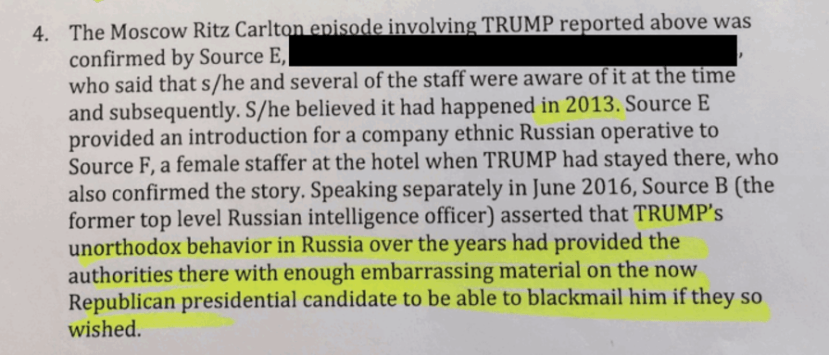 For sourcing click following link:
Jun 18, 2013: Donald Trump tweets: “Do you think Putin will be going to The Miss Universe Pageant in November in Moscow – if so, will he become my new best friend?”
Nov 9, 2013 Trump visits Moscow for Miss Universe pageant.
Nov. 9, 2013 Interviewed in Moscow, Trump is asked by MSNBC whether he has a relationship with Vladimir Putin. “I do have a relationship, and I can tell you that he’s very interested in what we’re doing here today.”
Nov. 9, 2013 Trump tells Tass news service that he plans to build a Trump Tower in Moscow and was in negotiations with billionaire Aras Agalarov’s Crocus Group. During his Moscow visit, Trump also meets with Herman Gref, CEO of state-controlled Sberbank PJSC, Russia’s biggest bank, which is under US sanctions. Sberbank and Crocus sponsor the beauty contest.
Nov 12, 2013 Trump tells Real Estate Weekly that the pageant was a good networking opportunity. “The Russian market is attracted to me. I have a great relationship with many Russians, and almost all of the oligarchs were in the room.”
May 27, 2014 At National Press Club lunch, Trump says, “I was in Moscow recently and I spoke, indirectly and directly, with President Putin, who could not have been nicer.”
June 2016: Fusion GPS, a Washington research firm run by former journalists, hires Christopher Steele, a respected former MI6 officer who once served in Moscow, to gather opposition material on Donald Trump’s ties to Russia. Steele reportedly paid 200,000 pounds for his work.
June 20, 2016: Steele reports that Russian intelligence has videotapes of “perverted conduct” of Trump and prostitutes recorded in a Moscow hotel suite in 2013 during Miss Universe pageant. Trump’s behavior in Russia has “compromised him sufficiently to blackmail him.” Steele reports that Russian authorities have been “cultivating, supporting and assisting” Trump for years and he has accepted a regular flow of intelligence on his Democratic rivals.
Early July 2016: Steele, the former MI6 officer, acting on his own initiative, sends material he has gathered on Trump to the FBI.
July 7, 2016: Trump campaign adviser Carter Page travels to Moscow to give speech critical of U.S. policy. According to Reuters, Page declines to say whether he was planning to meet anyone from the Kremlin, the Russian government or Foreign Ministry during his visit.
July 19, 2016: Steele reports that Carter Page had held a secret meeting with Igor Sechin, head of the Rosneft state-owned oil company who is considered Vladimir Putin’s “defacto deputy.” Sechin and Page discuss lifting US sanctions against Russia. Sechin offered Page the “brokerage” on a 19 percent stake in Rosneft if sanctions lifted. According to Steele, Page also met Igor Divyekin, an internal affairs official with a background in intelligence, who warns Page that Moscow had kompromat on Trump
August, 2016: FBI asks Christopher Steele, the former MI6 officer, for all information in his possession and asked him to explain how the material had been gathered and to identify his sources.
August, 2016: A retired spy tells the BBC’s Paul Wood that he had been informed of videotapes of compromising material on Trump by the head of an East European intelligence agency.
Aug. 5, 2016: Steele’s memo identifies Dmitry Peskov, Kremlin spokesman, as the “chief protagonist” in Russia’s campaign to aid Trump and harm Clinton. Chief of staff Sergei Ivanov, longtime friend and top Putin lieutenant, said to be angry that Peskov’s team had gone too far.
Sept. 25, 2016: Carter Page sends letter to FBI Director James Comey saying that he is subject of a “witch hunt” and has not met with any “sanctioned official” in Russia in the past year.
Oct. 30, 2016 Sen. Harry Reid reveals in public letter that FBI Director James Comey possesses “explosive information of close ties and coordination between Donald Trump, his top advisors and the Russian government” and urges him to share it with the American people.
Oct. 31, 2016: Mother Jones interviews Christopher Steele, and publishes article, without naming him, that reveals existence of Steele’s memos, reporting in vague terms that Russian intelligence had “compromised” Trump during his visits to Moscow and could “blackmail him.”
Nov. 4, 2016: Newsweek reports that the Kremlin has both video and audio recordings of Trump in a kompromat file.
Nov. 8, 2016: Donald Trump elected president
Nov. 18, 2016: Sir Andrew Wood, a British ambassador to Russia, speaks with Sen. John McCain at a conference in Halifax, Canada. Wood tells McCain “how Mr Trump may find himself in a position where there could be an attempt to blackmail him with Kompromat and claims that there were audio and video tapes in existence.”
Dec. 7, 2016: Rosneft sells 19.5 percent ($11B) stake to Glencore Plc and Singapore’s sovereign wealth fund
Dec. 8, 2016: Carter Page revisits Moscow
Dec. 9, 2016: Sen. John McCain, who had also acquired Steele’s memos, turns them over to FBI Director James Comey.
Dec. 26, 2016: Oleg Erovinkin, a former general in the KGB and its successor the FSB, described as a key aide to Igor Sechin, found dead in the back of his car in Moscow.
2017
Jan. 6, 2017: Heads of US intelligence agencies brief PEOTUS and POTUS and leaders of House and Senate intelligence committees on Steele’s kompromat material on Trump. Kompromat material not included in public portion of report.
Jan. 10, 2017: CNN reveals that PEOTUS and POTUS were briefed on kompromat material and were given a two-page summary of allegations.
Jan. 10, 2017: Buzzfeed.com publishes 35 pages of Steele’s dossier. Included are allegations that Trump had a golden shower party with prostitutes in the Ritz Carlton hotel in 2013. Steele’s sources also say that Russia has an alliance with Trump that goes back several years.
Jan. 10, 2017: Donald Trump derides kompromat dossier as “FAKE NEWS!”
Jan. 11, 2017: DNI James Clapper says the U.S. Intelligence Community “has not made any judgement that the information in the document is reliable, and we did not rely on it in any way for our conclusions. However, part of our obligation is to ensure that policymakers are provided with the fullest possible picture of any matters that might affect national security.”
Jan. 11, 2017: Trump tweets, “Intelligence agencies should never have allowed this fake news to ‘leak’ into the public. One last shot at me. Are we living in Nazi Germany?”
Jan. 11, 2017: Former MI6 agent Christopher Steele, author of the Trump kompromat memos, goes into hiding.
Jan. 12, 2017: Yedioth Ahranoth reports that at post-election meeting US intelligence officials warned Israeli counterparts that Russia had “levers of pressure” on Donald Trump and that information passed to the White House could be relayed to Russia and Iran.
Jan. 15, 2017: The Guardian reports that UK intelligence officials have sought assurances from the CIA that the identity of British agents in Russia will be protected because of the Trump team’s closeness to Russia.
Jan. 17, 2017: At news conference, Vladimir Putin says kompromat file was a fake used to smear Trump. “Why would he run to a hotel to meet up with our girls of limited social responsibility? Although they are, of course, the best in the world. But I doubt that Trump fell for it.”
Jan. 20, 2017: Trump inaugurated as 45th US president
Jan. 23, 2017: Steve Hall, retired CIA chief of Russia operations, tells NPR that there is a “live question” now at the CIA about what to do if President Trump asks for the source of information on something that puts Vladimir Putin in a bad light.
Jan. 24, 2017: The Wall Street Journal identifies Sergei Millian, a Trump associate and supporter, as an indirect source for Christopher Steele’s dossier, including existence of compromising videotapes
Feb. 10, 2017: CNN reports that, for the first time, US investigators say they have corroborated some of the communications detailed in Steele’s kompromat dossier. Confirmations were made with SIGINT (foreign intercepts) and relate to conversations with foreign nationals, not the the salacious “golden showers” allegations in the dossier. Confirmations give intelligence officials “greater confidence” in Steele dossier.
A Michael Flynn-Russia Timeline
Report: FSB Helped CIA Pinpoint Election Hacks
Two Russian FSB officers recently arrested on treason charges helped US intelligence agents pinpoint Russian hacking during the presidential election and spied for the CIA for seven years, according to a story on the Russian Rosbalt news agency.
Sergei Mikhailov, deputy director FSB’s Centre for Information Security (see my previous post), and Dmitri Dokuchayev, said to be an ex-hacker named “Forb” who joined the FSB under threat of prosecution, were paid to pass secret data, Rosbalt reported.
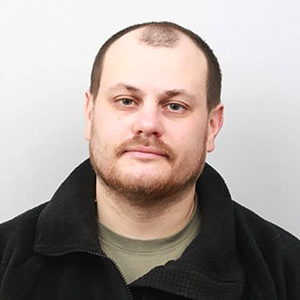
Ruslan Stoyanov (via Securelist.com)
The FSB officers relayed their secrets to Ruslan Stoyanov, a manager from the cybersecurity and anti-virus company Kaspersky Lab and an unnamed representative of another cybersecurity company. The information was then transferred to “acquaintances abroad who worked closely with foreign special service.”
“This is not a one-off story, this activity was carried out for a minimum of seven years and caused substantial harm to the interests of the Russian Federation,” the source told Rosbalt.
Rosbalt reportedly has good connections to Russian intelligence. Its editor in chief, Natalia Cherkesova, is the wife of Viktor Cherkesov, a former KGB operative who served under Vladimir Putin in the FSB. Sunday’s report in Rosbalt was picked up today by the reputable Times of London.
Stoyanov, Mikhailov, and Dokuchayev all face 20 year prison terms for treason.
The question of how this allegedly long-running spy operation was exposed remains unclear, and the timing of the arrests raises troubling questions given the Trump administration’s ties to Russia.
As noted in an earlier post, the U.S. Director of National Intelligence reported Jan. 6 that “further information has come to light since Election Day” that helped increase the U.S. intelligence community’s assessments of Russia’s motivations and goals in the election hacking.
One month later, Mikhailov was led out of an FSB with a bag over his head. Again we ask: Is there a mole in the White House?
Rosbalt also reported that in an unrelated case, Mikhailov also gave a representative of the foreign intelligence services “counterintelligence materials.”
Today in Trump-Russia
Sanctions
- The Treasury Department made some limited exceptions to sanctions imposed against Russia’s Federal Security Service (FSB) that affected the sale of cell phones and other electronics that use encryption.
- House Minority Leader Nancy Pelosi issued a statement calling the easing of sanctions a “thank you” from President Trump for Russia’s meddling in the 2016 election. “I have been asking the same question for a while: what do the Russians have on President Trump?” Pelosi stated.
- Russia’s state news agency TASS celebrated the easing of sanctions as a thaw in relations. Nikolai Kovalyov, a member of the Duma and a former director of the FSB, said the move paves the way for an anti-terrorism coalition.
- At the United Nations, US Representative Nikki Haley said sanctions will remain in place until Russia returns control over the Crimean Peninsula to Ukraine. Haley also condemned Russia for an upsurge of violence in Eastern Ukraine.
A New Investigation
- The US Senate Judiciary Subcommitee on Crime and Terrorism announced investigation of Russian efforts to influence democratic elections, both in the US and abroad. “Our efforts will be guided by the belief that we have an obligation to follow the facts wherever they may lead,” subcommittee chairman Lindsey Graham wrote in a statement. This is the third Congressional investigation into Russia’s election meddling.
War in the Ukraine
- During a press conference with the Hungarian prime minister, Vladimir Putin falsely accused the Ukrainian government of stoking violence the country’s east in a bid to win support from Donald Trump
“Certain oligarchs, certainly with the approval of the political leadership, funded this candidate, or female candidate, to be more precise. Now they need to improve relations with the current administration, and using a conflict to do so is always a better, easier way to draw the incumbent administration into addressing Ukrainian problems and thus establish a dialogue.”
 Trump / Russia