

Vantage Pointe: Who Holds the Note?

For San Diego, the troubled Vantage Pointe project is a huge deal. The 40-story tower is San Diego’s biggest condo. Construction was financed at a cost of $210 million — the biggest loan of its kind in city history.

Vantage Pointe now sits on the brink of foreclosure. Its loan is in default and most of its nearly 700 units sit empty.

For the lender, Caisse de Depot et Placement Quebec, Canada’s biggest pension fund, Vantage Pointe amounts to about 2 percent of its holdings of foreign real estate.  If you include Canadian real estate, Vantage Pointe is 1 percent of the $19 billion portfolio.

Caisse has reorganized its real estate division in the wake of devastating losses and a $5 billion writedown last year. That has led to a confusing picture about who actually holds the note.

The Vantage Pointe notice of default identifies the lender as CDPQ Mortgage Corp. (since renamed CDPQ Mortgage Investment Corp.)

CDPQ Mortgage is the official name for Otera Capital Inc., Caisse’s commercial real estate lender with $22 billion in assets. (Canadian records list CDPQ’s mailing address as Otera Capital. CDPQ’s directors are Ross Brennan, Michel Deslauriers, and Marie Giguere are all managers of Otera Capital.)

Caisse’s agent on the deal was MCAP Inc., which manages the pension’s real estate debt.

Caisse has financed other major projects in San Diego. According to its 2009 annual report, the Canadian pension financed 820 W. Ash St. and Caisse holds a stake in a real estate investment trust with properties in San Diego. At one time it co-owned the First National Bank Center at at 4th & A streets, which sold in 2003 for $112 million.
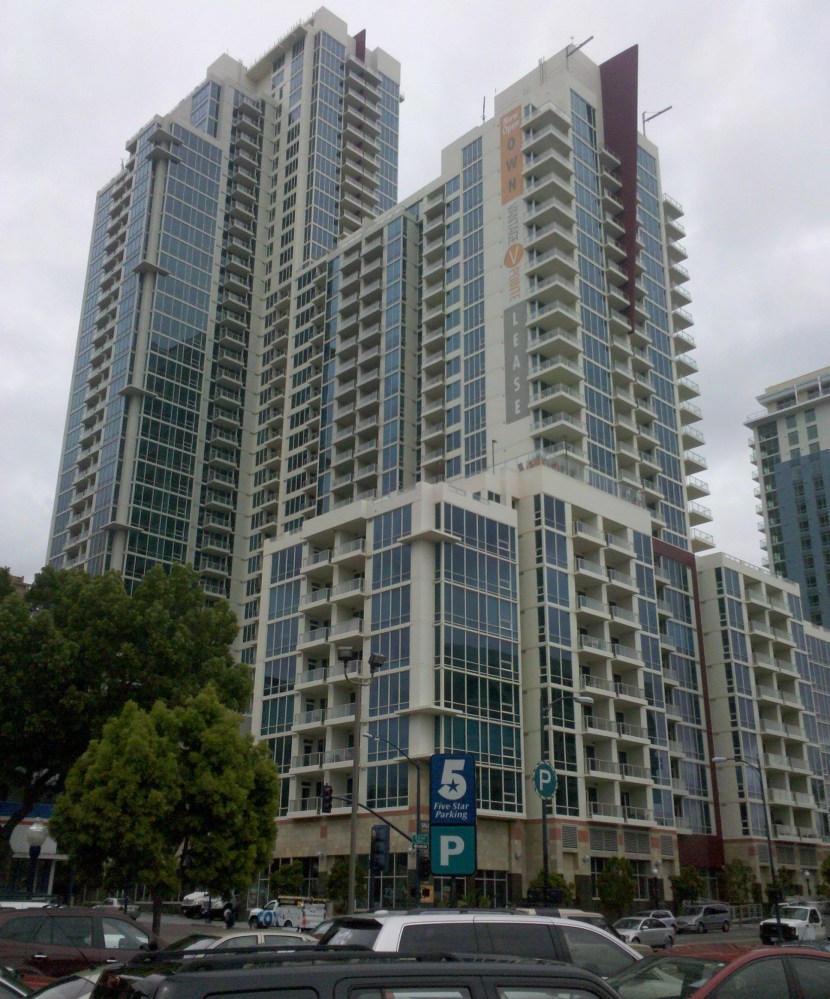
Vantage Pointe: Quebec's Folly

Kelly Bennett at Voice of San Diego has another interesting story today on Vantage Point, the massive downtown condo complex that’s on the verge of foreclosure.

The 40-story Vantage Pointe, downtown’s biggest condo building, is stuck with 679 units that it can’t sell.

Developers are on the hook for a $210 million loan — the largest construction loan on a single residential building in San Diego history. Lenders filed a notice of default in March with a loan balance of $197.8 million.

Writes Bennett:

Now the building’s being handled like a giant hot potato. While the rest of the downtown market shows signs of stabilizing, no one has yet found a way to make Vantage Pointe profitable enough. The developers have been trying for a couple of months to find a buyer for the whole project or to become a partner. But the bank separately stuck up its own for-sale sign seeking buyers for the mortgage.

The developer is Pointe of View, a Calgary-based company, which formed a California partnership, Pointe at Balboa LP, to build this colossus.

The money for the project came from Caisse de Depot et Placement Quebec, Canada’s biggest pension fund, with $130 billion in assets. In 2008, la Caisse posted a $40 billion (!) loss, due in part to devastating losses on its U.S. real estate portfolio.

Fannie Mae Has It Right on PACE

A decision by Fannie Mae and Freddie Mac to say no to a White House-backed solar energy program has a lot of people in California pretty upset. As much as I like solar power, I have to agree the regulators got this one right.

San Diego County Supervisors Pam Slater-Price and Dianne Jacob pleaded with President Obama and the region’s congressional delegation to save the program and called the Federal Housing Finance Agency’s statement on the matter “insulting.” Gov. Schwarzenegger was disappointed. California Sen. Barbara Boxer, NYC Mayor Mike Bloomberg and many others deluged the administration with letters.

The solar-financing  program, known as “property assessed clean energy program” or PACE would have allowed homeowners in 13 San Diego County cities and unincorporated areas to write off the high up-front cost of solar panels — typically $25,000 or more — over 20 years.

The nascent program was dealt a major setback last week when the federal regulator overseeing Freddie Mac and Fannie Mae said that the federal mortgage giants will not buy or sell mortgages on homes enrolled in the program.

The Federal Housing Finance Agency said in a statement Tuesday that the liens created by the PACE program were senior to existing mortgages. FHFA said first liens “present significant risk to lenders .. and are not essential for successful programs to spur energy conservation.”

The second part of the statement is the one Jacob and Slater-Price found insulting. The first part of the statement — that first liens present significant risks — happens to be true.

San Diego County’s program was administered through the CaliforniaFIRST program. Here’s a sample Pace Agreement.

Homeowners who sign up for CaliforniaFIRST have a “contractual assessment lien” placed on each participating property covering the cost of installation plus interest.

A $25,000 solar panel retrofit would wind up costing $40,000 at 5% over 20 years. Assuming you pay $100 a month in electricity like I do, you wouldn’t save enough power to make it worthwhile.

The lien would be paid through property taxes, and liens would be bundled together and sold to investors as bonds. Communities often issue special tax assessments to cover the cost of infrastructure repairs or improvements, but PACE assessments uniquely cover improvements to a single residence.

For would-be buyers, a problem is that the lien follows the house, not the owner. It would have remained on the property even if the owner sold it.

But the real problem lies in the liens’ “super senior” status, which means it takes precedence over all other debts, including mortgages. So you could lose your house if you can’t or won’t pay. Take a look at this clause in the CaliforniaFIRST agreement.

The Property Owner acknowledges that if any Assessment installment is not paid when due, the Authority has the right to have the delinquent installment and its associated penalties and interest stripped off the secured property tax roll and immediately enforced through a judicial foreclosure action that could result in a sale of the Property for the payment of the delinquent installments, associated penalties and interest, and all costs of suit, including attorneys’ fees.  The Property Owner acknowledges that, if bonds are sold to finance the Improvements, the Authority may obligate itself, through a covenant with the owners of the bonds, to exercise its foreclosure rights with respect to delinquent Assessment installments under specified circumstances.

Another of the FHLA’s concerns that hasn’t gotten much attention bears noting. Homeowners who can’t afford solar panel will now become targets for shady lenders in a repeat of the whole interest-only mortgage debacle that helped fuel the housing bubble. I’m not saying that PACE will create another housing bubble, but do we really need to be adding to personal debt levels right now, especially for people struggling at the margins?

I’d love to end the burning of fossil fuels and dependence on foreign oil too. Increasing debt burdens to pay for it isn’t the way to go about it.

ALTA Responds to "Title Insurance is a Scam"

Jeremy Yohe of The American Land Title Association, the industry’s mouthpiece, has written a lengthy response to my earlier post about title insurance being a scam.

You can read the original post here and Jeremy’s comment appears here.

In his comments, Jeremy has addressed some of the concerns I raised in my piece, but did not address the well-established inefficiencies and structural flaws in the multi-billion title insurance industry.

Jeremy wrote, “A homeowner’s title insurance protects the owner for as long as they or their heirs on the property. And only need to be paid for once.”

  • Why then was my $625 title insurance fee necessary on my refinance? Chain-of-title, the major service provided by title insurance, was previously established in my case. A Lexis search would have turned up a lien or a judgment. Interestingly, though, according to CTLA’s Title Wizard, I would have paid LESS in title insurance if I had purchased my home instead of refinancing it.
  • How does ALTA explain the findings of “reverse competition” in the mortgage industry that date back to the 1980 Peat Marwick study for HUD? (Also see Consumer Federation of America, 2006 testimony before Congress; California insurance commission study on title insurance)
  • If title insurance is performing a valuable service and the “preventive measures” are keeping the title insurance industry’s loss ratio low as Jeremy suggests, why weren’t these savings passed along to me and others in the form of lower fees? Are title insurers colluding to keep prices high?
  • How is it that only one company, Entitle Direct, markets title insurance directly to consumers and, as a result, is able to offer me and many other the same service for 35 percent less? Why does Entitle Direct have such a small share of the industry? Am I a customer or merely a fee payer?
  • Why shouldn’t California copy Iowa and just put an end to the title insurance racket?

Curious to hear the answers.

CalPERS: A Legal Ponzi Scheme

chart

California’s lame-duck Gov. Arnold Schwarzenegger likes to remind us, as he did last week, that California is facing an “unsustainable path that has taxpayers on the hook for $500 billion.”

Exhibit A is SB 400 of 1999, which  increased benefits for California state government employees between 20% and 50% — without the money to pay for them.

This is in essence a legal version of a Ponzi scheme where new investors pay old ones until the whole thing collapses.

Schwarzenegger aide David Crane has called SB 400 “the largest non-voter approved debt issuance in California history.”

The bill was signed during the dot-com boom and the legislature relied on vague promises that the investment wizards at California’s giant pension system would generate the money out of thin air.

Needless to say, that hasn’t exactly worked out.

On June 16th, Schwarzenegger struck a deal with four unions representing 23,000 of the state’s 170,00 unionized workers to roll back the benefits that were given away in SB 400. If similar agreements are reached with the state’s eight other employee unions, state savings in FY 2010-11 would total $2.2 billion, $1.2 billion General Fund.

Even with the cuts, Calpensions’ Ed Mendel notes, pension benefits for CHP officers are still more generous than the days before SB 400.

Democrats led by Gov. Gray Davis signed SB 400 as a thank-you to the unions that helped end 16 years of Republican rule in California the previous November.

Even though the legislature is controlled by Democrats. It needs to be said that the bill was supported by both parties. It passed unanimously in the Senate. Only seven members of the 80-member California Assembly voted against it.

The most notorious passage in the bill provided highway patrolmen with 3 percent of final pay for each year served at age 50, a significant improvement of the pre-SB 400 formula of “two at 50″ — 2 percent of final pay for each year served at age 50.

This is much, much more than 1 percent increase.

Before SB 400, a highway patrolman had to work 45 years before he could retire with 90 percent of pay. The bill shaved 15 years off that time, allowing them to retire with 90 percent of pay after 30 years on the job.

In 2008-2009, a full third of the payroll for all highway patrolman now goes into their retirement accounts.

CalPERS believed they could cover the additional costs through “continued excess returns” and said it expected that contributions from the state would hold steady at $350 million.

Instead, the compound annual growth rate of CalPERS investments grew a pathetic 1.6 percent from 1999 to the end of 2009. On June 16th, the same Schwarzenegger announced his deal with the unions, CalPERS announced that it was raising the state’s contribution to $3.9 billion.

CalPERS unfunded liability, the percentage of benefits promised that can be covered by the fund’s assets, has risen from $158 billion in 1999 to $238 billion last year.

With its myriad accounting trips, CalPERS can “smooth” (hide) losses for generations. Some day the bill will come due.

It’s looking increasingly doubtful that there will be anybody left to pay it.