
Glenn Beck Fuels Gold Hysteria — And Profits

I heard the other day about a man who took all his money, bought gold and buried it in his backyard. The poor fellow probably listens to commentator Glenn Beck.  

The incessant stream of end-of-the-world nonsense that Beck spews forth makes his incredibly popular radio and TV talk shows the ideal vehicle for gold advertisements.  

An average of 9 million listeners a week makes Beck’s radio show the third most popular in America, behind Rush Limbaugh and Sean Hannity. Mercy Radio Arts, aka Glenn Beck Inc., took in $32 million in revenue in the past 12 months, according to Forbes magazine.  

But this is not your traditional media advertising relationship:  


Anyone who listens to conservative radio is getting bombarded with messages from Santa Monica-based Goldline, which boasts that it does half a billion in annual sales of gold coins and bullion   

Others who offer testimonials on Goldline’s website are Laura Ingraham, Mark Levin, Mike Huckabee, Monica Crowley, Fred Thompson. You can listen to them shilling for Goldline here on the Goldline website.  

It would seem to be a natural fit. Gold thrives on instability and chaos, and Beck is constantly hammering home the theme that the United States is highly unstable … ergo, we should buy gold. The problem is the gold that Goldline is selling often isn’t bullion, but rare coins, which are a different animal.  

According to ABC News’ The Blotter, authorities in Los Angeles and Santa Monica are investigating complaints from Goldline customers say they were lied and misled in their purchases of gold coins and others who received something they didn’t order. The Santa Monica City Attorney’s office has set up a website to handle complaints.  
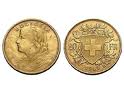
The gold 20 Swiss Franc


Goldline customers are often sold gold 20 Swiss Franc and other European coins. The Missouri Secretary of State’s office found in 2006 that a Goldline agent violated state law by advising an elderly woman to sell her annuity to buy gold. The woman ultimately bought 153 Gold 20 Swiss Francs and other coins.  

This is a classic bait-and-switch.  

Buying a Swiss Franc coin is NOT the same as buying gold bullion or even gold American Eagles, South African Krugerrands or Canadian Maple Leafs, all of which are linked to the spot price of gold.  

Gold 20 Swiss Francs, which are numismatic or rare coins, have less to do with gold spot prices and more to do with scarcity, condition and coin demand. In other words, if gold rises you still make not make any money.  

Goldline charges a sizeable markup on numismatic coins. According to Goldline’s own disclosure on its website:  

Our spread on semi-numismatic coins, rare or numismatic coins and rare currency currently ranges from 30% to 35%. Examples of coins which have a 30% to 35% spread include European gold coins such as the Swiss 20 Franc, the PCGS certified “First Strike®” coins, coins which have been encapsulated by a grading service such as PCGS or NGC, the Morgan and Peace silver dollars in all grades, and the Walking Liberty, Franklin and Kennedy silver half-dollars in all grades. Spreads may change based upon market conditions, availability and demand.  

Here’s how this works. If the spread on a coin is 35%, then a coin Goldline is selling for $500 is really worth only $325. The coin must appreciate $175 before you earn a profit. Again the prices of these coins move independently from the price of gold.  

According to a report issued in May Rep. Anthony D. Weiner, coins on the Goldline website were marked up an average of 90 percent compared to their melt values.  But this is unfair: rare coins value has less to do with the price of gold and more to do with scarcity and other factors.  

Mark Albarian, president and CEO of Goldline, is a coin collector. A coin collector knows what coins are worth. If you don’t, then caveat emptor — buyer beware — no matter what Glenn Beck says.

Sunstone Walks Away from the W Hotel

Major Foreclosures and Defaults in Downtown San Diego

When homeowners owe more than their home is worth and walk away, it’s called a “strategic default.” Fannie Mae warned potential strategic defaulters last month that they would never again get another mortgage.

But no one seems bothered that Sunstone Sunstone Hotel Investors Inc. is walking away from a $65 million mortgage on the 258-room W Hotel in downtown San Diego.

The San Diego Union-Tribune’s Lori Weisberg reports that the W Hotel was auctioned on the courthouse steps on June 29. The property is now in the hands of Bank of America, the lender.

Sunstone was underwater on the W Hotel. The Aliso Viejo-based real estate investment trust, concluded that it owed far more than the W Hotel was worth. Sunstone bought the W for $96 million in 2006 from a group led by developer Gatehouse Capital Corp., the Wall Street Journal reported last month.

But Sunstone is coming out ahead. Chief financial officer Ken Cruse crows to the U-T about “a significant gain” on the W San Diego because the hotel was recorded on Sunstone’s books at $35 million.

Thanks, assholes.

Steinbrenner the Felon

Who dropped the dime on Yankees owner George M. Steinbrenner for making illegal campaign contributions to the Nixon campaign?

According to Steinbrenner it was Nixon. Steinbrenner told baseball writer Roger Kahn for his book October Men that he wasn’t really a Republican at all and had been shaken down by the president’s men.

Steinbrenner was buddies with House Speaker Tip O’Neill and Ted Kennedy. He had raised about $2 million for Democrats running for Congress in the Cleveland area. That didn’t sit well with Nixon aides Bob Haldeman and John Erlichmann. “The Nixon people were very annoyed at my Democratic fund-raising,” Steinbrenner told Kahn.

As the 1972 presidential election approached, Nixon’s henchmen demanded dirt on Kennedy and other Democrats from Steinbrenner. “Rough stuff,” Steinbrenner told Kahn, “not only stories about the politicians but about their wives. Drinking. Sex. Very damn distasteful, if you ask me.”

Nixon’s men threatened an antitrust investigation of American Shipbuilding, Steinbrenner’s company, and punitive IRS audits. Steinbrenner decided to buy his way out with campaign contributions to CREEP, Nixon’s reelection campaign. But when he refused to squeal on his Democratic buddies, the Nixon campaign responded with a 14-count indictment in April 1974.

That’s Steinbrenner’s self-serving version anyway. As a prosecutor’s memo makes clear, Steinbrenner had no trouble squealing on Nixon’s people, Teamsters, Merrill Lynch or anyone else who might get him out of trouble.

WSJ's Latest Lerach Attack

Even though he has been driven from the practice of law, Bill Lerach, whom I recently profiled for Voice of San Diego, remains one of the conservative movement’s leading bogeymen.

Until he was sentenced to prison, Lerach struck fear in the heart of corporate America by extracting costly settlements from the nation’s biggest companies. He recently completed his sentenced and retired to his La Jolla mansion.

Today’s editorial “A Bill Lerach Tax Cut” finds the Journal in a lather over a report that the U.S. Treasury Department planned to give lawyers a tax break over contingency fee lawsuits.

Such a tax break would effectively subsidize the up-front costs of litigation for the the “zillionaire likes of felons Dickie Scruggs, Mel Weiss, and Bill Lerach,” the Journal writes.

These include San Diego firms such as Robbins Geller Rudman & Dowd, Lerach’s old firm, and Robbins Umeda that file shareholder derivative lawsuits and securities class actions. Firms that do this work on contingency, which means they are paid out of a settlement at the conclusion of the case.

The report Wednesday in LegalNewsline.com cited unnamed sources at a meeting of the trial lawyer’s association in Vancouver, Canada.

The Treasury Department declined comment “on speculation about any potential administrative rulings.”

When George Steinbrenner ratted out Merrill Lynch, Teamsters

The obituaries for Yankees owner George Steinbrenner, who died this week at age 80, all refer to his 1974 conviction for illegal campaign contributions to the Nixon campaign and the pardon Steinbrenner received from Ronald Reagan.

Steinbrenner’s defense attorney was the legendary trial lawyer Edward Bennett Williams. Steinbrenner wasn’t impressed. “I paid him $100,000” Steinbrenner once reportedly said, “and all he did was a cop a plea.”

That’s true, but Williams did the best he could for a client who had dug a mighty deep hole for himself.  The issue wasn’t the illegal contributions, per se. The problem was Steinbrenner, the chief executive of American Shipbuilding, had funneled the contributions through his employees (disguised as “bonuses”) and then instructed them to lie to a grand jury. That’s suborning perjury and people go to jail for it.

According to The Man to See, Evan Thomas’ splendid 1991 biography of Williams, the attorney told prosecutors that Steinbrenner could implicate others in exchange for leniency.

“Steinbrenner could provide us with more than a dozen companies which had been involved in 610 [illegal corporate contribution] violations. … Williams indicated that Merrill Lynch had substantial difficulties in the campaign finance area. …  Williams indicted that Steinbrenner had heard that the Teamsters had given more than a million dollars, that the million dollars had been kept at the Hotel Pierre, and that someone from the Teamsters had stolen it back again,” prosecutor John Koetl wrote following a meeting with Williams on October 18, 1973.

Ultimately, on the obstruction of justice charge, the government allowed Steinbrenner to plead guilty to being an accessory after the fact, a misdemeanor and the sentencing judge let him off with a fine. The commissioner of baseball wasn’t so merciful; he suspended Steinbrenner for two years.

Update: The Smoking Gun beat me to the punch on this one. Here’s a copy of the memo