Ray Lucia Is Wrong on REITs

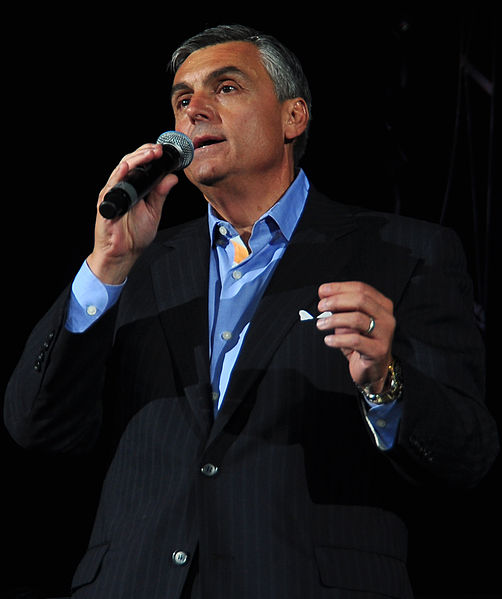
Ray Lucia speaking at Sean Hannity’s Freedom Concert in San Diego. Photo by Andi Hazelwood.

For more visit: A Professional’s View of Ray Lucia’s Non-Trade REITs


In 2010, radio talk show host Ray “Buckets of Money” Lucia threatened to sue me for $300,000 for defamation over a blog post on this website. My post pointed out Lucia’s relationship to a securities firm that paid $2 million to settle U.S. Securities and Exchange Commission charges.

Nothing ever came of the threats and, coincidentally, (or not?), Lucia shortly thereafter told the SEC that he would no longer register with them as investment adviser. Lucia still hosts his radio show and rounds up new clients at his free seminars with actor Ben Stein.

I was content to leave things alone until last week when I heard from a client of Lucia’s son, Ray Jr., who now runs the investment business started by his illustrious father.

This person, whom I’ll call Joe, is, runs a small home repair based business and is approaching retirement age. Joe attended one of Lucia Sr.’s “Buckets of Money” seminars 18 months ago and entrusted his money to Lucia Jr.  He wishes he had read this blog beforehand.

Today, they are illiquid. About $80,000 of Joe’s money — 30 percent of his net worth — is locked away in real estate investment trusts (REITs) that aren’t traded on any exchange and therefore can’t be sold for years.

Joe’s wife is ill and may need to take early retirement, which leaves Joe wondering how he’s going to pay the bills.

For some retirees, REITs can be a good investment. REITs are required to repay at least 90 percent of taxable income to investors or the forfeit their tax exempt status. So, they are sort of function like bonds but with much better rates, something like 6 percent.

So what’s the catch? The REITs Joe is invested are non-traded REITs. This is an investment that can’t be sold for years — at least not without taking a big loss. FINRA, the financial industry self-regulatory body, last year issued an investor alert warning about the dangers of these non-traded REITs.

Both Ray Lucia Sr. and Jr. are big believers in these non-traded REITs. What they don’t tell you is that it’s a great deal for the folks at RJL Wealth Management. Brokers love non-traded REITs for the whopping commission a sale generates, which can range between 10 percent and 15 percent (!). If you really feel that you need a REIT in your portfolio, then buy a publicly traded one on Charles Schwab or some other online broker where the commissions run $8.95.

Joe never found out what the commissions were on his non-traded REITs including Behringer Harvard Multifamily I, which for years has combined high fees with poor performance. (For more, see reitwrecks.com’s Non-Traded REIT Forum.)

But that’s not all! For getting Joe in this predicament, RJL Wealth Management, Lucia Jr.’s company, collects a 1.9 percent fee — more salt on the wound. Buyer beware.


What Facebook Knows About You

What Facebook knows about you everytime you visit:

  • Your IP address
  • Your location via GPS
  • The type of browser you use
  • The webpages you visit
  • When and where you took the photos or videos you post

Anyone, including people off of Facebook, can see the following information about you:

  • Name
  • Profile photo
  • Your network
  • Your username

With your username, someone can find out:

  • Your age range
  • Your location
  • Your gender

If you don't care about your Facebook privacy then carry on


Update: “Mr Zuckerberg’s latest mea culpa is unlikely to be his last,” The Economist

Facebook settled with the Federal Trade Commission today, admitting that its repeated assurances to its 500 million users that it would puyour private information in a secure little box were lies. Mark Zuckerberg calls them “mistakes.”

I’m posting this because this news might well be overshadowed by a well-timed leak to The Wall Street Journal that Facebook is hoping for a $100 billion initial public offering later this year.

The FTC complaint lists a number of instances in which Facebook allegedly made promises that it did not keep:

  • In December 2009, Facebook changed its website so certain information that users may have designated as private – such as their Friends List – was made public. They didn’t warn users that this change was coming, or get their approval in advance.
  • Facebook represented that third-party apps that users’ installed would have access only to user information that they needed to operate. In fact, the apps could access nearly all of users’ personal data – data the apps didn’t need.
  • Facebook told users they could restrict sharing of data to limited audiences – for example with “Friends Only.” In fact, selecting “Friends Only” did not prevent their information from being shared with third-party applications their friends used.
  • Facebook had a “Verified Apps” program & claimed it certified the security of participating apps. It didn’t.
  • Facebook promised users that it would not share their personal information with advertisers. It did.
  • Facebook claimed that when users deactivated or deleted their accounts, their photos and videos would be inaccessible. But Facebook allowed access to the content, even after users had deactivated or deleted their accounts.
  • Facebook claimed that it complied with the U.S.- EU Safe Harbor Framework that governs data transfer between the U.S. and the European Union. It didn’t.

Carry on!


Great Quotes

It is utterly impossible, as this country has demonstrated again and again, for the rich to save as much as they have been trying to save, and save anything that is worth saving. They can save idle factories and useless railroad coaches; they can save empty office buildings and closed banks; they can save paper evidences of foreign loans; but as a class they can not save anything that is worth saving, above and beyond the amount that is made profitable by the increase of consumer buying. It is for the interests of the well to do – to protect them from the results of their own folly – that we should take from them a sufficient amount of their surplus to enable consumers to consume and business to operate at a profit. This is not “soaking the rich”; it is saving the rich. Incidentally, it is the only way to assure them the serenity and security which they do not have at the present moment

– 1933 Senate testimony of Mariner Eccles, later first chairman of Federal Reserve.

via the excellent London Banker