What Is Russia’s Centre for Information Security?

The New York Times reports on a series of arrests involving Russia’s FSB, the successor agency to the KGB that may be connected to the hacking of the 2016 U.S. Election.

According to the Times, one of those arrested, Sergei Mikhailov, was serving as deputy director FSB’s Centre for Information Security. He was arrested on a charge of treason. Earlier in the month, the head of the Centre, Andrei Gerasimov, was dismissed.

What is the FSB’s Centre for Information Security?

Some answers come from Jeffrey Carr, a security consultant out of Seattle who runs the consulting firm TAIA Global and published Inside Cyber Warfare. Carr describes the FSB’s Centre for Information Security (also known as Military Unit 64829) as the organization in charge of protecting Russia’s Internet.

“In sum, any Internet operation originating in Russia are almost certainly monitored and probably overseen by the FSB ISC,” Carr wrote in this analysis. “Current Russian press covers Russian intentions to implement further restrictions on RuNet to counter foreign attempts to wage “information warfare” against Russian and ideologically subvert the Russian population. Whatever final form the new restrictions take, the FSB ISC will be heavily involved.”
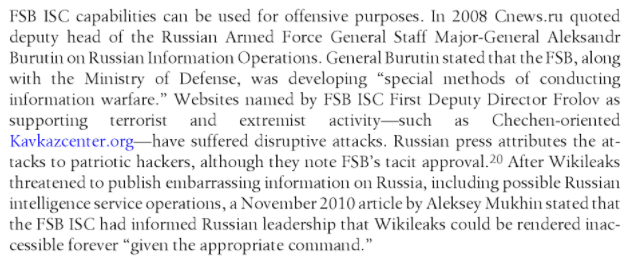
In his book, Inside Cyber War, Carr goes a bit further.  The Centre not only defends the Russian Internet (RuNet) it can also attack.
screen-shot-2017-01-28-at-8-24-12-am
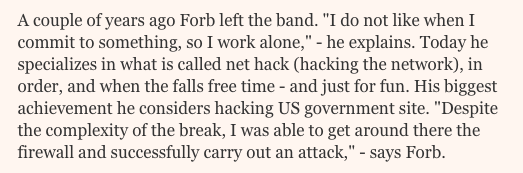
Also arrested was Dmitry Dokuchayev, a former hacker going by the pseudonym Forb who agreed to work for the FSB in exchange for dropping charges of credit card fraud. In an interview with a Russian newspaper, (or here in the original Russian) Dokuchayev/Forb said he had carried out a successful cyberattack on the US government.
screen-shot-2017-01-28-at-9-45-08-am

I would be wary of any reports that claim the Centre hacked the U.S. election. Cyberwarfare like conventional warfare is a confusing picture, with many different groups carrying out different but overlapping missions.

Different FSB components are responsible for attacks outside Russia. One is the FSB’s 16th Center, also known by the Orwellian name of the FSB Center for Electronic Surveillance of Communications, according to TAIA Global Another is the FSB’s 18th Center. Another is the FSB’s Fifth Directorate. All three were blamed for cyberattacks and propaganda during the Russian invasion of the Crimean Peninsula.

And President Obama’s executive order imposing sanctions in response to the hacking of the 2016 U.S. Election names both the FSB and the GRU, the main intelligence directorate. It’s believed that the GRU hacks were passed along to Wikileaks and other media outlets during the election.

There’s no evidence yet that the Centre for Information Security had a hand in the 2016 U.S. election hacking, but with their complete command of the Russian Internet they almost certainly would have known about it.



San Diego’s Spook Shop

Along Interstate 5 in San Diego just south of the airport, lies a hulking building with blacked out windows and a roof that looks like a long silver saw blade. The site of a former B-24 factory during World War II, this giant piece of corrugated metal is the home of the Space and Naval Warfare Systems Command or SPAWAR.

I’ve long been interested in SPAWAR (pronounced spā-wôr) mostly because exactly what it does is a bit of a mystery. Its mission is “enabling information warfare superiority” for our Naval and military forces. Operating with a $2.5 billion budget, SPAWAR employs more than 2,000 scientists, specializing in areas such as cyberwarfare, information warfare and space systems. SPAWAR’s chief technology officer holds over 100 patents. I have no idea what that all means, but it sounds like they do some very interesting stuff.

About three years ago, in the midst of Edward Snowden’s revelations about the National Security Agency, I learned that the Defense Department’s Inspector General had conducted a Top Secret investigation into allegations involving SPAWAR’s “access to U.S. persons data.”

That phrase “U.S. persons data” caught my eye. Under federal law, our intelligence agencies cannot spy on U.S. persons, i.e. American citizens. The misuse of “U.S. persons data” is intelspeak for spying on Americans so I filed a request under the Freedom of Information Act for the report.

The 37-page heavily redacted report I received began as a whistleblower complaint filed in December 2006 by an unnamed government employee. This employee claimed he was mistreated and ultimately reassigned after reporting that SPAWAR had misused classified information involving U.S. persons, which is forbidden under U.S. law.

Of the two main allegations cited in the report, one remains classified under a FOIA b(1) exemption, which involves matters of national security. The whistleblower’s second allegation was that SPAWAR personnel had been in the words of the report “photographing U.S. persons.”

There are several allegations involving misuse of imagery at SPAWAR in the report, most of which are completely or partially redacted.

The only one that is readable is a charge that SPAWAR had been collecting data without notice, warrant or authority “on U.S. persons in federal parks located at Point Loma,” a hilly peninsula in San Diego.

This allegation involved a camera is mounted on a tower at SPAWAR’s command HQ, located on the southern tip of Point Loma, adjacent to Cabrillo National Monument, which is operated by the National Parks Service. The camera, which can be rotated 360 degrees, is used for calibration purposes by pointing it at different government radars, the IG’s investigation found. The video feed from the camera goes to a laboratory and is not stored.

The IG also looked for inappropriate images on another imagery system, details of which remain classified on national security grounds. The system was tested at a site on Point Loma overlooking San Diego Harbor on the USS Dolphin, a research submarine, after it had been repaired for fire damage.

Other allegations involving satellite imagery or other technologies are heavily redacted.

The investigation by the DoD’s Inspector General did not substantiate the whistleblower’s complaints that SPAWAR was mishandling intelligence and possibly compromising U.S. persons information. The Inspector General did, however, partially substantiate the allegation that SPAWAR had failed to move quickly to correct deficiencies in its handling of intelligence information. The whistleblower had not been subject to reprisals, the IG’s investigation found.

What the report makes clear is that SPAWAR is a spook shop. It does R&D work for various components of the U.S. intelligence community. Some of the imagery allegations involved an R&D project for the Office of Naval Intelligence. Officials with the National Geospatial-Intelligence Agency (NGA), the National Reconnaissance Agency (NRO), which runs spy satellites, and one agency whose name was blacked out were interview for the IG’s report.

San Diego’s Biggest Investment Advisor Firms

The table that follows is derived from the latest SEC data:

Name City AUM Clients
1 Brandes Investment Partners San Diego $25,945,405,178 19,800
2 Torreycove Capital Partners San Diego $18,287,962,533 11-25
3 Guided Choice Asset Management San Diego $12,317,410,631 500,000
4 Stepstone Group La Jolla $11,926,414,601 100
5 Gurtin Fixed Income Management Solana Beach $9,929,753,485 500
6 Chandler Asset Management San Diego $8,893,810,490 800
7 LM Capital Group San Diego $5,215,906,609 26-100
8 First Allied Advisory Services San Diego $4,864,088,841 25,800
9 Clarivest Asset Management San Diego $4,150,278,731 11-25
10 Globeflex Capital San Diego $3,611,000,000 26-100
11 Dowling & Yahnke San Diego $3,047,962,290 1,000
12 Aletgris Advisors La Jolla $2,105,402,681 26-100
13 Rice Hall James & Associates San Diego $1,955,115,330 300
14 Nicholas Investment Partners Rancho Santa Fe $1,876,535,379 26-100
15 American Assets Investment Management San Diego $1,661,745,223 26-100
16 Independent Financial Group San Diego $1,647,108,373 5,700
17 Cuso Financial Services San Diego $1,564,559,871 6,000
18 EAM Investors Cardiff $1,266,828,504 26-100
19 LM Advisors San Diego $1,256,305,636 600
20 Pure Financial Advisors San Diego $1,196,742,924 1,400
21 Dunham & Associates Investment Counsel San Diego $1,191,835,520 3,900
22 Wall Street Associates La Jolla $1,075,551,757 11-25
23 Cardiff Park Advisors Carlsbad $1,034,925,745 325
24 IPG Investment Advisors San Diego $1,013,080,208 700


There are some interesting little stories in here.

Torreycove Capital, founded in 2011, manages $18 billion for fewer than 25 clients, mostly pension and profit sharing plans. Torreycove was named in June as private equity consultant for the $79.2 billion New Jersey Pension Fund.

Brandes has seen its assets under management plummet since 2007, when it had $111 billion under management. According to Pensions & Investments magazine, Brandes’ two largest strategies — international equity and global equity — have been hit hard in recent years. In 2008, Brandes’ AUM declined more than 50% to $52.9 billion.

Stepstone may be the most interesting of them all. StepStone, founded by Monte Brem and Thomas Keck, has grown into a  self-described”global private markets firm.” It oversees $75 billion of private capital allocations in addition to its $11.9 billion under management. Stepstone serves as private equity advisor for the states of Connecticut and Wisconsin.

Last year, Stepstone leased the entire 17th floor at the Lipstick Building, the site where Bernie Madoff ran his $65 billion Ponzi scheme.


Mark Cuban files brief supporting … Ray Lucia?

mark-cuban-people-need-to-learn-that-no-email-is-safe

What was I thinking?


Update: A federal appeals court denied Ray Lucia’s appeal to have his lifetime ban overturned in August 2016.

Mark Cuban, the outspoken Dallas Mavericks owner, is a regular on Shark Tank, a show where he’s regularly pitched by entrepreneurs seeking to expand their businesses.

Cuban and the other investors say “I’m in” or “I’m out” depending on whether they like the pitch or not.

Cuban is obviously a savvy investor, but he’s an explosive guy. He’s known in the sports world for his outbursts at NBA officials and referees that have cost him more than $1 million in fines.

Today, I learned that Cuban has filed a friend of the court brief on behalf of Ray Lucia, a former San Diego investment adviser who was permanently banned from trading by federal securities regulators. This legal brief is the courtroom equivalent of an angry outburst at NBA official.

Cuban filed his brief this month in Lucia’s appellate lawsuit against the U.S. Securities and Exchange Commission before the D.C. Circuit Court of Appeals.  Lucia argued that his lifetime ban should be thrown out since his case was heard by an administrative law judge, instead of an appointed officer, as required by the U.S. Constitution.

His brief, filed Feb. 8, states, “As a first-hand witness to and victim of SEC overreach, Mr. Cuban has an interest in supporting petitioners’ appeal in this case, and in particular demonstrating that both statutory language and legislative history clearly show that Congress specifically intended that SEC hearings only be held before constitutional officers.”

Seems like weak stuff to me, but Mark Cuban is a vindictive fellow and he has an axe to grind.

The SEC accused Cuban of insider trading when he sold his stake in a Canadian Internet company to avoid a $750,000 loss. Cuban maintained his innocence, and was acquitted by a federal jury in Texas three years ago.

Cuban goes on to state, “When the laws are applied inconsistently or the process by which they are enforced is rigged to favor the government, capital formation is impeded because market participants do not have clear rules for understanding their investment risks.”

This is the point where I say “I’m out.” Ray Lucia wasn’t some bold entrepreneur chasing the next big thing. He was making millions fleecing retirees out of their nest eggs.

220px-ray_lucia

Ray Lucia addressing the crown at Sean Hannity’s Freedom Concert in 2010.

I started writing critically about Lucia in 2010 after his attorney  threatened to sue me for $300,00 . I figured that if someone would bother with a bozo like me something must be seriously wrong.  Turns out, I was right.

Back then, Lucia was at the height of his power. He had thousands of accounts and $300 million in assets under management. In the 12 months leading up to January 31, 2010, his family of companies reported $14.1 million in gross income, according to court records.

Lucia made money mainly by collecting commissions on those who fell for his “Buckets of Money” strategy. He pitched retirees at flashy seminars, often with the help of his buddy, actor Ben Stein. 

Elderly clients were convinced to invest in non-traded real estate investment trusts (REITs) that locked away their money for years. That’s not a great position for an elderly person who needs liquidity, but when REITs are generating $8.7 milllion in gross commissions for Lucia’s companies in 2010, you might overlook such details.

Lucia assured his clients they could retire in comfort because he had backtested his “Buckets of Money” strategy and it was based on “science, not art.”  The SEC called his bluff and today, Lucia says he is nearly bankrupt.

Someone, however, must be paying for Lucia’s legal team at Gibson, Dunn & Crutcher, one of the country’s top law firms. Is that you Mark?