
Category: Spooks
Former Rep. Charlie Wilson Dead at 76
First John Murtha. Now former Texas Rep. Charlie Wilson has died at 76.
The ethically-challenged Wilson was made famous by the excellent book by the late George Crile (and the movie) Charlie Wilson’s War, which revealed how he secretly supplied the funds for the CIA’s covert war in Afghanistan in the 1980s.
He appears a couple of times in my book, Feasting on the Spoils, most memorably in a a scene at a poker game at the Watergate Hotel. The Watergate was a home away from home for San Diego defense contractor Brent Wilkes and his CIA buddy, Kyle “Dusty” Foggo.
Wilkes and Foggo continued their long-standing tradition of weekly card games in Washington. Foggo would invite along friends from the CIA, and Wilkes would bring the congressmen. One of the congressional guests was Charlie Wilson, who had in 1993 received the CIA’s Honored Colleague Award, the first time it was ever awarded to anyone outside the agency. At one game, Wilson invited along his friend from Texas Joe Murray, a columnist for The Atlanta-Journal Constitution. Murray met Wilson in the hotel lobby. “I’m not sure how they chose the Watergate,” Murray wrote in a May 20, 1994 column, a few days after the poker game. “Perhaps because a sense of history. Either that or a sense of humor.”Murray followed Wilson into the suite, which was filled with cigar smoke. Wilson knew a few of the CIA personnel at the game. One was Brant Bassett, a well-regarded officer who spoke fluent Russian, German, and Hungarian. Bassett was known as Nine Fingers after a motorcycle accident had cost him a finger. Wilson brought gifts, a sack full of guns that included a Soviet automatic used by Russian paratroopers. Wilson had a special pen for everyone, one that with a click fired a .32-caliber bullet. Everyone in the room started clicking his pen.
“Boy, I wish I’d had it this afternoon,” someone said.
“If only Aldrich Ames were here.”
Murray and Wilson stayed only a short while, and as they were leaving, one of the agents offered Murry one of his cigars, a Dominican. Murray offered the agent one of his, a Cuban. The agent told him, “You know, of course, this is considered contraband. But you’ve done the right thing as a good citizen. You’ve turned it in to the proper authorities. Be assured that very shortly it will be destroyed by fire.”
Wilson insisted there was no hanky-panky the night he was there. “The only activities that took place there that would be considered illegal and unlawful was cigar smoking on a nonsmoking floor,” Wilson said. Cunningham was the only other congressman who ever attended the poker games, according to Wilkes.
The “hanky-panky” Wilson is referring to were the rumors that flew around Washington that congressmen were supplied with prostitutes at these games. The FBI never found any evidence of this (the government certainly would have used it against Wilkes if they had) but people still think it’s what happened anyway.
After my book came out, Wilkes’ nephew and right-hand man, Joel Combs, testified that Wilkes told his employees to lose to Duke at poker and he yelled at one man who wasn’t losing enough.
Wilkes was sentenced to 12 years for bribing Cunningham; Foggo is serving time in prison for steering CIA contracts to Wilkes.
As for Charlie Wilson, he didn’t remember Wilkes; Foggo, however, he remembered well when I interviewed him in 2006.
When I told Wilson that Foggo had a rather unsavory reputation, Wilson said that the CIA sometimes had need of people like that in the CIA to do the dirty work against the KGB. (Foggo was no James Bond, however; he was a logistics officer.)
Ah, well, I’m sorry Charlie is gone. He made Congress fun.
Al-Jazeera Speaks to Ex-SD Imam
Excerpts of Al-Jazeera interview with Anwar Awlaki on Feb. 2, 2010. Translated and released by NEFA Foundation. Awlaki lived in San Diego in the 1990s.
Q. What is the truth about you meeting with Omar Farooq [the suspect in the attempted Christmas Day airline bombing] or that you announced a Fatwa about the legitimacy of the operation?A. The mujahid brother Omar al-Farooq—may Allah release him—is one of my students; yes, we were in correspondence, but I did not give Omar Farooq a Fatwa in regards to this operation.
Q. You envision him as a mujahid; meaning, do you back him up?
A. I support what Omar Farooq has done after I witnessed my brothers in Palestine for more than 60 years being killed, and in Iraq they are being killed, and in Afghanistan they are being killed, and the American missiles and raids killed 17 women and 23 children in my tribe; thus, don’t ask me whether al-Qaeda killed, or if it bombed an American civil jet after all of that, as three hundred Americans are nothing before the thousands of Muslims they killed.
Q. You supported [alleged Fort Hood shooter] Nidal Hasan and you justified it that the target is military and not civic. In regards to the jet [incident] of Omar Farooq it is a civic jet; meaning, the targets are the American public?
A. If the jet was military or the target was for the American army, it would be better. And, al-Qaeda Organization has its choices, and in regards to the public, the American populace is living within a democratic regime and they hold the responsibility of its policies; the American populace elected the criminal Bush for two presidential runs, and they elected Obama who’s not different from Bush, and one of his first declarations were that he will not abandon Israel despite that there were other candidates in the American elections who oppose the foreign American wars and those only received low percentages of the total votes. The American populace is a participant in all the crimes of their government, but if they weren’t supportive of that then they should change their government; they are the ones who pay taxes that are being spent on the army and they are who send their children to the army; they carry the responsibility.
Q. Do you believe that the Yemeni Government is facilitating your assassination?
A. The Yemeni government sells its own citizens to America in order to eat bloody money it received from the west, with their blood. The Yemeni officials say to the Americans: attack whatever you desire but do not adopt the actions thereof in order to not have people revolt against us, and with total impertinence the Yemeni government adopts it. For example, the Cruise Missiles were seen by the people in the region in Shabwa and Abeen and Arhab, and the some of the Cluster Bombs remained undetonated and people saw them. The state is lying in its claims, and the state adopted the operation in order to refute the accusation of being a cooperative. The American surveillance jets always revolve in the Yemeni sphere; so what is this country that allows its enemy to eavesdrop on its people and invade their privacies, then considers this cooperation accepted?
How Ex-SD Imam Will Be Marked For Death
The LATimes follows up today with an excellent story on how the bullseye will be planted on Anwar Awlaki, the former San Diego imam who U.S. counterterrorism officials believe has joined al Qaida’s forces in Yemen.
First, ABC News and then The Washington Post reported last week that the Obama administration is considering whether to order a Predator strike on Awlaki, a case that’s complicated by the fact that he’s a U.S. citizen.
The LATimes’ Greg Miller provides more detail on the process of how the CIA marks suspected terrorists for death in its “targeted killing” program:
- Memos proposing new targets are drafted by analysts in the CIA’s Counter-Terrorism Center.
- CTC analysts typically submit several new names each month to high-level officials, including the CIA General Counsel, Stephen W. Preston, and sometimes Director Leon E. Panetta.
- The list is scrutinized every six months; some names are scrubbed if the intelligence grows stale.
- The program is overseen by the National Security Council.
- The CIA does not need White House approval when adding names to the target list, unless the individual is a U.S. citizen.
Miller’s story contradicts a Jan. 27 story by Dana Priest at The Washington Post on a key point:
Miller: “No U.S. citizen has ever been on the CIA’s target list, which mainly names Al Qaeda leaders, including Osama bin Laden, according to current and former U.S. officials. But that is expected to change as CIA analysts compile a case against a Muslim cleric who was born in New Mexico but now resides in Yemen.”
Priest: “As of several months ago, the CIA list included three U.S. citizens, and an intelligence official said that Aulaqi’s name has now been added.”
Also are targeting decisions based on whether on an individual is “deemed to be a continuing threat to U.S. persons or interests,” as Miller reported. That appears to be a slightly lower threshold that what Priest describes as an individual who presents “a continuing and imminent threat to U.S. persons and interests.”
Semantics, perhaps, but we are talking about executing a U.S. citizen without due process.
Report: US Mulls Killing Former SD Imam
Can the president target an American citizen in a lethal attack?
White House lawyers are struggling with that question in the case of Anwar Awlaki, a former San Diego imam and SDSU graduate student, according to an ABC News report.
The Senate Foreign Relations Committee noted last week that U.S. intelligence and military officials consider Anwar Awlaki, a former San Diego imam and U.S. citizen, to be “a direct threat to U.S. interests” although he has not yet been accused of a crime.
Awlaki corresponded with alleged Fort Hood shooter Maj. Nidal Hasan before the attack that killed 12 soldiers, and investigators believe he also met with accused “underwear bomber” Umar Farouk Abdulmutallab.
- For more see my Awlaki timeline.
ABC’s Matthew Cole, Richard Esposito and Brian Ross are reporting:
According to the people who were briefed on the issue, American officials fear the possibility of criminal prosecution without approval in advance from the White House for a targeted strike against Awlaki.
The former imam at the Masjid al-Rabat al-Islami in San Diego was said to be in the Predator’s sights after the Fort Hood attack, but the strike wasn’t authorized because of questions over the citizenship of the New Mexico-born Awlaki.
President Reagan signed an an executive order in 1981 that forbid anyone employed by or acting on behalf of the U.S. government from engaging in or conspiring to engaging in assassination. That order remains in effect today.
However, we can kill those who are trying to kill us. After the Sept. 11 attacks, Congress gave the president the authority to use “all necessary and appropriate force” to prevent future acts of terrorism against the United States. The specifics are said to be set out in a secret presidential “finding” signed by President Bush after the attacks.
In 2002, a CIA drone attack in Yemen killed a carload of suspected terrorists, including the target of the operation, the top al-Qaida leader in the country. U.S. officials weren’t troubled that the strike killed Yemeni-American Kamal Derwish, a U.S. citizen. “No constitutional questions are raised here,” said National Security Adviser Condoleezza Rice.
Putting the bullseye on Awlaki and pulling the trigger would break new legal ground and raise fresh questions about the limits of presidential power.
At the very least, the U.S. government should make plainly clear what Awlaki has done to earn the wrath of a Hellfire missile. Meeting, corresponding and, odious as it may be, enouraging jihadists, doesn’t cut it.
The Arrest of El Teo
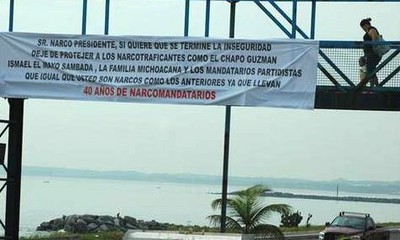
In The Politics of Heroin, Alfred McCoy notes that we capture a drug lord only when he is no longer a drug lord.
So it is with news of the arrest of El Teo, a vicious Tijuana drug baron who is accused of having the bodies of his enemies beheaded or dissolved in caustic soda.
McCoy reminds us that a man like El Teo, or rather, the man authorities accuse him of being, can only be arrested when the drug traffic shifts, stripping him of the power, profits and protection he needs to stay in business. In other words, the arrest of El Teo was only possible because he was already irrelevant.
While the bloodbath in Tijuana attracts the attention, the Sinaloa carter and its leader, Joaquin El Chapo (“Shorty”) Guzman, quietly prospers, as The Economist noted this week:
Sinaloa, by contrast, has stuck to drugs and money laundering and is smarter and more sophisticated. It prefers anonymity to the ostentation of others (Mr Beltrán was undone by inviting a famous accordionist to play at a Christmas party). It eschews jobless teenagers, its rivals’ rank and file, in favour of graduates, infiltration and intelligence. Although all the gangs have penetrated local governments, only Sinaloa and the Beltráns have been discovered to have bribed senior officials. Officials complain that Sinaloa operatives receive warning of pending raids. Sceptics wonder whether success against other gangs comes from tip-offs from Sinaloa.
Forbes reckons that Guzman, who bribed his way out of prison in 2001, is now the 701st richest man in the world.
 Trump / Russia