
Category: Politics
Former Rep. Charlie Wilson Dead at 76
First John Murtha. Now former Texas Rep. Charlie Wilson has died at 76.
The ethically-challenged Wilson was made famous by the excellent book by the late George Crile (and the movie) Charlie Wilson’s War, which revealed how he secretly supplied the funds for the CIA’s covert war in Afghanistan in the 1980s.
He appears a couple of times in my book, Feasting on the Spoils, most memorably in a a scene at a poker game at the Watergate Hotel. The Watergate was a home away from home for San Diego defense contractor Brent Wilkes and his CIA buddy, Kyle “Dusty” Foggo.
Wilkes and Foggo continued their long-standing tradition of weekly card games in Washington. Foggo would invite along friends from the CIA, and Wilkes would bring the congressmen. One of the congressional guests was Charlie Wilson, who had in 1993 received the CIA’s Honored Colleague Award, the first time it was ever awarded to anyone outside the agency. At one game, Wilson invited along his friend from Texas Joe Murray, a columnist for The Atlanta-Journal Constitution. Murray met Wilson in the hotel lobby. “I’m not sure how they chose the Watergate,” Murray wrote in a May 20, 1994 column, a few days after the poker game. “Perhaps because a sense of history. Either that or a sense of humor.”Murray followed Wilson into the suite, which was filled with cigar smoke. Wilson knew a few of the CIA personnel at the game. One was Brant Bassett, a well-regarded officer who spoke fluent Russian, German, and Hungarian. Bassett was known as Nine Fingers after a motorcycle accident had cost him a finger. Wilson brought gifts, a sack full of guns that included a Soviet automatic used by Russian paratroopers. Wilson had a special pen for everyone, one that with a click fired a .32-caliber bullet. Everyone in the room started clicking his pen.
“Boy, I wish I’d had it this afternoon,” someone said.
“If only Aldrich Ames were here.”
Murray and Wilson stayed only a short while, and as they were leaving, one of the agents offered Murry one of his cigars, a Dominican. Murray offered the agent one of his, a Cuban. The agent told him, “You know, of course, this is considered contraband. But you’ve done the right thing as a good citizen. You’ve turned it in to the proper authorities. Be assured that very shortly it will be destroyed by fire.”
Wilson insisted there was no hanky-panky the night he was there. “The only activities that took place there that would be considered illegal and unlawful was cigar smoking on a nonsmoking floor,” Wilson said. Cunningham was the only other congressman who ever attended the poker games, according to Wilkes.
The “hanky-panky” Wilson is referring to were the rumors that flew around Washington that congressmen were supplied with prostitutes at these games. The FBI never found any evidence of this (the government certainly would have used it against Wilkes if they had) but people still think it’s what happened anyway.
After my book came out, Wilkes’ nephew and right-hand man, Joel Combs, testified that Wilkes told his employees to lose to Duke at poker and he yelled at one man who wasn’t losing enough.
Wilkes was sentenced to 12 years for bribing Cunningham; Foggo is serving time in prison for steering CIA contracts to Wilkes.
As for Charlie Wilson, he didn’t remember Wilkes; Foggo, however, he remembered well when I interviewed him in 2006.
When I told Wilson that Foggo had a rather unsavory reputation, Wilson said that the CIA sometimes had need of people like that in the CIA to do the dirty work against the KGB. (Foggo was no James Bond, however; he was a logistics officer.)
Ah, well, I’m sorry Charlie is gone. He made Congress fun.
"King of Pork" John Murtha Dead at 77.
John Murtha, chairman of the House Defense Appropriations Committee who was considered one of the most corrupt members of Congress, died today.
The Defense Appropriations subcommittee is perhaps the most powerful in the House, funding not just the world’s biggest military, but the U.S. intelligence community as well.
President Obama signed the $636 billion 210 Defense appropriations bill into law in December. In it, Taxpayers for Common Sense counted 1,720 earmarks totalling $4.2 billion.
As chairman, Murtha cleaned up with 23 earmarks worth $76.5 billion.
With so much power and money flowing through it, the Defense Appropriations Subcommittee has become fertile ground for corruption on both sides of the aisle. One of its more infamous members was another Vietnam war hero like Murtha, Randy “Duke” Cunningham, R-Calif.
With Murtha gone, the lobbyists and defense contractors who fed at his trough for so many years are in mourning. At the top of that heap is lobbyist Paul Magliochetti, a former Murtha aide whose PMA Group was raided last year.
Johnstown, Pennsylvania will also need to find another sponsor for all the pet projects nurtured for years by Murtha, the representative since 1974. Things like the National Drug Intelligence Center. Or the John P. Murtha Johnstown-Cambria County Airport. Or the Johnstown Flood National Memorial.
The FBI captured Murtha’s bare-knuckled performance on videotape in 1980 during an undercover sting aimed at exposing corrupt lawmakers. Murtha turned down 50,000 cash from the representative for a phony Arab sheikh, but not before adding, “After we’ve done some business, I might change my mind.”
Murtha was never charged with a crime, and in Congress, Speaker Tip O’Neill protected Murtha, as George Crile revealed in Charlie Wilson’s War. Wilson shut down the House Ethics Committee’s probe before a special prosecutor could move on Murtha.
When Murtha was in the running for majority leader in the fall of 2006, someone leaked a copy of the FBI videotape to The American Spectator. (See here.)
The Embarrassing Case of Jesus Navarro (Updated)

(Note: I updated this post after a reader pointed out that the Border Patrol didn’t let Navarro go in 2007. What actually happened is even worse)
Now that a Mexican smuggler suspected in the murder of a U.S. Border Patrol agent is on his way to San Diego, maybe we can finally get some answers as to how and why the case went so horribly wrong.
The U.S. government’s bungling allowed the suspect, Jesus Albino Navarro-Montes, to get out of a Mexican jail. That part is well known, but what hasn’t gotten much attention is that U.S. officials let Navarro slip away not once, but twice.
Not long before the death of Border Patrol Agent Luis Aguilar, Navarro was caught by the Border Patrol with a half-ton of pot.
But he got away.
How?
According to a federal complaint, Navarro and his female passenger stole a Border Patrol vehicle and drove it back to Mexico.
This would laughable if the results weren’t so tragic.
A few months later, Navarro was allegedly behind the wheel of a Hummer H2 on Jan. 19, 2008 that illegally crossed the border near Yuma, Arizon.
Agent Aguilar, 32, was run over while trying to throw down a spike strip. The Hummer got away, but Navarro was arrested on January 28, 2008.
On June 18, 2008, he was released from jail by a Mexican judge.
Why?
The U.S. government never sought Navarro’s extradition. It never presented an arrest warrant. Without any evidence of a crime, Navarro had to be released.
“Although we had asked the U.S. government a couple of times before his release to help us deal with the matter so we could hold Mr. Navarro, we got nothing whatsoever,” embassy spokesman Ricardo Alday told a reporter for The Washington Times. “The U.S. response never came.”
Congress Brian Bilbray, a San Diego-area Republican, asked Attorney General Michael B. Mukasey and the White House for an explanation.
He got the brush off.
Disclosure would “inevitably compromise highly sensitive law enforcement investigative information,” Deputy Assistant Attorney General Keith B. Nelson wrote in a letter to Bilbray.
Navarro was re-captured near Zihuatanejo on Feb. 11, 2009 by Mexico’s Agencia Federal de Investigacion in an operation coordinated with the FBI and U.S. Marshal’s Service.
After Navarro’s re-arrest, authorities in San Diego unsealed a criminal complaint that showed that Border Patrol agents had captured Navarro on Sept. 23, 2007 following a chase east of San Diego.
(Click here to read the complaint and accompanying statement of facts.)
Border Patrol agents used a spike strip to successfully slow him down. Navarro ditched his pickup in the desert and fled on foot with an unidentified female passenger.
Border Patrol agents caught the pair and put them in their vehicle.
According to the statement of facts, “The female passenger was able to take control of the Border Patrol vehicle, and both the female passenger and NAVARRO-Montes absconded to Mexico in the Border Patrol.”
The agents were stuck in the desert with a Toyota pickup with three blown out tires and 979.7 pounds of marijuana inside.
San Diego's Relational Investors and CalPERS
CalPERS, the giant California state pension fund, is taking a close look at its investment with Ralph Whitworth, who heads Relational Investors, a shareholder activist firm based in San Diego.
A law firm hired by CalPERS is examining the nearly $17 million Relational paid an obscure middleman who helped secure business from the pension fund, The Wall Street Journal reports today.
Relational Investors is headed by Ralph V. Whitworth and David Batchelder, who met while working in the 1980s for Texas oilman and corporate raider T. Boone Pickens.
Relational buys up stakes in underperforming companies like Mattel and J.C. Penney for a turnaround directed by Whitworth.
CalPERS is Relational’s biggest investor. The pension fund has about $1.5 billion in Relational.
Huge fees are standard for middlemen who successfully line up investments from CalPERS, but Relational’s payment to Tullig Inc. stands out. No one earned more from a single client.
Tullig Inc. is an obscure New York firm headed by an obscure man named Donal Murphy. What he did to earn his rich paycheck is as clear as mud.
Essentially, these middlemen are lobbyists and operators. It’s a shady business — money buying more money — that is finally getting some attention following a massive kickback and bribery scheme at New York State’s public pension fund.
Whitworth is perhaps best known for paying Paul McCartney $1 million in 2003 to perform at his wife’s private birthday party at a restaurant Rancho Santa Fe. The couple filed for divorce less than a year later.
The Arrest of El Teo
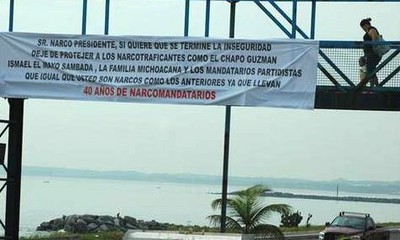
In The Politics of Heroin, Alfred McCoy notes that we capture a drug lord only when he is no longer a drug lord.
So it is with news of the arrest of El Teo, a vicious Tijuana drug baron who is accused of having the bodies of his enemies beheaded or dissolved in caustic soda.
McCoy reminds us that a man like El Teo, or rather, the man authorities accuse him of being, can only be arrested when the drug traffic shifts, stripping him of the power, profits and protection he needs to stay in business. In other words, the arrest of El Teo was only possible because he was already irrelevant.
While the bloodbath in Tijuana attracts the attention, the Sinaloa carter and its leader, Joaquin El Chapo (“Shorty”) Guzman, quietly prospers, as The Economist noted this week:
Sinaloa, by contrast, has stuck to drugs and money laundering and is smarter and more sophisticated. It prefers anonymity to the ostentation of others (Mr Beltrán was undone by inviting a famous accordionist to play at a Christmas party). It eschews jobless teenagers, its rivals’ rank and file, in favour of graduates, infiltration and intelligence. Although all the gangs have penetrated local governments, only Sinaloa and the Beltráns have been discovered to have bribed senior officials. Officials complain that Sinaloa operatives receive warning of pending raids. Sceptics wonder whether success against other gangs comes from tip-offs from Sinaloa.
Forbes reckons that Guzman, who bribed his way out of prison in 2001, is now the 701st richest man in the world.
 Trump / Russia