
Category: Law and Lawyers
Coughlin Stoia's Money Machine
A move is underway to clamp down on the massive fees earned by plaintiffs lawyers suing behalf of public pension funds.
Florida recently capped the fees its lawyers can earn at $50 million per case. Alabama, Iowa, Mississippi, and Oklahoma have introduced bills that would force states to disclose their contracts for legal services. Several states have already enacted similar measures.
This movement could be bad for business at San Diego’s Coughlin Stoia Geller Rudman & Robbins LLP, a politically-connected firm that has extracted huge settlements in class-action corporate lawsuits.
As I noted last week, Coughlin Stoia is cozy with Phil Angelides, the former California treasurer who is now leading a congressional inquiry into the causes of the financial crisis.
Byron Georgiou, of counsel to Coughlin Stoia, is a member of the Angelides commission.
For an excellent example of how the firm operates, there are few better examples than Coughlin Stoia’s 2006 lawsuit against UnitedHealth Group on behalf of CalPERS, the giant California pension fund.
The firm — known then as Lerach Coughlin — sued UnitedHealth over the company’s practice of backdating stock options granted to its executives.
A month after filing suit, Coughlin Stoia and its attorneys contributed $107,000 to Angelides’ gubernatorial campaign. Angelides was an influential member of the CalPERS board.
CalPERS became lead plaintiff in the lawsuit and Coughlin Stoia became lead counsel.
CalPERS’ general counsel, Peter Mixon, and Lerach Coughlin negotiated the firm’s compensation a year later.
The deal anticipated a billion-dollar settlement. Lawyers on the case were to receive 11 percent of the first $250 million recovered; 12 percent of the next $250 million; and 13 percent of anything exceeding $750 million.
Sure enough, UnitedHealth Group settled in 2008 for $925 million — the largest settlement ever in a stock options backdating case.
Under its fee arrangement, CalPERS’ attorneys were entitled $110 million, most of which would have gone to Lerach Coughlin.
Judge James S. Rosenbaum wouldn’t allow it. He cut Lerach Coughlin’s golden egg nearly in half to $65 million.
In his ruling, Judge Rosebaum said that while Lerach Coughlin may have been pursuing in its own interests, CalPERS was not. The judge found no signs that the pension had used its enormous leverage to shop around for another law firm. Nor had it tried to negotiate a lower fee before filing the complaint.
Another problem was that the firm’s lead attorney, William Lerach, hadn’t bothered to tell the judge that he was under federal investigation. Lerach is serving two years in prison for paying kickbacks to his clients.
In fact, Lerach’s firm told Judge Rosenbaum in 2006 that the government “has notified Mr. Lerach that it does not intend to take any action against him.”
“Had the truth been timely and fully disclosed to the Court, in all likelihood the Court would never have appointed his firm as lead counsel,” Judge Rosenbaum wrote.
It could also be said that had the truth been fully disclosed, Lerach Coughlin/Coughlin Stoia wouldn’t have been able to bill $900 an hour for the services of prisoner Bill Lerach.
How Ex-SD Imam Will Be Marked For Death
The LATimes follows up today with an excellent story on how the bullseye will be planted on Anwar Awlaki, the former San Diego imam who U.S. counterterrorism officials believe has joined al Qaida’s forces in Yemen.
First, ABC News and then The Washington Post reported last week that the Obama administration is considering whether to order a Predator strike on Awlaki, a case that’s complicated by the fact that he’s a U.S. citizen.
The LATimes’ Greg Miller provides more detail on the process of how the CIA marks suspected terrorists for death in its “targeted killing” program:
- Memos proposing new targets are drafted by analysts in the CIA’s Counter-Terrorism Center.
- CTC analysts typically submit several new names each month to high-level officials, including the CIA General Counsel, Stephen W. Preston, and sometimes Director Leon E. Panetta.
- The list is scrutinized every six months; some names are scrubbed if the intelligence grows stale.
- The program is overseen by the National Security Council.
- The CIA does not need White House approval when adding names to the target list, unless the individual is a U.S. citizen.
Miller’s story contradicts a Jan. 27 story by Dana Priest at The Washington Post on a key point:
Miller: “No U.S. citizen has ever been on the CIA’s target list, which mainly names Al Qaeda leaders, including Osama bin Laden, according to current and former U.S. officials. But that is expected to change as CIA analysts compile a case against a Muslim cleric who was born in New Mexico but now resides in Yemen.”
Priest: “As of several months ago, the CIA list included three U.S. citizens, and an intelligence official said that Aulaqi’s name has now been added.”
Also are targeting decisions based on whether on an individual is “deemed to be a continuing threat to U.S. persons or interests,” as Miller reported. That appears to be a slightly lower threshold that what Priest describes as an individual who presents “a continuing and imminent threat to U.S. persons and interests.”
Semantics, perhaps, but we are talking about executing a U.S. citizen without due process.
The Embarrassing Case of Jesus Navarro (Updated)

(Note: I updated this post after a reader pointed out that the Border Patrol didn’t let Navarro go in 2007. What actually happened is even worse)
Now that a Mexican smuggler suspected in the murder of a U.S. Border Patrol agent is on his way to San Diego, maybe we can finally get some answers as to how and why the case went so horribly wrong.
The U.S. government’s bungling allowed the suspect, Jesus Albino Navarro-Montes, to get out of a Mexican jail. That part is well known, but what hasn’t gotten much attention is that U.S. officials let Navarro slip away not once, but twice.
Not long before the death of Border Patrol Agent Luis Aguilar, Navarro was caught by the Border Patrol with a half-ton of pot.
But he got away.
How?
According to a federal complaint, Navarro and his female passenger stole a Border Patrol vehicle and drove it back to Mexico.
This would laughable if the results weren’t so tragic.
A few months later, Navarro was allegedly behind the wheel of a Hummer H2 on Jan. 19, 2008 that illegally crossed the border near Yuma, Arizon.
Agent Aguilar, 32, was run over while trying to throw down a spike strip. The Hummer got away, but Navarro was arrested on January 28, 2008.
On June 18, 2008, he was released from jail by a Mexican judge.
Why?
The U.S. government never sought Navarro’s extradition. It never presented an arrest warrant. Without any evidence of a crime, Navarro had to be released.
“Although we had asked the U.S. government a couple of times before his release to help us deal with the matter so we could hold Mr. Navarro, we got nothing whatsoever,” embassy spokesman Ricardo Alday told a reporter for The Washington Times. “The U.S. response never came.”
Congress Brian Bilbray, a San Diego-area Republican, asked Attorney General Michael B. Mukasey and the White House for an explanation.
He got the brush off.
Disclosure would “inevitably compromise highly sensitive law enforcement investigative information,” Deputy Assistant Attorney General Keith B. Nelson wrote in a letter to Bilbray.
Navarro was re-captured near Zihuatanejo on Feb. 11, 2009 by Mexico’s Agencia Federal de Investigacion in an operation coordinated with the FBI and U.S. Marshal’s Service.
After Navarro’s re-arrest, authorities in San Diego unsealed a criminal complaint that showed that Border Patrol agents had captured Navarro on Sept. 23, 2007 following a chase east of San Diego.
(Click here to read the complaint and accompanying statement of facts.)
Border Patrol agents used a spike strip to successfully slow him down. Navarro ditched his pickup in the desert and fled on foot with an unidentified female passenger.
Border Patrol agents caught the pair and put them in their vehicle.
According to the statement of facts, “The female passenger was able to take control of the Border Patrol vehicle, and both the female passenger and NAVARRO-Montes absconded to Mexico in the Border Patrol.”
The agents were stuck in the desert with a Toyota pickup with three blown out tires and 979.7 pounds of marijuana inside.
Report: US Mulls Killing Former SD Imam
Can the president target an American citizen in a lethal attack?
White House lawyers are struggling with that question in the case of Anwar Awlaki, a former San Diego imam and SDSU graduate student, according to an ABC News report.
The Senate Foreign Relations Committee noted last week that U.S. intelligence and military officials consider Anwar Awlaki, a former San Diego imam and U.S. citizen, to be “a direct threat to U.S. interests” although he has not yet been accused of a crime.
Awlaki corresponded with alleged Fort Hood shooter Maj. Nidal Hasan before the attack that killed 12 soldiers, and investigators believe he also met with accused “underwear bomber” Umar Farouk Abdulmutallab.
- For more see my Awlaki timeline.
ABC’s Matthew Cole, Richard Esposito and Brian Ross are reporting:
According to the people who were briefed on the issue, American officials fear the possibility of criminal prosecution without approval in advance from the White House for a targeted strike against Awlaki.
The former imam at the Masjid al-Rabat al-Islami in San Diego was said to be in the Predator’s sights after the Fort Hood attack, but the strike wasn’t authorized because of questions over the citizenship of the New Mexico-born Awlaki.
President Reagan signed an an executive order in 1981 that forbid anyone employed by or acting on behalf of the U.S. government from engaging in or conspiring to engaging in assassination. That order remains in effect today.
However, we can kill those who are trying to kill us. After the Sept. 11 attacks, Congress gave the president the authority to use “all necessary and appropriate force” to prevent future acts of terrorism against the United States. The specifics are said to be set out in a secret presidential “finding” signed by President Bush after the attacks.
In 2002, a CIA drone attack in Yemen killed a carload of suspected terrorists, including the target of the operation, the top al-Qaida leader in the country. U.S. officials weren’t troubled that the strike killed Yemeni-American Kamal Derwish, a U.S. citizen. “No constitutional questions are raised here,” said National Security Adviser Condoleezza Rice.
Putting the bullseye on Awlaki and pulling the trigger would break new legal ground and raise fresh questions about the limits of presidential power.
At the very least, the U.S. government should make plainly clear what Awlaki has done to earn the wrath of a Hellfire missile. Meeting, corresponding and, odious as it may be, enouraging jihadists, doesn’t cut it.
The Arrest of El Teo
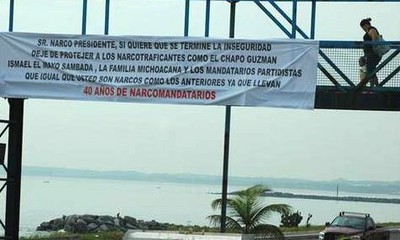
In The Politics of Heroin, Alfred McCoy notes that we capture a drug lord only when he is no longer a drug lord.
So it is with news of the arrest of El Teo, a vicious Tijuana drug baron who is accused of having the bodies of his enemies beheaded or dissolved in caustic soda.
McCoy reminds us that a man like El Teo, or rather, the man authorities accuse him of being, can only be arrested when the drug traffic shifts, stripping him of the power, profits and protection he needs to stay in business. In other words, the arrest of El Teo was only possible because he was already irrelevant.
While the bloodbath in Tijuana attracts the attention, the Sinaloa carter and its leader, Joaquin El Chapo (“Shorty”) Guzman, quietly prospers, as The Economist noted this week:
Sinaloa, by contrast, has stuck to drugs and money laundering and is smarter and more sophisticated. It prefers anonymity to the ostentation of others (Mr Beltrán was undone by inviting a famous accordionist to play at a Christmas party). It eschews jobless teenagers, its rivals’ rank and file, in favour of graduates, infiltration and intelligence. Although all the gangs have penetrated local governments, only Sinaloa and the Beltráns have been discovered to have bribed senior officials. Officials complain that Sinaloa operatives receive warning of pending raids. Sceptics wonder whether success against other gangs comes from tip-offs from Sinaloa.
Forbes reckons that Guzman, who bribed his way out of prison in 2001, is now the 701st richest man in the world.
 Trump / Russia