Sheikh Khalid bin Mahfouz

Writing anything about Sheikh Khalid bin Mahfouz used to be a bit of a risk. The billionaire Saudi banker issued a sheaf of libel writs to obscure writers and forced them to retract their stories and apologize. But the Saudi’s days of using British courts to clear his name are now buried in Jeddah along with 60-year-old Sheikh Khalid himself.

You can buy accutane here

He was one of the world’s wealthiest men and, at one time, he was the most powerful banker in the Middle East — King Fahd’s personal banker, it was said. Sheikh Khalid inherited his vast wealth from his father, an illiterate money-changer from Yemen who founded what became Saudi Arabia’s leading bank, the National Commercial Bank.

An intensely private man, Sheikh Khalid spent considerable sums in London’s plantiff-friendly courts to prove what he was not. He was not a financier of terrorism. He was not Osama bin Laden’s brother-in-law. No, he was not an investor in George W. Bush’s Harken Energy. The allegations continued to dog him nonetheless.

That he was involved in the BCCI scandal, however, is beyond doubt. Sheikh Khalid was a director and major investor in the Bank of Commerce and Credit International. He did deny that he knew anything about what the bank of Manuel Noriega, terrorist Abu Nidal, the Medellin cartel, and the CIA was really up to.

Prosecutors in New York thought otherwise. A state grand jury indicted him in 1992 on criminal charges of conspiring to steal $300 million from BCCI depositors. The Federal Reserve accused Sheikh Khalid of misleading American regulators and closed the New York branch of the National Commercial Bank.

The charges were a deep embarrassment to the royal family. There were rumors that the House of Saud had borrowed huge sums from National Commercial Bank, perhaps as much as $3 billion, according to False Profits, a book on the BCCI scandal. King Fahd summoned U.S. Ambassador Charles Freeman “to express his surprise and dismay that a local prosecutor in New York City had indicted Sheik Khalid,” The New York Times reported. The king also made an extraordinary request: Would the United States issue a statement supporting the Saudi banking system? The ambassador refused.

To make the charges go away, Sheikh Khalid paid $225 million, including a $37 million fine (which he insisted was not a fine.)  While under investigation, Sheikh Khalid and his family had bought Irish passports. A helpful Citibank vice president supplied a reference, describing the sheikh as “the most important and respected client with Citicorp Private Bank in the UK and Channel Islands and one of the most valued clients of the bank globally.”

With the charges behind him, Sheikh Khalid reemerged as chairman and sole owner of his family’s bank. According to Forbes magazine, however, Sheikh Khalid oversaw a “dramatic” increase in the bank’s nonperforming loans, some of which were made to Sheikh Khalid himself. In 1999, the Saudi government acquired control of National Commercial Bank.

Sheikh Khalid remained in the public eye, however. He was a favorite of conspiracy theorists because of his connections, however indirect, to both the Bush family and the Sept. 11, 2001 attacks.

In the 1970s, his U.S. legal representative was James R. Bath, a dealmaker who served in the Texas Air National Guard with George W. Bush. Bath introduced Sheikh Khalid, Bath, and former U.S. Treasury Secretary John Connally bought Main Bank of Houston.

Sheikh Khalid spent the last decade in seclusion, using his emissaries to stamp out reports that linked him to terrorism. Much was made of the Muwafaq Foundation, a charity Sheik endowed in 1991. A trustee of the foundation, Yassin al-Qadi, was listed by the U.S. government as a financier of terrorism. Sheikh Khalid, once again, insisted he knew nothing about what others had done with his money.

Texas was no hospitable for Sheikh Khalid, and his foreign base shifted to London.  According to news reports, a lawsuit in London revealed that Sheikh Khalid had acquired a London mansion in 1996 without his family’s knowledge. Sheikh Khalid planned to stay in the 97-room apartment in Mayfair with his young male friend, Khalid Ganzal.

Sheikh Khalid exemplified the conflicted realities U.S-Saudi relationship, a mutual dependence of powerful interests built on murky deals. He was not a royal but he was part of the inner sanctum of wealth and power in Saudi Arabia, and one pathway to the royals went through him. Even as he battled criminal charges, Sheikh Khalid continued to serve  powerful interests in the United States, remaining a consultant to Boeing Co., which sought an extremely lucrative contract from Saudi Arabia.

If there was wheeling and dealing to be done with the House of Saud, Sheikh Khalid was your man.

The Partnership

I’ve been reading The Partnership: The Making of Goldman Sachs by Charles D. Ellis. Goldman has been in the news quite a bit lately so I decided to get a bit of background, and Ellis is an investment consultant so the book is as close to an official history as has yet been written.

The major players from Goldman are pretty well known — Henry Paulson, Bob Rubin, Joshua Bolten, but it’s pretty interesting where some of the lesser known ones others turn up.

Take former Goldman partner Thomas L. “Dusty” Rhodes, president of National Review, chairman of the conservative Club for Growth, and one of the strategists behind Proposition 209, a California initiative that ended affirmative action. He shows up briefly in The Partnership:

“SAMA — the Saudi Arabian Monetary Authority — had huge cash flows to invest in the late 1970s, and interest rates were not as important to SAMA as credit quality. Through the contacts of partner Thomas “Dusty” Rhodes, the utility group arrange two- to five-year private placements with SAMA for many of the highest grade U.S. utilities.”

I’ll be giving updates on other interesting Goldman alumni as I come across them in the book.

Foggo Talks to the NY Times

Kyle “Dusty” Foggo, the imprisoned former top CIA official, has given an interview to The New York Times, which published his claims last week in a front-page story titled, “A Window Into CIA’s Embrace of Secret Jails.

From behind the walls of a Kentucky prison where he is serving more than three years for fraud, Foggo says he was given a special assignment to help build secret prisons for suspected terrorists.Foggo “went on to oversee construction” of three prisons — one in Bucharest, Romania, one in Morocco (that went unused) and a third in an unnamed Eastern European country, the Times reported.

A review of the story and the background of the case shows there is evidence to believe Foggo’s account, but ultimately, there’s more reason to doubt he’s telling the whole truth.

First a bit of background:

Foggo pleaded guilty last year in a fraud scheme involving a defense contractor named Brent Wilkes. Foggo admitting using his influence at the agency to steer $2 million in contracts to Wilkes, who paid for lavish overseas vacations for Foggo and his family. Wilkes was separately convicted of bribing former Rep. Randy “Duke” Cunningham with cash, travel and hookers.

The scheme centered around Foggo’s time as chief support officer of FRANSUPT, the agency’s crucial regional support terminal in Frankfurt, Germany from July 2001 to November 2004. In that position, Foggo had control over millions of dollars in government funds.In November 2004, CIA Director Porter Goss picked Foggo to run day-to-day operations at the CIA, as the agency’s executive director, the No. 3 job. Foggo says he was promoted in part because of his work on the prisons.

The Times story paints a picture of Foggo as a lovable rogue, “a cigar-waving, burbon-drinking operator” who could get things done. The job of building prisons was “too sensitive to be handled by headquarters,” Foggo said.  “I was proud to help my nation.”

One problem lies with what isn’t in the story. Missing from the Times account is any comment from federal prosecutors, who have a strikingly different view of Foggo. To them, Foggo is a man who is motivated not by patriotism but by “narcissism and deceitfulness.”

In sworn declarations filed by prosecutors, a former director of the CIA’s Counterterrorism Center director described Foggo as a “con man” who was “seriously flawed, ethically and morally.” Former CIA Director Porter Goss says Foggo left him feeling “deceived and betrayed.”  A CIA attorney recounted how she became convinced that Foggo was “effortlessly lying” to her.

Is it possible Foggo is telling the truth? As chief support officer, he quite likely knew something about the prisons. Before securing his guilty plea, prosecutors complained that the defense wanted turn the case into “a referendum on the global war on terror” and a debate over sensitive “CIA programs and methods.”

Foggo’s attorneys asked to be read into areas of sensitive compartmented information — the most closely guarded class of secrets. One pertained to the CIA’s terrorist detention and interrogation program. The request was denied. Shortly before he went off to prison, Foggo spoke with a prosecutor investigating the CIA’s destruction of videotaped interrogations.

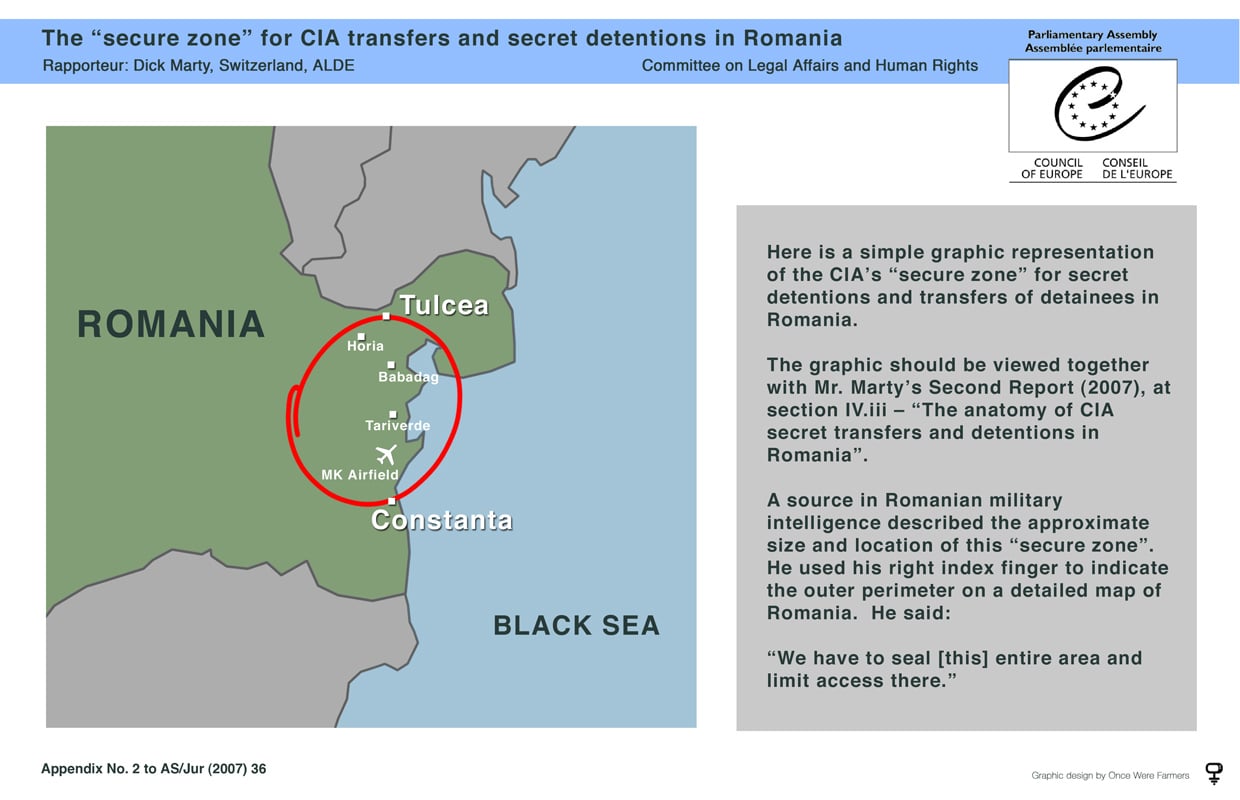
Human Rights Watch, the Council of Europe and ABC News have reported that Romania (as well as Poland) served as locations of CIA prisons. The most detailed of these investigations (pdf) by the Council of Europe’s rapporteur Dick Marty found evidence that Romania’s “black site” was located near in a secure zone around an airbase near the Black Sea — a ways from Bucharest.

The choice of a busy street for a location of a secret prison, however, strains credulity, since the changing of guard shifts, supplies and transport of detainees could attract unwanted attention.

As James Risen wrote in State of War, “The CIA wanted secret locations where it could have complete control over the interrogations and debriefings, free from the prying eyes of the international media, free from monitoring by human rights groups, and, most important, far from the jurisdiction of the American legal system.”

The story lacks some internal consistency, something interrogators look for when evaluating truthfulness:  Foggo says he was given the task secret prisons because it was “too sensitive for headquarters.” Nevertheless, his work on the CIA’s so-called black sites helped him win a promotion back at headquarters, suggested that headquarters was well aware of his sensitive mission.

And finally, while the Times doesn’t rely on Foggo alone — it cites anonymous “former intelligence officials and others briefed on the matter.” One of these sources may be Brant Bassett, who is quoted later on in the piece speculating that Foggo was taken down because of his “fast rise and blunt approach.”

Regardless of whether Bassett is a confidential source or not, The Times didn’t fully explain his connection to the story. Bassett was a friend of both Wilkes and Foggo, part of their poker playing D.C. social circle. Bassett also served under Porter Goss the House Intelligence Committee and may have played a role in getting Foggo named executive director.

We owe a great deal to reporters like The Washington Post’s Dana Priest, who helped expose the CIA’s network of secret prisons with the help of agency insiders who were troubled by what was going on. It’s an important story, perhaps too important for the Times to give such credence to a man like Kyle “Dusty” Foggo.

Who's buying guns?

Ken Silverstein poses an interesting question on his blog at Harper’s: Who’s Buying Guns? He notes that stock of Smith & Wesson is way up and so are gun sales, spurred, annecdotally, by fears over the Obama administration.

Silverstein also suggests that the NRA has stoked these fears with an advertising campaign that notes Obama has indicated support for a 500 percent tax on guns. In 1999, when he was in the Illinois state senate, Obama did show support for such a tax but he hasn’t said much about it lately, according to factcheck.org.

Gun maker Remington notes in its 10-K (via) report that fear is good for business:

Management believes that despite the challenges in the banking industry, the resulting stock market drop, unstable fuel prices and the ensuing government bailout, we have experienced no significant adverse impact in our overall sales. We believe the overall market for our products picked up subsequent to the U.S. Presidential election and we believe this is attributable to consumer concerns that the new administration could ban and regulate certain guns and ammunition in a more restrictive manner.

The key word here is “certain” guns.  Remington isn’t publicly traded so it doesn’t break out details on its sales but Smith & Wesson is traded publicly and it reported this in its 10Q report of Oct. 31, 2008:

Sales of our M&P 15 rifles were $8,654,385 for the three months ended October 31, 2008, a $6,534,882, or 308.3%, increase over the three months ended October 31, 2007. M&P 15 sales were helped by a consumer promotion as well as what appears to have been speculation on the outcome of the presidential election. On the law enforcement side, 204 police and security agencies to date have either selected the M&P 15 or approved the M&P 15 for on-duty use. The backlog for tactical rifles was $5,988,418 at October 31, 2008. (emphasis added)

No other category of Smith & Wesson firearms was up as much as the tactical rifle category. Notably, sales of hunting rifles and shotguns fell. If hunters feared losing their guns under the Obama administration they would have bought more hunting rifles and shotguns from S&W, not less.

The ones who were doing the buying here were the hardcore gun lovers, who were worried that they wouldn’t be able to buy a military-style rifle like the M&P 15 once the Obama administration got in.

For the three months ending January 31, 2009, which covers gun sales after Obama was elected, Smith & Wesson reported that total firearms sales were up 11 percent to 219 million.

Once again, tactical rifles again led the way with a 108 percent increase in sales.  Hunting firearms, however were down again nearly 36 percent.

Gun sales are up, but it seems like hunters — the core of the NRA’s membership — are just fine with Obama. Those who fear our new president are the black helicopter types, the kind of folks who shelled out $22 million to buy an update on the old military-tested AR-15.