The Godfather Goes to Washington (Updated)
 

torshin nra

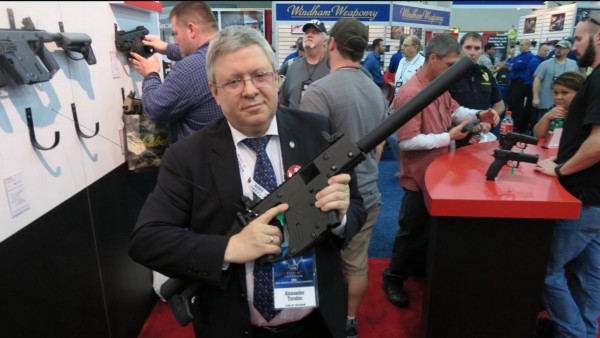
Reputed Russian mob “godfather” at the 2016 NRA convention in Louisville, Ky.

How did a suspected Russian mob “Godfather” (update: and Kremlin emissary) nearly make it to a private meeting in February with President Trump? With help from friends in the NRA.

Dramatis Personae
51_b

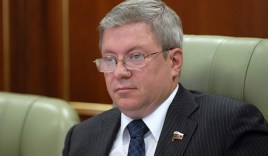
The “Godfather” Alexander Torshin

The Godfather: Spanish police investigating the Moscow-based Taganskaya crime syndicate laundering ill-gotten gains through banks and properties in Spain learn that Alexander Torshin, while serving as  a deputy speaker of the upper house of parliament in Russia, instructed members how to launder criminal proceeds. Wiretaps recorded Torshin talking in 2012 and 2013 to the alleged Taganskaya leader in Spain, Alexander Romanov. An internal document from the Spanish Civil Guard Information Service, explains Torshin’s central role in the criminal plot.

“As a consequence of the phone tapping carried out in the aforementioned inquiries it has been ratified that, above Romanov, on a higher hierarchical level, is Alexander Torshin. In the numerous phone conversations and with different contact persons, Alexander Romanov himself recognized his subordination before someone who he describes as ‘the Godfather’ or ‘the boss’ … which in itself is telling when it comes to situating their relationship.”

Torshin also has longstanding ties to the FSB, successor agency to Russia’s KGB.

11096611_813002538789514_5994826642982391582_n

Maria Butina

The Honeypot: Maria Butina. In 2011, this tall redhead was involved in sales of appliances and furniture in the Altai region of Siberia, A year later, she was rubbing elbows with Torshin and putting together Право на Оружие (translated as “Right to Bear Arms”) in Moscow, an international gun rights organization.
davide-keene-must-credit-photog-gage-skidmore

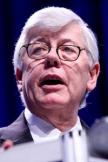
David Keene

The Useful Idiot: David A. Keene is a political consultant, longtime director of the American Conservative Union, past president of the National Rifle Association, and currently the opinion editor of The Washington Times. Although not the power broker he once was, Keene still wields influence. He takes a liking to Torshin and Butina and opens doors for them in Washington and introduces them to influential people.

Our Story Begins

It’s election day in America, 2012. Barack Obama is running for a second term against Mitt Romney. Enter Torshin.

Nov. 6 2012: Torshin travels to Nashville, Tennessee where the NRA an American friend has granted him special status as an observer for the 2012 presidential election. Tweet below reads: “Standing in line at the polling place. As an ordinary American. 6:45 a.m.” At the time, Torshin is a senator in Putin’s United Russia in the upper house of Russia’s parliament.

Nov. 8, 2012: Torshin visits the Russian ambassador’s residence in Washington and NRA headquarters in Washington, DC.

May 2013: Torshin attends the NRA’s annual meeting in Houston, Texas.
Screen Shot 2017-04-04 at 10.17.21 AM

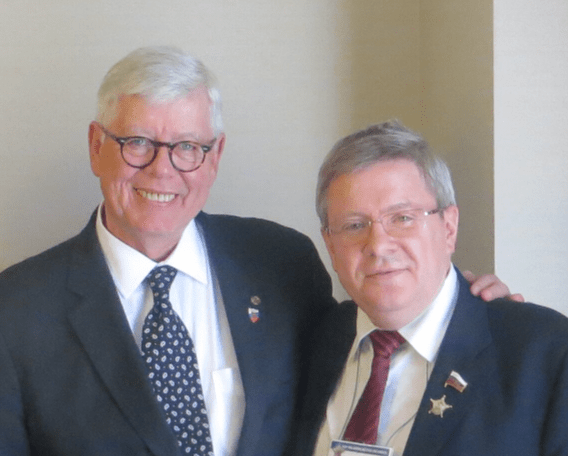
Torshin photographed in 2013 with then NRA president David Keene at the NRA’s annual convention in Houston.

August 21, 2013: Torshin decides not to attend a birthday celebration for Taganskaya leader in Spain, Alexander Romanov, as planned. Spanish authorities believe he was warned by the Russian prosecutor that if he stepped onto Spanish soil he would be arrested.

November 2013: NRA president David Keene travels to Russia for a conference hosted by The Right to Bear Arms. Keene speaks at the conference, with Torshin in attendance.
keene-butina-moscow-20131102

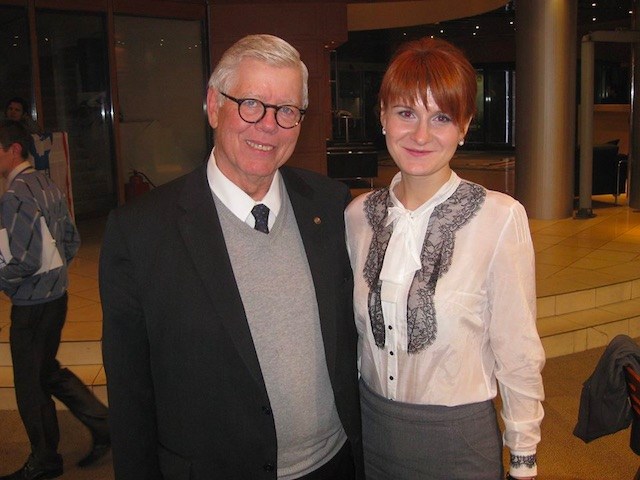
David Keene and Maria Butina in Moscow. (Source: Facebook)

January 2, 2014: David Keene publishes an op-ed piece in the Washington Times by his friend, Alexander Torshin. “Last year, I had the pleasure of attending the National Rifle Association’s annual meeting in Houston,” he writes. Torshin says he has been a “life member” of the NRA for years.

April 2014: Torshin and Butina attend the NRA’s annual meeting in Indianapolis, where they are given the red carpet treatment. Butina attends the annual NRA Women’s Leadership Luncheon as a guest of former NRA President Sandy Froman and participates in general meetings over the weekend as a guest of former NRA President David Keene. She also presents the then-NRA president Jim Porter with a plaque. Butina is given the “rare privilege” of ringing a Liberty Bell replica.

May 5, 2014: Maria Butina visits NRA headquarters in Washington, DC. and meets with David Keene.

May 6, 2014: Butina and her organization are profiled by conservative website Townhall.

We are a young organization. We are three years old. And we invited David Keene. He made a speech at our annual meeting. And so it’s like an answer from one side. The next side is the life member of our organization. He is our Russian senator. His name is Senator Alexander Torshin. He is a life member of NRA too, and he’s usually a participant of such events, and every annual meeting of NRA. But now the situation between (our) two countries is very difficult. And we have to go here together with Senator Torshin. He is a great gun lover, he supports our organization and he’s a friend of the NRA.

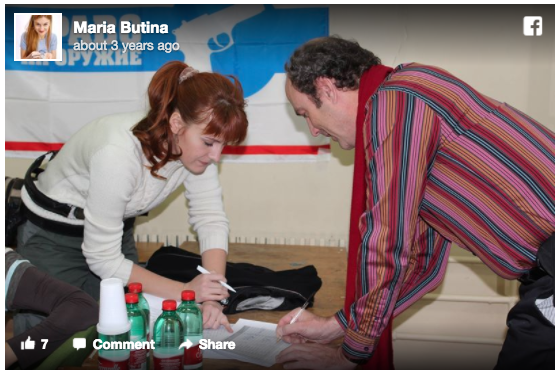
September 3, 2014: Paul Erickson, NRA member, GOP operative, campaign manager for Pat Buchanan’s 1992 presidential run, attends an open forum in Moscow organized by Right to Bear Arms.
Screen Shot 2017-04-04 at 5.42.00 PM

Butina and Erickson in Moscow

January, 20 2015: Torshin is named deputy governor of the Central Bank of Russia, responsible for liaison with the Federal Assembly chambers, and also federal and regional state executive bodies. Torshin selects Maria Butina as his special assistant.

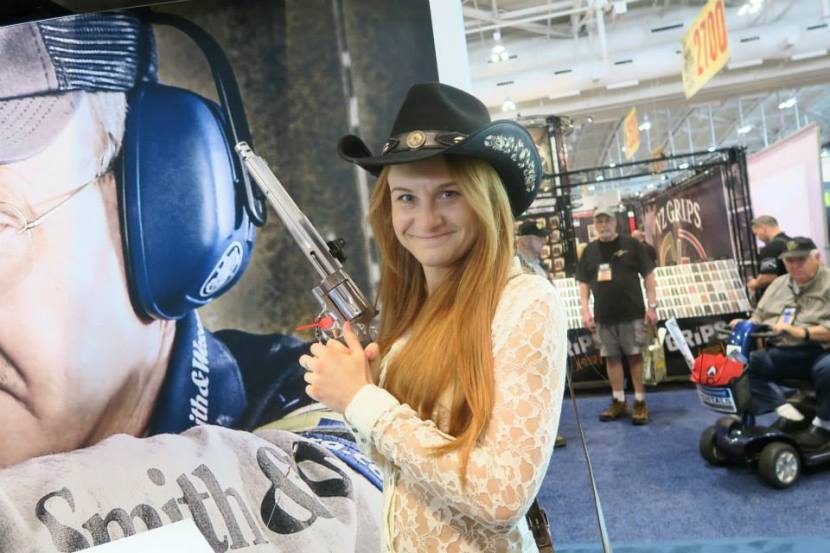
April 2015: Torshin and Butina both attend NRA’s annual meeting in Nashville.
11096611_813002538789514_5994826642982391582_n

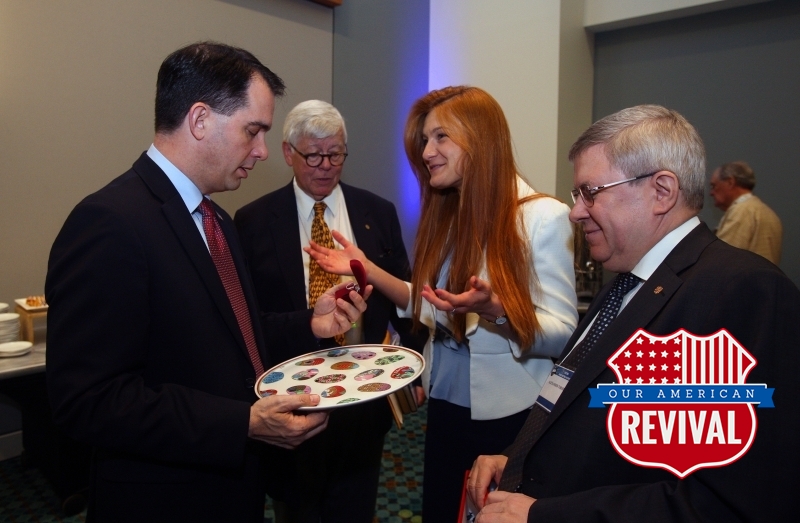
April 10, 2015: Butina, Torshin and Keene meet future  Republican presidential candidate and Wisconsin governor Scott Walker during an event in Tennessee.
Walker4-10-5258

July 11, 2015: Maria Butina attends Trump Freedom Fest rally in Las Vegas and poses a question to the Republican candidate: “I’m from Russia. My question will be about foreign politics. If you will be elected as president, what will be your foreign politics, especially in the relationships with my country? Do you want to continue the policy of sanctions that are damaging both economies? Or [do you] have any other ideas?”

Trump replies: “I know Putin, and I’ll tell you what, we’ll get along with Putin. … I would get along very nicely with Putin, I mean, where we have the strength. I don’t think you’d need the sanctions. I think we would get along very, very well.”

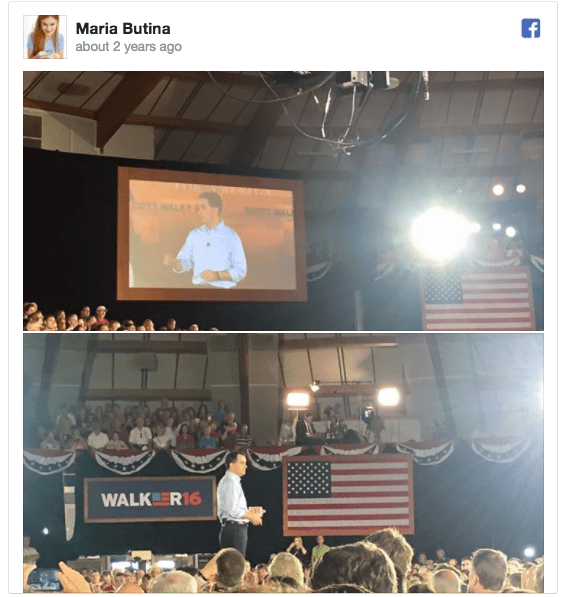
July 13, 2015: Butina attends the official launch of Wisconsin Gov. Scott Walker’s run for governor.
Screen Shot 2017-04-04 at 8.39.32 PM.png

December 2015:  An NRA delegation travels to Moscow to meet with Dmitry Rogozin, the deputy prime minister in charge of Russia’s defense industry who is a subject of US sanctions. The delegation consists of David Keene, Paul Erickson, and Milwaukee County, Wisconsin sheriff David A. Clarke. Right to Bear Arms pays $6,000 for Clarke’s meals, hotel, transportation, and entertainment. (Daily Beast story)

Feb. 7, 2016: Torshin attends National Prayer Breakfast in Washington, D.C.

February 10, 2016: Paul Erickson forms a limited liability corporation with Maria Butina called Bridges, LLC., based in South Dakota. What this company does is a mystery.

May 2016: According to The New York Times, Torshin tries to meet with Trump during the NRA comeeting between Trump and Vladimir Putin. Torshin Rick Clay, an advocate for conservative Christian causes, to Rick Dearborn, a Trump campaign aide.

May 2016: Paul Erickson, Marina Butina’s friend and business partner, writes an email to a Trump campaign aide, The New York Times reports.

Subject: “Kremlin Connection.”

Russia, Erickson writes, was “quietly but actively seeking a dialogue with the U.S.” and would use the NRA’s annual convention in Louisville, Kentucky, to make “first contact.”

“Putin is deadly serious about building a good relationship with Mr. Trump,” Erickson writes to Trump aide Rick Dearborn. “He wants to extend an invitation to Mr. Trump to visit him in the Kremlin before the election. Let’s talk through what has transpired and Senator Sessions’s advice on how to proceed.” Sessions says he does not recall the outreach.

“The Kremlin believes that the only possibility of a true reset in this relationship would be with a new Republican White House,” Erickson writes. “Ever since Hillary compared Putin to Hitler, all senior Russian leaders consider her beyond redemption.”

By “happenstance” and the reach of the NRA, Erickson says he had been put in position to “slowly begin cultivating a back-channel to President Putin’s Kremlin” in recent years.

“Russia is quietly but actively seeking a dialogue with the U.S. that isn’t forthcoming under the current administration.”

May 20, 2016: Torshin attends NRA convention in Louisville, Kentucky. He shares a table with Donald Trump, Jr. at a private dinner. According to The New York Times, Torshin had tried and failed to meet with candidate Trump in Louisville to pitch a “backdoor meeting” with Putin. In the picture below, David Keene is in the background and Torshin is wearing a button that reads “I’m the NRA and I Voted.”

May 2016: Taganskaya mafia boss Alexander Romanov is sentenced to almost four years in a Spanish prison, after pleading guilty to illegal transactions totaling 1.65 million euros ($1.83 million) and $50,000.

August 8, 2016: Bloomberg reveals Torshin’s connections to organized crime.

Nov. 12, 2016: Butina celebrates her birthday with a costume party in Washington, DC. attended by several Trump’ campaign consultants.

January 15, 2017: Torshin tweets that he brought a gift for NRA President Allan D. Cors.  President Cors loves tanks.


January 20, 2017: Maria Butina and Paul Erickson attended the invitation-only Freedom Ball to celebrate Donald Trump’s swearing in as President of the United States.

Feb. 2, 2017: Torshin and Butina are excited to meet newly-elected President Donald Trump at the National Prayer Breakfast. Their hopes are dashed at the last minute when a White House national security aide notices Torshin’s name and flags him as a figure who had “baggage,” a reference to his suspected ties to organized crime, according to Yahoo News.

Butina told Yahoo:

“Late the night before, we were told that all meet and greets were off,” Butina wrote in an email. “There were no specific questions or statements that Mr. Torshin had in mind during what we assumed to be a five-second handshake. We all hope for better relations between our two countries. I’m sure there will be other opportunities to express this hope.”

Fin.
Unwitting Agents, Useful Idiots, Donald Trump and other dupes

29906170001_4894667946001_4894656193001-vs

In his excellent testimony March 30 before the Senate intelligence committee, Thomas Rid, a professor in the Department of War Studies at King’s College London, explains how Russia has perfected the art of exploiting unwitting agents.

Unwitting agents are fools who are doing the bidding of another person or country without realizing it. Another term for them is “useful idiot,” a phrase supposedly used by Lenin to describe liberals and Social Democrats who helped advance the Communist cause outside the Soviet Union.

Rid said three different types of unwitting agents stand out from the chaos of the 2016 election:

Unwitting agent #1: Wikileaks.

The US intelligence community concluded with a high degree of confidence that Russia’s foreign military intelligence service, the GRU, was the source for the reams of stolen Clinton campaign emails published by Wikileaks.

Wikileaks has repeatedly denied that Russia was the source for the leaked DNC emails, which shows why an unwitting agent is so useful.

Wikileaks clings to the moral high ground because it believes it acted in the name of justice or goodness, not in the name of a Russian intelligence agency.

So when Wikileaks insists that the emails were leaked to them by an insider, it does so with considerable conviction that has taken others such as the influential Fox commentator Sean Hannity.

Unwitting Agent #2: Twitter

Twitter was hugely influential among opinion leaders in the 2016 election, foremost among them the Twitterer-in-chief, Donald Trump. But it’s very hard to tell what on Twitter is real and what is fake.

A recent study by computer scientists at Indiana University and USC tried to tackle the question of how many Twitter accounts are bots. These are automated and semi-automated software applications that mimic human behavior and can be used to drive grassroots political support, spread rumors, or bully opponents.

The researchers conclude that as many as 15 percent of all Twitter accounts are bots, and given the increasing sophistication of bots, this may be a conservative estimate. Twitter claims it has 313 million “active” monthly users. If the study is correct, 47 million Twitter users are not human.

Twitter for its part could easily inform the public how many of its accounts are bots, whether influential accounts during the 2016 election were human or not, or how many Twitter trends began overseas.

But it is not in the company’s interest to do so. The inflated numbers make it appear that Twitter has active users than its published numbers claim it has. Pulling back the curtain on bots would depress Twitter’s value as a publicly-traded company.

Unwitting Agent #3: Journalists

The Soviet Union excelled at planting stories. Operation INFEKTION planted the devastatingly rumor that AIDS had been created by US scientists seeking new and potent biological weapons that still echoes around the globe.

But planting these stories was hard work, as this CIA history shows. It took time to craft believable forgeries and build relationships with newspapers. A CIA study estimated that the Soviets spent $3 billion annually influencing world perceptions through its “active measures” campaigns.

That was then. Now, Rid says, it’s much easier:

Cold War disinformation was artisanal; today it is outsourced at least in part — outsourced to the victim itself. American journalists would dig deep into large dumps, sifting gems, mining news, boosting ops.

The hours and reams of newsprint that reporters devoted to hacked emails — with little thought to the who, what or why of their appearance — made American journalism an unwitting agent of Russian intelligence.

Unwitting Agent #4: Donald Trump

Trump is not part of Rid’s testimony, but I felt the need to add him. Donald Trump is the biggest unwitting agent of them all.

He has professed his love for Wikileaks and for Twitter, as well as for rumors that originate with Russia. He has allowed himself to used and manipulated by people with questionable motives.

In an op-ed in The New York Times, former acting CIA Director Michael Morrell summed it up this way:

President Vladimir V. Putin of Russia was a career intelligence officer, trained to identify vulnerabilities in an individual and to exploit them. That is exactly what he did early in the primaries. Mr. Putin played upon Mr. Trump’s vulnerabilities by complimenting him. He responded just as Mr. Putin had calculated.

Mr. Putin is a great leader, Mr. Trump says, ignoring that he has killed and jailed journalists and political opponents, has invaded two of his neighbors and is driving his economy to ruin. Mr. Trump has also taken policy positions consistent with Russian, not American, interests — endorsing Russian espionage against the United States, supporting Russia’s annexation of Crimea and giving a green light to a possible Russian invasion of the Baltic States.

In the intelligence business, we would say that Mr. Putin had recruited Mr. Trump as an unwitting agent of the Russian Federation.

Fake News as a Weapon: Trump, Russia and the World of Rumors

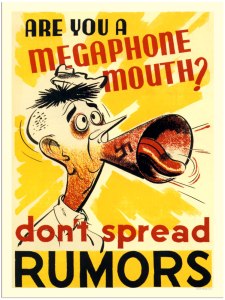
Have you heard the rumor that Donald Trump is mentally ill? Did you hear that President Obama wiretapped Trump Tower? With the help of British intelligence?  Or that a child-sex ring connected to Democrats was being run out of a Washington, D.C. pizza restaurant?

boston-herald-rumor-clinic-dont-spread-rumours-war-poster

via New England Historical Society

American society is being bombarded by rumors. Fake news websites push stories like the aforementioned “Pizzagate.” Russian has an army of Twitter trolls who blast out all sorts of wild rumors. Even Donald Trump’s own tweets deluge us with confusing and contradictory information.

It seems awful hard to know what’s true and what’s not these days. Where is the antidote for the epidemic of fake news? Many of us may feel like we can’t even trust our own judgment. And maybe, that’s the point.

The post-truth era, as it’s been called, might feel very familiar to American spies operating behind enemy lines in World War II. Back then, U.S. operatives were coming up with creative ways to damage morale and divide the leadership of Nazi Germany. One of their best weapons was the use of carefully crafted, well-timed rumors.

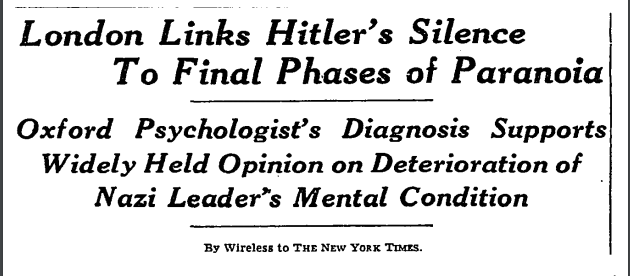
Rumors were a specialty of the Morale Operations Branch of the Office of Strategic Services (OSS), the predecessor of today’s CIA. One of the most famous of the OSS’ rumor campaigns was “Where Is Hitler?” The OSS would broadcast a fake report that Hitler was supposed to appear at an upcoming rally.  When Hitler inevitably failed to show, the OSS would float rumors that Hitler was ill or suffering from a mental breakdown. These rumors spread so widely that they became the subject of articles in American newspapers, including The New York Times.

Screen Shot 2017-03-21 at 10.02.37 PM

Creating a loss of confidence in leaders was just one was just one the tricks dreamed up by the OSS Morale Operations branch. Others are spelled out in a now declassified field manual, which is a guide on how to use rumors, forgeries, blackmail and bribery to destabilize a country. What the OSS called “subversive rumors” could be used to cause enemy populations to distrust their own news sources, create division among racial, political and religious lines, to create confusion and dismay with a welter of contradictory reports, and to tip the balance when public opinion was in a precarious state, among other things.

Viewed in this light, fake news seems less a nuisance and more like something that would trouble our intelligence community. And indeed, they do appear concerned. The U.S. intelligence community recently concluded that Russia mounted an “influence campaign” during the 2016 presidential election that blended covert intelligence operations with overt efforts by Russian Government agencies, state-funded media, third-party intermediaries, and paid social media users or “trolls.” Russia influence campaign sought to undermine faith in U.S. democracy and denigrate Hillary Clinton’s campaign.

In essence, Russia has created a modern version of the OSS Morale Operations branch. Social media gives the modern operative powers the likes of which his or her OSS forerunner could only have dreamed. Whereas the OSS had to send operatives into enemy territory to plant rumors, the modern influence campaign can without leaving home harness the power of social media sites. Facebook, Twitter and YouTube are machines for the rapid transmission of rumors.

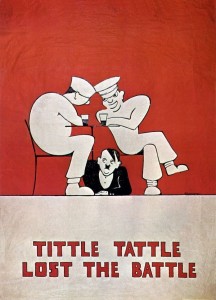
While the technology behind rumor campaigns has evolved, the nature of rumor itself hasn’t changed much in the 74 years since the OSS wrote its field manual. The OSS defined a rumor as “an unauthenticated, unofficial story or report, represented and transmitted as fact.” This distinguishes it from propaganda, which stamps its authorship on its message. Anybody can start a rumor. Crafting a good one is an art form.

via New England Historical Society

The old OSS characteristics of what makes a good rumor still hold true: A good rumor still must be simple, consisting of a single idea. It must be plausible. It is tied to some known facts, yet is impossible to completely verify. It frequently appears as an “inside” story.  The best rumors to spread are existing ones. “In many cases, the most effective rumor policy will be to spread further rumors that have arisen spontaneously in enemy territory,” the field manual advises.

A good rumor must also be vivid. Rumors with “strong emotional content” are extremely effective. (Case in point: the unforgettable, unverifiable story of Trump cavorting in a Moscow hotel room with prostitutes.) A suggestive rumor was well adapted to spreading fear and doubt, by doling out limited but tantalizing bits of information that allow the audience to formulate conclusions (“FBI Director James Comey made an unexpected trip to the White House.”)

Robert Knapp, who developed the section of the OSS’ Field Manual on rumors and wrote academic papers on the subject, likened a rumor to a torpedo. “Once launched, it travels of its own power,” he wrote. Knapp had an insight into what gave rumors their power: They expressed and gratified the emotional needs of the community, just as daydreams and fantasies expressed the needs of the individual. Rumors gave sense and direction to fears, resentments or hopes. ”No rumor will travel far unless there is already a disposition among those who hear it to lend it credence,” he wrote in a 1944 paper.

Among the many coincidences involving Russia and Donald Trump, one that goes unnoticed is their mutual grasp of the power of rumor. Trump used rumors to stunning effect in his campaign, beginning with the suggestion that President Obama was born in Kenya. This rumor tapped into deeply-held beliefs about President Obama that many people were not comfortable expressing publicly. Outright racism is unacceptable to most Americans. However, many found the disguised racism of a rumor about the African-American president’s birthplace more palatable. There is frequently a racist undertone to many of Trump’s rumors: Muslims celebrating Sept. 11 in New Jersey, illegal immigrants voting, terrorist incidents that didn’t happen, and so on.

Rumors may also help explain Trump’s appeal. In a recent interview, Time magazine’s Michael Scherer pressed Trump on his use of rumors. “What am I going to tell you? I tend to be right,” the president told him. “I’m an instinctual person, I happen to be a person that knows how life works.” In other words, Trump’s rumors feel true to him, even if they can’t be verified. Trump’s words also feel true to his supporters, almost like an article of faith. He is making a connection on a deep emotional level that, once established, is difficult to break.

However, Trump’s predilection for rumors over facts is dangerous, for it leaves him wide open to manipulation. Unwittingly or not, Trump has spread rumors that originated in Russia. The story spread by the White House that President Obama used British intelligence to spy on Trump and his associates started as a story on RT, the Kremlin-backed propaganda outlet.  On the campaign trail, Trump quoted a report that appeared to originate on Sputnik, another Kremlin-backed media outlet.  At a March 30 Senate intelligence committee hearing, Clint Watts, a former FBI agent and an expert on Russian disinformation, explained  in striking terms the problem with having a rumor-monger for a president:

Rumors do work on the campaign trail, but they are toxic to the presidency. Credibility is one of the president’s strongest assets, never more so than in moments of crisis. Trump seems not to understand that, as president, he is the authority, and the White House is the place where rumors end, not where they begin. If President Trump truly wants to make America great again, he must stop spreading rumors.

If Trump won’t quash rumors, others must do it for him. Many news organizations are now regularly refuting the president’s rumors. This effort harkens back to World War II, when rumors were an even bigger problem then they are now. Robert Knapp, the OSS’ rumor expert, founded a “rumor clinic” in Boston that collected rumors and sought to put and end to them. A column first published in the Boston Herald in 1943 quoted the rumor in italics followed by the word FACT. Rumor clinics opened in many cities, but quickly faded following a clash with the Roosevelt administration’s Office of War Information. Government bureaucrats wanted to smother rumors with facts, rather than call attention to them by singling them out for disproof. (For more on this click here.)

Knapp proposed that rumors could serve as an “index of morale.” They may be a better gauge of the true state of public opinion than any poll or survey. Rumors allow expression of the deeply held beliefs and fears that won’t be repeated to a stranger. A look at the rumors prevalent in American society show we are a deeply divided along racial, political, and religious lines. Many Americans have little or no confidence in our elected leaders. We distrust our own news sources.

In sum, American morale has been deeply wounded. We are much weaker than we think we are.

Obama and GCHQ tale is Russian disinformation

Note: This piece has been updated.

It anyone surprised that the allegation that President Obama used Britain’s GCHQ intelligence agency to eavesdrop on Donald Trump was first broadcast on RT, the Kremlin’s international propaganda outlet?

This allegation has gone in a few days from being a crackpot theory on social media to an international dispute. Britain was furious when White House spokesman Sean Spicer cited the GHCQ story as part of his defense of Trump’s claim that he was “wire tapped” by President Obama. The GHCQ, Britain’s version of the National Security Agency, issued a rare denial.

That this GHCQ allegation was first given life by RT shows the influence of the Kremlin-backed network, which has found a sympathetic ear in the White House. According to the U.S. intelligence community that Trump so openly distrusts, RT has the goal of undermining its viewers’ trust in US democratic procedures.

On March 5, the day after Trump tweeted that “Obama had my ‘wires tapped’ in Trump Tower,” RT broadcast an interview with Larry C. Johnson, once an analyst with the CIA.

In the clip, linked above, Johnson said “very good friends” had told him that information  gathered by GHCQ on Donald Trump was illegally disseminated within the US government in an effort to destroy his candidacy.  Obama, Johnson said, “gave the green light” to distribute the information from GHCQ in an improper way.

On his blog, Johnson goes into more detail about his sourcing. (Update: Johnson’s blog was taken off line shortly after this piece was published).

No one involved with the Trump campaign reached out to me and asked me to get involved with this. I spoke three months ago with a source that, if the source’s name was revealed, would be known and recognized as a reliable source of information. Based on that contact I reached out to friends in the intel community and asked them about the possibility that a back channel was used to get the Brits to collect on Trump associates. My sources said, “absolutely.” I later confirmed this via a cut out with a person who is a Senior Intelligence Service executive in the CIA.

Assuming that’s true, why would Johnson, a former CIA analyst, would go on a Russian propaganda network that presents anti-American views?  CNN’s Brian Stelter put that question to Johnson on his show, Reliable Sources.

STELTER: Why is it appropriate for any American to appear on a Kremlin propaganda network?

JOHNSON: Well, it’s not a Kremlin propaganda network. … What I found the difference with Russia Today is they don’t do pre-interviews. I’ve done pre-interviews with your people. I’ve done pre-interviews in the past when I appeared on other networks.

Just two days ago, I did a pre-interview with BBC. They were going to have me on air. But once they heard what I had to say, they came back and said, oh, no, we don’t need to use you now. So, I’m —

Johnson’s point is that RT doesn’t censor its guests. Stelter’s point, which he presses later in the interview, is that anyone can go on RT and say whatever they want without bothering about details like sourcing and verification.

Johnson theories about GHCQ are likely to prove false: officials in Britain and Washington have called it ridiculous.  For RT’s purposes it doesn’t matter whether Johnson is telling the truth, only that his information serves its broader goals.

RT’s GHCQ story is the textbook definition of disinformation:

false information deliberately and often covertly spread (as by the planting of rumors) in order to influence public opinion or obscure the truth.

So back on March 5, while former Director of National Intelligence James Clapper was knocking down Trump’s claims on Meet the Press, RT was quickly building a counter-narrative that besmirched the United States with Johnson’s help.

An outfit like Meet the Press needs a big audience to deliver ad dollars; since it strives to be objective, it has to present credible sources. That means it has guests like Clapper who as insiders know whether Obama really “wire tapped” Trump or not.  If Meet the Press had people like Larry Johnson or RT’s Illuminati correspondent sitting around talking about what their friends supposedly told them, the audience would find something better to do and the ad dollars would dry up pretty quickly.

RT, on the other hand, is funded by the Russian government. It doesn’t need a big audience. So it can quickly disseminate poorly sourced, unverified information that drives home the message that Russia is not the bad guy and America isn’t so great, anyway.

Johnson sought to minimize his role in the GHCQ affair by telling Stelter that nobody watched RT.

STELTER: You’re saying Russia today is not that influential?

JOHNSON: I’m telling you that’s the truth. I mean, who watches it?  The fact that I spoke about it two weeks ago and it didn’t even surface — it wasn’t even a blip anywhere in the U.S. news media. And so, I guarantee, if people like yourself who were very informed, very up to speed on things, don’t pick up on something like that, you expect a coal miner in Pennsylvania, an auto worker in Michigan, that they’re going to be on top of Russia Today?

But information warfare, as Johnson surely knows, doesn’t need a big audience to work.

It has just to plant a false idea that contradicts the conventional narrative. Johnson made a big fuss about how it took so long for his story to spread, but that’s how rumors work. And that’s what makes them so effective. They are spread person-to-person by social media and word-of-mouth  until they reach a critical mass. If you wanted to drive a wedge between allies, there’s no way to do it better. It’s cheap, bloodless, and stunningly effective.

Johnson’s unsupported allegation was rebroadcast on right-wing Internet on blogs and websites until March 14 when it jumped into mainstream media. Fox contributor Andrew Napolitano repeated the allegation on the talk show “Outnumbered” and then repeated it again on Fox News. Johnson told The New York Times he was one of Napolitano’s sources.

On Friday, Trump refused to back down from the allegation, telling reporters, “All we did was quote a very talented legal mind.”

Did the president realize he was also quoting Johnson via Russian media?

Johnson, who is almost always referred to as a former CIA analyst, worked for the spy agency in the 1980s. After four years in the State Department’s Office of Counterterrorism, Johnson left government service in 1993.

Since then, he gotten embroiled in controversy such as his claim that Republican operatives possessed a tape of Michelle Obama railing against “whitey.” (Johnson claims he was manipulated by Clinton confidant Sidney Blumenthal.) Or that Bush White House advisor Karl Rove had been indicted.

Johnson has been a member of Veteran Intelligence Professionals for Sanity (VIPS), a group of intelligence professionals formed in 2003 to protest the use of faulty intelligence that was used as a grounds for the invasion of Iraq.

VIPS and Johnson have been critical of the US intelligence community’s findings that Russia hacked the U.S. election. On Dec. 15, Johnson co-signed a VIPS letter that stated the hacking allegations “have no basis in fact” and suggested an “inside leak,” not hacking, was behind the release of DNC emails. Not surprisingly, RT publicized the letter.

It’s worth noting here that Ray McGovern, a former CIA analyst and founding member of Veteran Intelligence Professionals for Sanity attended the now infamous 2015 RT 10th anniversary dinner in Moscow, where he sat at the same head table with President Vladimir Putin and former Gen. Michael Flynn. (link) It seems McGovern makes an annual pilgrimage to Moscow where we find him pontificating in RT’s studios.

Napolitano for his part has also peddled Kremlin disinformation before. On May 6, 2016, he reported that “there’s a debate going on in the Kremlin between the Foreign Ministry and the Intelligence Services about whether or not they should release the twenty thousand of Mrs. Clinton’s emails that they have hacked into and received and stored.” (archived link)

Now, mind you, this was days before hacked emails from the Clinton campaign began appearing on the Internet.

According to Malcolm Nance’s informative book, The Plot to Hack America, Napolitano’s source this go-around appeared to be a conspiracy website called Whatdoesitmean.com.

It appears that the source of the story emanated from a mythical figure, a journalist named Sorcha Faal. Sorcha Faal is widely believed to be a pseudonym for David Booth. Booth hosts a wild-eyed conspiracy theory website called Whatdoesitmean.com. Usually websites like this and the more popular and crazier Infowars.com are easily dismissed as tinfoil hat crowds who see government conspiracy everywhere. Yet in this case “Sorcha Faal” appears to be so well wired into the Kremlin that “her” work at this website was often copied by mainstream Russian information propaganda like Russia Insider’s Svobodnaya Pressa (“ Free Press”). This site pushes wild conspiracy theories such as the proposition that the US trains and directs ISIS, and writes op-eds about the dangers of European multiculturalism. It is a core component of the Russian propaganda system, and such news organs as Ren TV (a large, private, pro-Putin Russian television channel) and Sputnik News (a multinational propaganda organ of the Russian government)

We might as well learn the Russian word for this, folks.

Dezinformatsiya.

The Yuge Trump-Russia Timeline

Here it is: All the publicly-available evidence that suggests collusion between Trump, his campaign, and Russia.

It stretches over three years and comprises the contacts, meetings, tweets and revelations involving Christopher Steele, Michael Flynn, Jeff Sessions, Roger Stone, Paul Manafort, Sergei Kislyak, and others.

I’ve been working on this timeline for weeks and will continue to update it as more information becomes available.

If you know of something that should be in here but isn’t drop me an email.

The link below is an embedded Google sheet with sources hyperlinked. If anyone has a better idea how to display this in a form that is more easily accessible please let me know. I am not very handy with Google scripts.