
Category: Uncategorized
Golden State of Default
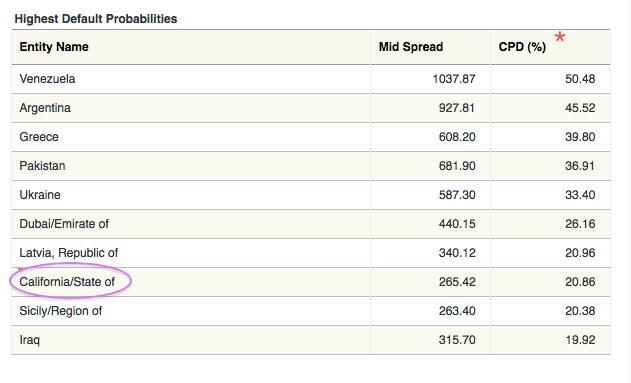
Data from CMA Sovereign Risk Monitor
* CPD – Cumulative Probability of Default over the life of a 5-year credit default swap contract. In other words, the market is estimating California’s chance of default in the next five years as one of five.
Google Slayers
I have a new story out in the May issue of The American Lawyer about Cadwalader, Wickersham & Taft, the law firm that wants to bring Google back down to size.
There have been a few developments in the case since the story went to press:
Late last month, the Ohio Attorney General has intervened in the case, asking Judge John P. Bessey to deny Google’s motion to dismiss the antitrust case filed by Cadwalader on behalf of MyTriggers.com.
AG Richard Cordray takes exception to Google’s argument that Ohio law doesn’t apply to Google’s conduct. And Cordray also finds fault wiht the Internet search giant argument that the state’s Valentine Antitrust Act doesn’t outlaw monopolies that act unilaterally to crush competition.
Goldman's Day in the Klieg Lights
“Mr. Chairman, I cannot help but get a feeling that a strategy of the witnesses is to try to burn through the time of each questioner,” Sen. Susan Collins said during last week’s Goldman Sachs hearing before the Senate.
Was this a reference to a story I wrote last year for The American Lawyer about, K. Lee Blalack II, a partner at O’Melveny & Myers who was reportedly retained by Goldman?
Click here to read a pdf of the article.
My story was about a group of lawyers who specialize in guiding firms and individuals who are in the crosshairs of the U.S. Senate’s Permanent Subcommittee on Investigations (PSI), perhaps the most powerful investigative committee on Capitol Hill.
Blalack is a former chief counsel to the subcommittee, a job once held by Bobby Kennedy and Roy Cohn, where he learned how effective a tactic delay can be:
So to avoid having his client get buried, how does Blalack prepare him or her for a day before the committee? He tells them that the congressional hearing room is not a forum for getting at the truth. Don’t get on a soapbox. A day in the klieg lights should end with minimal damage to reputation while not complicating a client’s position in other investigations or litigation. Blalack says a well-trained witness can minimize exposure by simply running out the clock: “Long, thoughtful pauses followed by rambling nonresponsive answers can easily devour half of a member’s allotted questioning time.”
Talking Points Memo said this quote explains Goldman’s entire strategy during the PSI hearing..
But I wonder if Collins had her tongue firmly pressed in her check. The woman from Maine has served on PSI for the past 13 years and is no stranger to the Kabuki-like drama of these hearings.
Her chief counsel? None other than K. Lee Blalack.
The Rise and Fall of Eliot Spitzer
My review of Rough Justice, the new biography of Eliot Spitzer by journalist Peter Elkind is the review of the week at Time Out New York.
Here’s an excerpt:
We may never know what launched the federal investigation of Emperors Club VIP, the New York City call-girl ring. It wasn’t the sort of case that attracted the FBI, which normally wouldn’t have bothered to wiretap the sweaty, Russian-born pimp in his sixties who ran the operation with his much younger girlfriend. The bureau also wasn’t in the habit of busting johns. What is clear is that from day one, the real target of the investigation was Client No. 9, Eliot Spitzer.
Did someone drop a dime and tip off the feds? It sure seems that way. Rough Justice, journalist Peter Elkind’s revealing and sympathetic biography of the disgraced governor, is peppered with hints that the politician’s secret life wasn’t so secret. According to Elkind, even Mario Cuomo believed Spitzer was “unfit” to be governor for reasons that cryptically had something to do with the “relationship between a man and a woman.” Spitzer privately believes that the investigation was a political hit by one of the enemies he made during his crusade against Wall Street. His loyal wife, Silda, has come to believe this, too. In the end, it doesn’t matter. Spitzer, the man once known as the Sheriff of Wall Street, handed his enemies the ammunition they needed.
Meet San Diego's Most Overpaid Executive
Donald Felsinger, chairman and CEO of Sempra Energy, isn’t at the top of the list of San Diego’s highest paid executives. But if you read the fine print, he should be.
Sempra listed Felsinger’s total pay at nearly $21 million in 2009, according to the company’s proxy filed today.
If “performance conditions” of his restricted stock grants “were to be satisfied at their highest level,” Felsinger’s pay could actually be more than $24 million for the year.
The biggest pay boost came in Felsinger’s retirement plan,which grew in 2009 by more than 50 percent ($12 million) to a total value of more than $35 million this year. From the Sempra proxy:
The 2009 substantial increase in Mr. Felsinger’s accumulated benefits under our pension plans results primarily from the spousal benefit provided by our Supplemental Retirement Plan and his recent marriage, and the inclusion of his more highly compensated recent years of service as Chief Executive Officer in calculating pension benefits.
He also has deferred compensation over the years in an interest-bearing account now worth $18.5 million.
If the company changes hands and Felsinger gets booted, he will walk away with an additional $40 million.
Not counted in Felsinger’s pay were grants of option on Sempra’s stock that can’t be exercised for 10 years. Felsinger was granted the right to buy 114,300 shares in 2019.
Stock options, of course, are supposed to motivate Mr. Felsinger to enhance shareholder value. Sempra’s 2009 option awards hardly give him a reason to do much of anything at all.
Sempra granted Felsinger options that were exercisable in 2019 at the Jan. 2, 2009 market price of $43.75.
This gives him zero incentive for him to make the company more attractive to investors.
All he has to do is maintain the status quo. Yesterday, Sempra announced shareholder-pleasing moves of buying back about $700 million in stock and boosting its dividend.
Sempra shareholders don’t have much of a say in Felsinger’s pay, but that may change.
A proposal granting shareholders an advisory vote on executive compensation. The same proposal narrowly failed last year with 49 percent of the vote.
 Trump / Russia