Category: San Diego
Brent Wilkes: Justice Delayed
 Remember Brent Wilkes? The formerly high-flying San Diego defense contractor was sentenced to 12 years in prison for bribing former Congressman Randy “Duke” Cunningham, but it will be a long time before Wilkes is behind bars.
Wilkes has been free since January on $2 million bail while he appeals his conviction.
The 9th U.S. Circuit Court of Appeals recently delayed the appeal for the third time this year after Wilkes’ court-appointed attorneys argued that they needed more time.
All the paperwork in the case is now due April 9, 2010. Unless there’s another delay.
According to the court, it takes on average 4-5 months for the 9th Circuit to hear oral arguments, and then three months to a year for the court to decide, so Wilkes likely won’t have a decision before 2011.
By then, Wilkes’ former consultant and fellow convicted Cunningham briber, Mitch Wade, will be nearing the end of his sentence, as will Wilkes lifelong best friend, Kyle “Dusty” Foggo, the CIA’s former executive director.
Cunningham has a 2013 release date.
How defense giant SAIC made $3.5b in 5 years
In the Hall of Fame of missed business opportunities, a special place is reserved for Emmit McHenry.
In 1995, McHenry sold his small company called Network Solutions for $4.7 million to the secretive and powerful San Diego defense giant SAIC.
Five years later, McHenry’s business sold again for $3.5 billion.
Network Solutions (known today as VeriSign) administers a database of 90 million domain names that includes all the dot-coms on the Internet (including this one). This database told your computer where to find the page you are now reading. Without it, there would be no Internet as we know it. No Google. No Amazon.
If you haven’t heard the full story of SAIC and Network Solutions it’s because the full story hasn’t really been told before. SAIC hasn’t exactly tooted its own horn on the whole the Network Solutions saga. Many were outraged that the government had granted the employee-owned company what amounted to a license to print money.
In this 2-part piece by my friend Bruce Bigelow at Xconomy, a local San Diego business website that I have done some work for in the past, got SAIC founder Robert Beyster to tell the story.
In SAIC’s hands, McHenry’s small company turned out to be “unbelievably profitable,” says Robert Beyster, the scientist who founded and ran SAIC until his ouster from the company in 2004. In fact, thanks to Network Solutions, SAIC may have been making too much money:
X: Why did SAIC decide to do the partial IPO in 1997? Did that turn out to be a smart thing to do? SAIC sold 3.3 million common shares, or a 21 percent-stake in Network Solutions, raising more than $59 million. SAIC retained almost 12 million shares of the stock, which carried preferential rights that basically preserved 96 percent control of the company.
JRB: The value of NSI was becoming so great that we wanted to take some of the profits we had made off the table in case of difficulties later on. (emphasis added)
There were — and still are — many people who think this never should have been allowed. The Internet had its origins in a network created by a research unit at the Pentagon and thus belonged to no one. The National Science Foundation oversaw the domain name registration database, a job that it contracted out to Network Solutions.
If McHenry didn’t realize what he had, SAIC sure did. A few months after SAIC acquired the company, the government amended the terms of Network Solutions’ contract. The amendment allowed SAIC to charge $100 to register a domain name (subsequently lowered). Equally important, the contract amendment allowed SAIC to keep 70 percent of the revenue, and gave the company a monopoly over the business.
This monopoly began to rub people the wrong way, and a spate of lawsuits were filed. So SAIC turned to its friends in Washington, says Mitch Daniels, who engineered the Network Solutions deal:
MD: We spent significant amounts of time and money at NSI educating the public, Congress, and senior government officials about aspects of the business that were really important: the Internet, domain names, Internet security, major policy questions involved with domain names, and keeping the “A” server and the other domain names servers running and secure. From 1995 until 2000, we brought at least one-half of the entire United States Senate and House members as well as senior White House and cabinet-level officials to tour our facilities in Herndon, VA.
Even if McHenry had hung on to the company, he would have been unable to marshal the kind of firepower that SAIC had in Washington. After a court held that Network Solutions was assessing an illegal tax, Congress in 1998 slipped language into an appropriations bill that retroactively made this “fee” legal. (See Thomas v. Network Solutions.) One of SAIC’s lobbyists in 1998, incidentally, was the ethically challenged former San Diego congressman Bill Lowery.
Last month, SAIC moved its headquarters to McLean, Va. At last report, it had annual revenues of more than $10 billion.
As for McHenry, he’s moved on and tries not to dwell on what could have been.
The Strange Case of Mohdar Abdullah
Did the U.S. government consider designating San Diego college student Mohdar Abdullah (left) as an enemy combatant after the 9/11 attacks?
The suggestion appears in one of several 9/11 Commission memoranda that were recently released by the National Archives and that make it clear that U.S. authorities viewed Abdullah as a major threat. An enemy combatant designation would have allowed President Bush to order Abdullah detained indefinitely in Guantanamo or military brig.
Ten days after the attacks, Abdullah was arrested as a material witness to the 9/11 attacks and shipped off to New York. Prosecutors there considered charging him along with Zacarias Moussaoui, who is serving life in prison for conspiring to kill Americans in the 9/11 attacks but ultimately decided not to.
Commission documents show that Abdullah presented a dilemma for the government, which believed that he knew much more about the attacks than he would admit, but lacked sufficient evidence to support a terrorism charge. Abdullah was charged with visa fraud and deported to Yemen in 2004.
“If anyone in San Diego had prior knowledge of the 9/11 attacks it would be Abdullah,” one unnamed FBI agent told the Commission.
Abdullah had befriended the two hijackers when they lived in San Diego in 2000 and admitted helping the two men obtain state identification, contacting flight schools on their behalf and translating for them. Abdullah knew the pair had extremist leanings and sympathized with them, according to the 9/11 Commission’s final report. After Hazmi after he left San Diego, he remained in contact with Hazmi.
For three weeks before the attacks, Abdullah had been acting strangely. Several witnesses described him as nervous, paranoid and anxious. He stopped using the phone and didn’t show up at work or school.
On the morning of Sept. 10 at the Texaco station where Abdullah worked, an FBI source reporting hearing Abdullah saying something like, “It’s finally going to happen.” That night, Abdullah wanted to marry a young woman he had met a few months earlier, according to FBI Special Agent Daniel Gonzales.
Much later, Abdullah’s fellow inmates told the FBI that he had bragged to them of advance knowledge of the attacks, but authorities couldn’t substantiate the reports.
Abdullah denied foreknowledge of the attacks.
Gonzales described Abdullah as “a ‘slick’ and charismatic ‘liar.’” The unnamed San Diego FBI agent described Abdullah as a “goofball” and didn’t think he was a willing facilitator for the hijackers.
In their efforts to deport Abdullah, U.S. authorities were “running against the clock,” Justice Department officials told 9/11 Commission staffers in 2004.
Exactly what this means is unclear. The full explanation remains classified, but there’s no doubt that authorities didn’t want to let Abdullah go.
“The fear was a worst-case scenario where the opportunity to deport disappears, criminal charges do not materialize, and Abdullah succeeds in his habeas petition and is walking the streets,” Jonathan Cohn of the Justice Department told Commission staffers.
Foggo Talks to the NY Times
Kyle “Dusty” Foggo, the imprisoned former top CIA official, has given an interview to The New York Times, which published his claims last week in a front-page story titled, “A Window Into CIA’s Embrace of Secret Jails.”
From behind the walls of a Kentucky prison where he is serving more than three years for fraud, Foggo says he was given a special assignment to help build secret prisons for suspected terrorists.Foggo “went on to oversee construction” of three prisons — one in Bucharest, Romania, one in Morocco (that went unused) and a third in an unnamed Eastern European country, the Times reported.
A review of the story and the background of the case shows there is evidence to believe Foggo’s account, but ultimately, there’s more reason to doubt he’s telling the whole truth.
First a bit of background:
Foggo pleaded guilty last year in a fraud scheme involving a defense contractor named Brent Wilkes. Foggo admitting using his influence at the agency to steer $2 million in contracts to Wilkes, who paid for lavish overseas vacations for Foggo and his family. Wilkes was separately convicted of bribing former Rep. Randy “Duke” Cunningham with cash, travel and hookers.
The scheme centered around Foggo’s time as chief support officer of FRANSUPT, the agency’s crucial regional support terminal in Frankfurt, Germany from July 2001 to November 2004. In that position, Foggo had control over millions of dollars in government funds.In November 2004, CIA Director Porter Goss picked Foggo to run day-to-day operations at the CIA, as the agency’s executive director, the No. 3 job. Foggo says he was promoted in part because of his work on the prisons.
The Times story paints a picture of Foggo as a lovable rogue, “a cigar-waving, burbon-drinking operator” who could get things done. The job of building prisons was “too sensitive to be handled by headquarters,” Foggo said. “I was proud to help my nation.”
One problem lies with what isn’t in the story. Missing from the Times account is any comment from federal prosecutors, who have a strikingly different view of Foggo. To them, Foggo is a man who is motivated not by patriotism but by “narcissism and deceitfulness.”
In sworn declarations filed by prosecutors, a former director of the CIA’s Counterterrorism Center director described Foggo as a “con man” who was “seriously flawed, ethically and morally.” Former CIA Director Porter Goss says Foggo left him feeling “deceived and betrayed.” A CIA attorney recounted how she became convinced that Foggo was “effortlessly lying” to her.
Is it possible Foggo is telling the truth? As chief support officer, he quite likely knew something about the prisons. Before securing his guilty plea, prosecutors complained that the defense wanted turn the case into “a referendum on the global war on terror” and a debate over sensitive “CIA programs and methods.”
Foggo’s attorneys asked to be read into areas of sensitive compartmented information — the most closely guarded class of secrets. One pertained to the CIA’s terrorist detention and interrogation program. The request was denied. Shortly before he went off to prison, Foggo spoke with a prosecutor investigating the CIA’s destruction of videotaped interrogations.
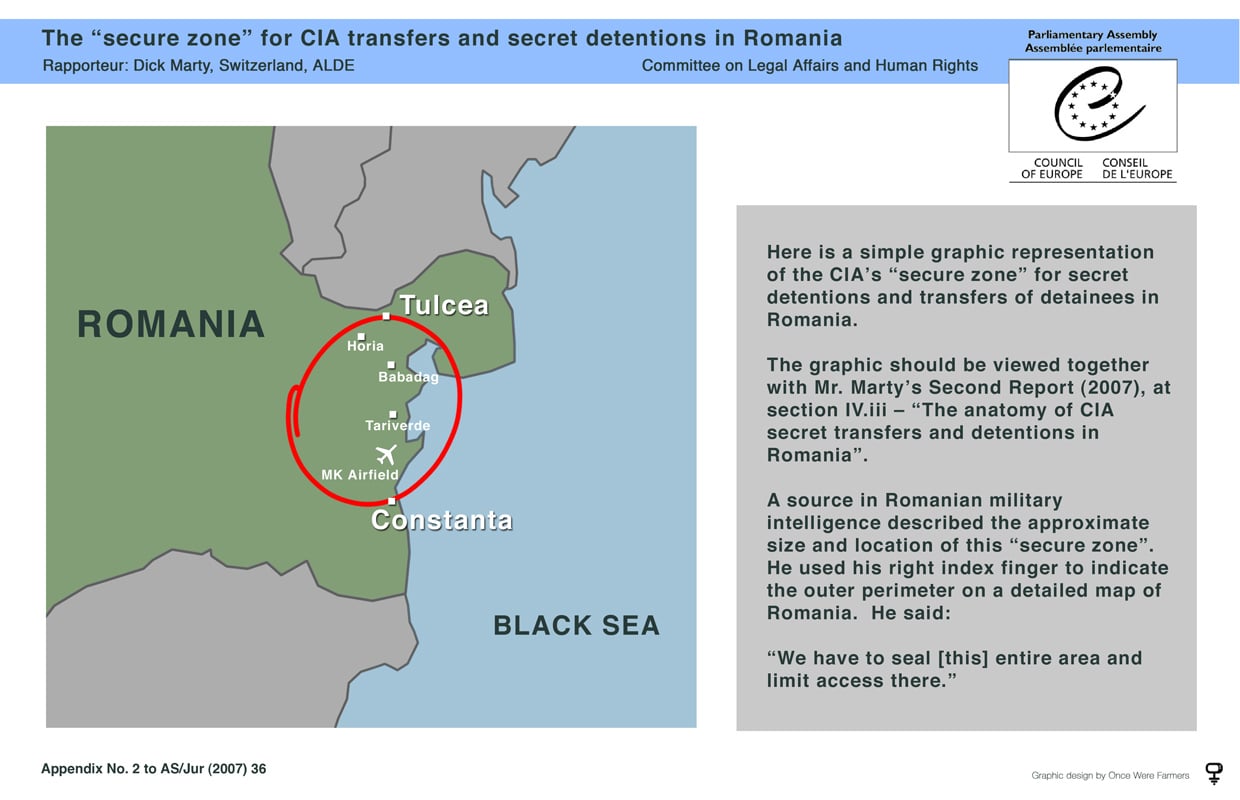
Human Rights Watch, the Council of Europe and ABC News have reported that Romania (as well as Poland) served as locations of CIA prisons. The most detailed of these investigations (pdf) by the Council of Europe’s rapporteur Dick Marty found evidence that Romania’s “black site” was located near in a secure zone around an airbase near the Black Sea — a ways from Bucharest.
The choice of a busy street for a location of a secret prison, however, strains credulity, since the changing of guard shifts, supplies and transport of detainees could attract unwanted attention.
As James Risen wrote in State of War, “The CIA wanted secret locations where it could have complete control over the interrogations and debriefings, free from the prying eyes of the international media, free from monitoring by human rights groups, and, most important, far from the jurisdiction of the American legal system.”
The story lacks some internal consistency, something interrogators look for when evaluating truthfulness: Foggo says he was given the task secret prisons because it was “too sensitive for headquarters.” Nevertheless, his work on the CIA’s so-called black sites helped him win a promotion back at headquarters, suggested that headquarters was well aware of his sensitive mission.
And finally, while the Times doesn’t rely on Foggo alone — it cites anonymous “former intelligence officials and others briefed on the matter.” One of these sources may be Brant Bassett, who is quoted later on in the piece speculating that Foggo was taken down because of his “fast rise and blunt approach.”
Regardless of whether Bassett is a confidential source or not, The Times didn’t fully explain his connection to the story. Bassett was a friend of both Wilkes and Foggo, part of their poker playing D.C. social circle. Bassett also served under Porter Goss the House Intelligence Committee and may have played a role in getting Foggo named executive director.
We owe a great deal to reporters like The Washington Post’s Dana Priest, who helped expose the CIA’s network of secret prisons with the help of agency insiders who were troubled by what was going on. It’s an important story, perhaps too important for the Times to give such credence to a man like Kyle “Dusty” Foggo.
More on hedge funds and pensions
The chief investment officer at San Diego County’s beleaguered pension fund has resigned after the fund lost more than $2.6 billion and invested millions in a hedge fund whose owners were arrested for fraud. Here’s my story on what happened at yesterday’s dramatic board meeting. The board is raising sharp questions about some of the issues I raised in my story earlier this week on the WG Trading scandal. One important question: Why isn’t the fund helping law enforcement?
 Trump / Russia