
Category: Russia
The Strange Case of Eurotech
The company that links Paul Manafort, Anthony Pellicano, the Mafia, and action star Steven Seagal

Bruce Bigelow was a San Diego journalist and friend of mine who sadly passed away after a hiking trip in Utah at the age of 63.
A few weeks before his untimely death last year, Bruce and I shared a beer at a local bar in San Diego with game three of the NBA finals playing the background.
Bruce had spotted my book in Barnes & Noble and he wanted to catch up. He also had a story he wanted to share with me about a strange little company in San Diego that tried to sell the finest in Soviet technology.
Eurotech, Ltd. was trying to bring to market a foam that that had been developed in Russia and used to control the nuclear disaster at Chernobyl’s Reactor No. 4.
It might sound like the setup for a bad joke but Eurotech had convinced some investors to part with their money. The company’s shares had soared more than 800 percent in a few months from 1996 to January 1997. “Not bad for an enterprise with no sales, four employees and a strategy focused on striking deals in the risky, raucous business world of Russia,” as Bruce put it in his story.
At first glance, Eurotech seemed respectable. The chairman of the publicly-traded company was James D. Watkins, a retired Navy admiral and former chief of Navy operations who had served as energy secretary in the first Bush administration.
Things were less clear on close inspection. One Eurotech board member, Karl Krobath, was a business advisor to Nordex GmbH. That’s a name that ran alarm bells in the CIA in the 1990s, which suspected Nordex of smuggling drugs, weapons, and even nuclear technology for the Russian Mafia. Eurotech also was introducing automated parking garage technology in Moscow’s Arbat district in partnership with the notoriously corrupt local mayor’s office.
To Bruce, Eurotech looked like a classic “pump-and-dump” stock scam, where a company cashes out on sales of illegally inflated stocks. Eurotech’s shares were sold in private placements that evaded disclosure to the U.S. Securities and Exchange. As readers of my book know, this is the same murky world that Felix Sater operated in the 1990s in his days at the Mafia-linked White Rock Partners.
Bruce did a little digging and learned that no one working at Chernobyl had ever heard of Eurotech or its foam, called Ekor, and the company’s claims that it was part of a $3.1 billion cleanup was dubious, at best.
Bruce’s story, which ran in February 1997, left a mark. The Nordex advisor left the board followed shortly by the rest of the board and the company moved to Virginia.
A few days after Bruce’s story ran, he noticed someone sitting in a car parked on the street outside his house. The car stayed around for several days. An editor told Bruce he was just being paranoid.
Around the same time, he got a call from a private investigator in Los Angeles, who told Bruce that he was taking over press operations for Eurotech. If he had any questions for the company, this investigator told Bruce, he was the man to call.
I asked Bruce if he felt threatened. “No, it was just qualitatively different,” he told me. “This was not a typical PR/marketing firm. So it felt more intimidating in that sense.”
The private eye’s name was Anthony Pellicano.
*
I wrote to Pellicano at the Terminal Island prison in San Pedro where he was serving his 15-year sentence on 78 counts of wiretapping, racketeering, conspiracy and wire fraud.
Pellicano didn’t know anything about who was parked outside Bruce’s house and barely remembered Eurotech except for a possible connection to the mayor of Moscow, Yuri Luzhkov.
But Pellicano has other interesting ties to the Eurotech story.
His case unraveled in 2002 when Los Angeles Times journalist Anita Busch walked out to her car to find a dead fish with a red rose in its mouth on the cracked windshield along with a note that read “Stop.” Busch believed that the threat was related to a story she was working on involving a dispute between actor Steven Seagal and his former producer, Julius R. Nasso. The FBI soon learned that Pellicano was behind the fish incident. Seagal was one of Pellicano’s clients.
Nasso, an associate of the Gambino organized crime family, had produced 10 films starring Seagal, including On Deadly Ground and Under Siege 2, and Out for Justice but their relationship ended in 1999. Nasso sued Seagal for $60 million.
(Interestingly, Nasso has an uncle, also named Julius Nasso, who ran a concrete company that partnered with S&A Concrete, the Mob-connected firm that built Trump Tower.)
Seagal claims that in February 2001 he was visiting Nasso in Brooklyn when he was ordered into a car and ushered into the back room of a Brooklyn steakhouse, Gage & Tollner. There, Seagal was threatened by a Gambino family captain, who told Seagal that he would be required to pay earnings from his movies to Nasso. The feds were listening in and the extortion plot got Nasso sentenced to prison for a year.
Around the same time of Seagal’s back room meeting in the steakhouse, Nasso purchased 500,000 shares of Eurotech at 33 cents a share.
How did Nasso come to learn about this company trying to market Russian foam? Probably through his friend and partner, Paul Manafort.
*
In January 2001, Eurotech agreed to pay Paul Manafort $300,000 a year to help it bring its superfoam to market. Eurotech subsequently hired Davis Manafort to raise capital on its behalf in exchange for a 4 percent finder’s fee. The guy who hired Trump’s future campaign chairman was the late Don Hahnfeldt, a one-time Florida lawmaker.
In addition, Manafort acquired 2,500,000 shares of Eurotech at 33 1/3 cents per share, through one of his companies, John Hannah LLC.
That name might ring a bell. John Hannah LLC is the same company that paid $3.675 million in 2006 for Manafort’s apartment 43G in Trump Tower.
On the same day that Manafort acquired his shares in Eurotech, Julius Nasso also acquired 500,000 shares in the company.
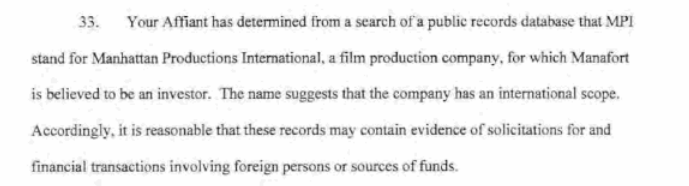
Nasso and Manafort, along with producer Paul Cohen and actor Danny Aiello, were partners together in a short-lived film production and distribution company formed in 2001 called Manhattan Pictures International. Another investor in Manhattan Pictures was Fred Trump’s right-hand man, Brad Zackson.
Manafort apparently saw film making as a natural extension of his work representing corrupt dictators around the world like Ferdinand Marcos and Mobutu Sese Seko.
“In many respects, a lot of what makes a film successful also makes lobbying successful,” Manafort told the New York Daily News. “You need to understand the demographics of the country whether it’s a candidate or a motion picture. In films, like successful campaigns, you need to know how to create messages.”
The company produced Enigma, starring Kate Winslet, and a few other films and then shut down.
During a search of Paul Manafort’s storage locker, the FBI came across some boxes relating to Manhattan Pictures and Julius Nasso.
Manafort is now in prison. Nasso, out of prison, is back producing movies. And his old friend Steven Seagal has gotten very, very close to the president of Russia. He’s now Vladimir Putin’s special envoy to the United States.
Who is Aron Shaviv?
Updates with additional background.
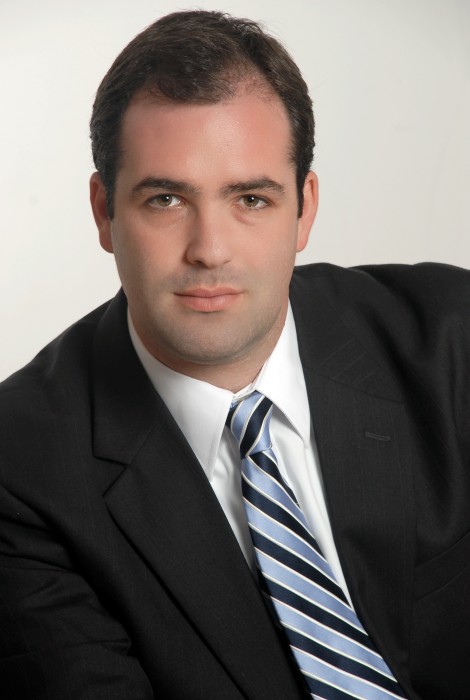
The name of Aron Shaviv, a British-born Israeli campaign consultant with an impressive resume, has surfaced lately in investigations of underhanded election plots by Russia.
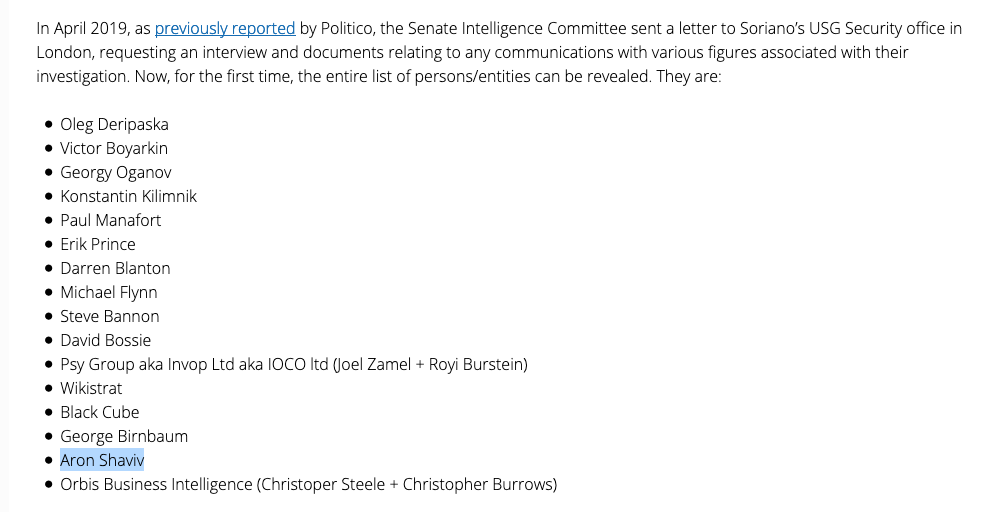
The Senate Intelligence Committee recently took an interest in Mr. Shaviv as part of its investigation into the Trump campaign’s ties to the Russian government.
According to a scoop by independent journalist Scott Stedman, Shaviv’s name was mentioned in a subpoena issued in April 2019 by the Senate Intelligence Committee to Walter Soriano, a British security consultant whose connections to Israeli intelligence and Russian oligarchs was the subject of one of my previous posts.
On his website, Shaviv claims to have helped elect 14 heads of state, including Israeli Prime Minister Benjamin Netanyahu.
It’s unknown whether Shaviv did any work for the Trump campaign or why the Senate Intelligence Committee is interested in him. But that isn’t the end of his problems.
One country that’s absent from Shaviv’s impressive roster of clients is the tiny Balkan state of Montenegro. Shaviv was the chief consultant for the pro-Russian party Democratic Front in the 2016 Montenegrin parliamentary elections.
My friend Alon Eisenberg pointed me to a report this week in The Times of Israel that suggested Shaviv had another, less overt mission there. According to prosecutors in Montenegro, Shaviv took part in a plot led by two Russian military intelligence officers to overthrow Montenegro’s government and stop it from joining NATO. Police broke up the plot on the eve of the country’s parliamentary elections.
Shaviv’s partner in this was an ex-CIA officer named Joseph Assad, who was working as Shaviv’s security consultant. Prosecutors suspected that Assad’s real job in Montenegro was to help coup plotters flee the country after assassinating the country’s prime minister, The New York Times reported.
“During the investigation that was launched against Joseph Assad and eight others for creating a criminal organization and attempting terrorism, the prosecutors found evidence that Shaviv, a UK and Israeli citizen, also committed a crime. So we have ordered an extension of the investigation,” Cadjenovic told Balkan Insight.
In the run up to the Montenegrin parliamentary elections, one of Shaviv’s companies received 1.5 million Euros from a Czech company — codenamed “S.” The Czech company’s CEO and representatives are Russian, Cadjenovic said. Assad was paid out of this fund.
Four men identified as ex-FBI agents are also said to be under investigation for their role in the attempted coup backed by Russia.
Shaviv was born in Oxford, England in 1979 and made aliyah to Israel as a teenager. He became a captain in the Israeli Defense Forces and served as a “field agent for a civilian intelligence agency,” according to an archived version of his company’s website.
Shaviv got his start in politics in 2006 working for Avigdor Lieberman, an influential Israeli politician who has long been investigated — but never charged — for receiving millions of dollars from Russian oligarchs like the notorious Michael Cherney and others connected to Vladimir Putin.
While working in government for Lieberman, then the minister of strategic affairs, Shaviv set up a private consulting firm, Shaviv Strategy & Campaigns, began consulting for politicians throughout Europe and Africa. Shaviv’s clients include past and current presidents and prime ministers of Israel, Thailand, Cambodia, Poland, Romania, Kenya, Congo, Bulgaria, Cyprus, Serbia and the European Commission, according to the company’s website, which also cites its work for U.S. presidential elections.
In 2012, Shaviv played a role in the U.S. presidential election. He ran iVoteIsrael, which sought to get U.S. citizens living in Israel to vote in the American election with messages like this:
Shaviv said iVoteIsrael received its financial backing from the “[Sheldon] Adelsons of the world.” Reporters found that iVoteIsrael’s corporate filings listed the Manhattan address of the Ronald S. Lauder Foundation. iVoteIsrael claimed 80,000 Americans living in Israel voted in 2012, with the majority overwhelmingly casting ballots for Republican Mitt Romney.
In 2015, Shaviv was campaign manager and chief strategist for Netanyahu’s re-election. As the vote approached, polls showed Netanyahu on the verge of losing. But then on Election Day, in a move straight out of the Cambridge Analytica playbook, Netanyahu bombarded right-wing voters with millions of fearmongering text messages warning them — falsely — that Arabs were going to the polls in “droves.” Netanyahu won.
See this excellent report, featuring Shaviv, on how Netanyahu won:
The iVoteIsrael campaign won Shaviv a political consulting award from Campaigns & Elections and the Netanyahu campaign victory earned him international consultant of the year honors from American Association of Political Consultants.
But Montenegro and his alleged role in an attempted coup has cast a dark shadow over his bright career. He tweeted that he has been “PNGed” — presumably a reference to being made persona non grata — after the alleged coup attempt.
In May 2017, Shaviv said there are two theories about what happened in Montenegro.
“The first theory would be to believe that it is a failed Russian operation involving an Israeli political consultant, a retired Serbian general, a former CIA agent and some villagers with hunting rifles,” a Democratic Front press statement quoted Shaviv as saying.
But, “if there is anything to be learned from the recent past, Russian military operations neither look like that nor fail like that.”
Time to Put a Lie about Felix Sater to Rest (Updated)
Of all the characters in the Trump/Russia saga, few are more fascinating than Felix Sater.

Sater is many things: a Russian emigre, the son of a gangster, an ex-con, and the guy who scouted real estate deals in Moscow for Donald Trump.
He was also a very valuable informant to the U.S. government for many years, as you can see from some photos I recently came across regarding Evgeny Shmykov, an ex-spy who was Sater’s long-time contact in Russia:
The guy that Shmykov stands shoulder-to-shoulder with? That’s Ahmad Shah Massoud, the anti-Taliban leader assassinated right before the 9/11 attacks.
These photos got some attention on Twitter, but as always, whenever Sater’s name comes up, people inevitably connect him to a powerful Russian Mafia boss named Semion Mogilevich, known as “the most dangerous mobster in the world.”
It’s time to put this to rest.
There is no, I repeat, no credible evidence linking Sater to a Russian Mob boss who was on the FBI’s 10 Most Wanted List.
In writing my book, Trump/Russia, I spent quite a bit of time looking for evidence of the Sater-Mogilevich connection. In the end, I concluded that it just wasn’t there. To paraphrase Robert Mueller, if I had found evidence that Sater was connected to Mogilevich, I would so state.
There’s no doubt Sater did have ties to Russian organized crime. Sater’s father, Michael Sheferfofsky, was a Russian gangster who pleaded guilty in 2000 to two counts of extortion for shaking down businesses in Brooklyn.
Update: In her 2020 book, Putin’s People, Catherine Belton wrote that she spoke to two former Mogilevich associates in 2018 who told her that Sater’s father “become an ‘enforcer’ for some of Mogilevich’s interests” in Brighton Beach, Brooklyn. Another British journalist, Paul Wood, told me in 2019 that he spoke with someone from Mogilevich’s organization who told him that there is a link between Sater himself and Mogilevich.
Even so, proof is still lacking. There’s no mention of Mogilevich in Sherorfksy’s criminal file.
So where does this claim come from?
The Sater-Mogilevich link is found in a Supreme Court petition for a writ of certiorari in Palmer v John Doe. 14-676.
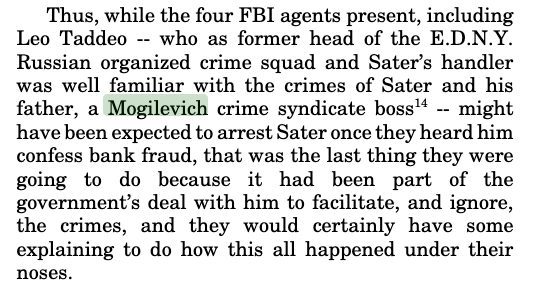
This sounds like credible evidence. It’s convinced many people, including me, as my 2017 blog post shows.
The thing is it’s bullshit. Yes, I know. Mea culpa, mea culpa, mea maxima culpa.
While reporting my book, Trump/Russia, I tried to get to the bottom of this. I asked Richard Lerner, the attorney who wrote the Supreme Court petition, how he learned about the Sater-Mogilevich connection.
He somewhat sheepishly admitted that it comes from a website called Deep Capture.
This is where things get weird.
Deep Capture was written by Mark Mitchell, a former editor at Columbia Journalism Review, to “expose the ‘deep capture’ of American institutions by powerful and corrupt financial interests.”
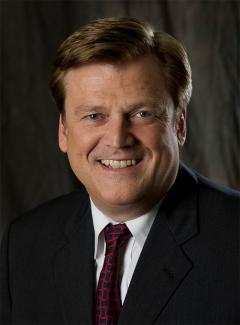
Bankrolling Deep Capture was Patrick Byrne, the CEO of Overstock.com, a publicly-traded online retailer.
Byrne is famous for, among other things, a 2005 conference call with investors that touched on subjects ranging from:
“Miscreants, an unnamed Sith Lord he hopes the feds will bury under a prison, gay bath houses, whether he is gay, does cocaine, both or neither, and an obligatory, not that there is anything wrong with that, phone taps, phone lines misdirected to Mexico, arrested reporters, payoffs, conspiracies, crooks, egomaniacs, fools, paranoia, which newspapers are shills and for who, payoffs, money laundering, his Irish temper, false identities, threats, intimidation, and private investigators,” wrote Mark Cuban, the basketball team owner, investor, and host of Shark Tank.
That’s just a sampling. You can read the full thing here.
Byrne has also accused reporter Bethany McLean of giving Goldman Sachs traders blowjobs and said on live TV that he knew for a fact of a fax machine in the offices of CNBC where every morning hedge funds send in “instructions” for journalists. Authorities at Salt Lake City’s airport arrested him in 2013 when they found a loaded handgun in his carry-on luggage.
Sater is one of Byrne’s “miscreants” who appears as a recurring character in Deep Capture, where he is described to this day as a “Mafia boss” and “a Russian mobster and a member of the Mogilevich organization (controlled by Semion Mogilevich).”
To give you a taste of Deep Capture, check out this now-deleted post that describes … well, just read it for yourself:
A month or so after that, an offshore businessman who had provided some information to our investigation received in the mail a beautiful, lacquered, Russian matryoshka doll. And inside this doll, there was a slip of paper.
On the paper was the letter “F” — with a cross on it. The businessman knew right away that the letter “F” stood for “Felix” – Felix Sater.
The businessman said he had called Felix Sater to see what the deal was with the doll. And after talking to Felix, the businessman invited Patrick Byrne to a greasy spoon diner in Long Island. It was urgent, aid the businessman — so Patrick made haste.
And when Patrick arrived at the diner (along with two other people, who can testify to this) the offshore businessman, discarding with formalities, said, “This meeting can be very short. I have a message for you from Russia.”
The message, said the businessman, was this: “‘We are about to kill you. We are about to kill you.’ Patrick, they are going to kill you – if you do not stop this crusade [the investigation into destructive market manipulation], they will kill you. Normally they’d have already hurt you as a warning, but you’re so weird, they don’t know how you’d react. So their first step is, they’re just going to kill you.”
According to the businessman, this threat had come straight from the mouth of Felix Sater.
Maybe this did happen. Then again, maybe the moon landing was faked. Maybe the Illuminati controls the world. Maybe 9/11 was an inside job.
I’m pretty sure it didn’t happen.
Editor’s note: I am striking my snarky comments because I was wrong. Patrick Byrne has shown me evidence that this conversation did take place. In a recorded 2007 phone call, a transcript of which is in my possession, Byrne’s associate was told: “And there’s a beautiful box and inside is a matryoshka and I opened up the last matryoshka and inside is an F with a cross on it, which is for Felix.” I was also played the recording of this call. A clear threat was relayed to Mr. Byrne, who did not make this story up. I owe him an apology.
Patrick Byrne emailed me August 4 to say:
“For the record, your email reminded me that Felix wrote me once (while I was very ill) and denied being the source of the Russian death threat against me. He was quite gentlemanly, and I think I said I would post it. However, I think I was in a cardiac unit at the time, come to think of it, and it never got done.”
Byrne didn’t answer my questions about what evidence he has for the Sater-Mogilevich connection, which can still be found on his website.
In 2016, a Canadian judge ordered Byrne and Mitchell to pay $1.2 million (Canadian) over published claims that Altaf Nazerali, a Vancouver businessman, was a gangster, an arms dealer, a drug trafficker, a financier of al-Qaida and member of the Russian and Italian Mafias.
Nazerali is mentioned in the deleted post quoted above about Sater and the matryoshka doll. Nazerali is described as a friend of Sater’s, although I’d wager that they never met.
The judge wrote that Mitchell and Byrne “engaged in a calculated and ruthless campaign to inflict as much damage on Mr. Nazerali’s reputation as they could achieve. It is clear on the evidence that their intention was to conduct a vendetta in which the truth about Mr. Nazerali himself was of no consequence.” Read the decision here.
A month before the ruling was issued, Byrne announced he was taking an indefinite personal leave of absence from Overstock.com to battle stage 4 Hepatitis C. He returned to his duties a few months later.
The Supreme Court of Canada dismissed Mitchell and Byrne’s appeal in August 2018 and affirmed a seven-figure award.
Maybe you think Sater a bad guy. Maybe you think he made amends for his criminal past. Either way, a man whose life is far more fascinating than most of ours will ever be doesn’t need to be embellished with fiction.
We’re Responding to Russia. Don’t Tell the President
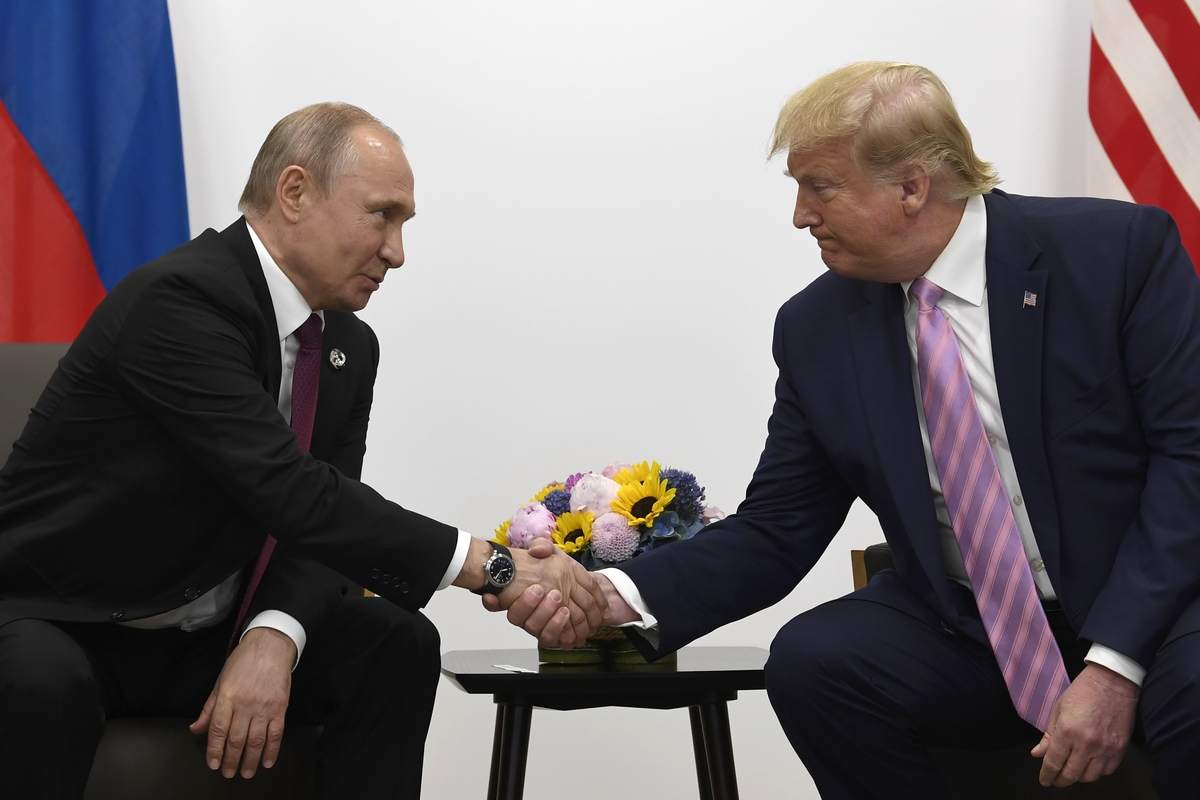
During the just-concluded G20 summit in Osaka, Japan, President Trump cynically told Russian President Vladimir Putin not to meddle in our elections.
The president might think that the ongoing Russian efforts to interfere in American democracy is all just a big joke. But his administration doesn’t.
It was only a few days earlier that Trump accused The New York Times of a “virtual act of treason” for a June 15 story that revealed that U.S. Cyber Command had placed “implants” — software code that can be used for surveillance or attack — deep inside the Russian electrical grid. Still mad about the story two days later, he tweeted that it was “fake news” and called on the newspaper to release its “phony” sources.
Even Putin was puzzled by the president’s reaction. “I am not sure how we should interpret that — if it means that they disclosed real information or it was a planted story,” he said during his annual “Direct Line” with Russian citizens. “But in any case, we have to respond one way or another; we must understand what this is about.”
Putin was asking the right question. What about the report had prompted the president’s unhinged response? Why was the president so upset about a report that the U.S. government was, after years of inaction, finally fighting back against Russian cyberattacks?
The little-noticed answer lies buried in defense legislation and executive orders signed by Trump himself. Although written in dense bureaucratese, what it says is pretty remarkable: Rather than work with the president when it comes to Russia, Trump’s administration has simply decided to work around him.
Like a parent with a obstinate child, the Trump administration, with an assist from Congress, cut the president out of the decision-making loop on national security decisions involving Russia. The Times, then, was a convenient scapegoat for the president’s impotent fury at his own people.
It’s no secret that Trump has long refused to acknowledge even basic truths about the Russian threat, but the consequences to U.S. national security aren’t so well known.
This definitive report in The Washington Post — based on interviews with more than 50 (!) current and former U.S. officials — described how the intelligence community was structuring the president’s daily brief (PDB) to avoid upsetting Trump.
“If you talk about Russia, meddling, interference — that takes the PDB off the rails,” said a second former senior U.S. intelligence official….
Trump has never convened a Cabinet-level meeting on Russian interference or what to do about it, administration officials said. Although the issue has been discussed at lower levels at the National Security Council, one former high-ranking Trump administration official said there is an unspoken understanding within the NSC that to raise the matter is to acknowledge its validity, which the president would see as an affront.
“Doubting the intelligence, Trump pursues Putin and leaves a Russian threat unchecked,” Greg Miller, Greg Jaffe, Philip Rucker, Dec. 14, 2017.
For far too long, the response to ongoing Russian cyberattacks was a big fat ZERO. That only encouraged Russia and other countries to wreak havoc in cyberspace.
“The warning lights are blinking red again,” Dan Coats, Trump’s own director of national intelligence warned in July 2018. “Today, the digital infrastructure that serves this country is literally under attack.”
Then things started to change.
On August 13, 2018, Trump signed a defense bill that basically gave the U.S. military’s Cyber Command a green light to respond to Russia.
The aptly named John S. McCain National Defense Authorization Act authorized Cyber Command to take “appropriate and proportional” action aimed at disrupting, defeating, and deterring Russian cyberattacks, including those aimed at our democracy. The bill also allowed the defense secretary to authorize clandestine military activity in cyberspace without prior presidential approval.
The conference report on the bill was revealing:
The conferees have been disappointed with the past responses of the executive branch to adversary cyberattacks and urge the President to respond to the continuous aggression that we see, for example, in Russia’s information operations against the United States and European allies in an attempt to undermine democracy. The administration’s passivity in combatting this campaign, as documented repeatedly in hearings before the congressional defense committees in the past 2 years, in the judgment of numerous executive branch officials, will encourage rather than dissuade additional aggression. The Congress has worked diligently to ensure that the Department possesses the necessary capabilities and authorities to combat, in particular, these Russian information operations, and this authorization represents further progress toward that objective. The conferees strongly encourage the President to defend the American people and institutions of government from foreign intervention.
Read that again and take a moment to reflect on that remarkable passage.
Two days after signing the McCain defense bill, the president signed National Security Presidential Memorandum No. 13. This still-secret memorandum freed the military to conduct offensive cyber operations “without a lengthy approval process,” so long as they don’t cause “death, destruction or significant economic impact,” The Washington Post reported last year.
Apparently without realizing what he was doing, Trump had just given the go-ahead for the types of operations described in the Times article that left him so unhinged.
.jpg/1200px-General_Paul_M._Nakasone_(NSA).jpg)
Spearheading America’s aggressive response in cyberspace to Russia is General Paul Nakasone, the dual-hatted leader of the National Security Agency and U.S. Cyber Command.
Nakasone has pushed a strategy of “persistent engagement” with our Russian foes in cyberspace. In other words, we don’t sit back and wait for our enemies to attack; we take the fight to them.
Under Nakasone, U.S. Cyber Command has shifted from a response force to a proactive one that meets our adversaries in the foreign networks where they lurk. “If we find ourselves defending inside our own networks, we have lost the initiative and the advantage,” Nakasone told a professional military journal.
Securing the 2018 midterm elections was Cyber Command’s No. 1 priority, Nakasone told Congress, and it prompted him to create the “Russia Small Group.”
On Election Day last year, the Russia Small Group shut down the computer networks at the Internet Research Agency, the so-called St. Petersburg “troll factory” behind much of the social media manipulation during the 2016 election. The Russia Small Group also helped state election officials identify vulnerabilities and improve threat warning and it dispatched forces to beef up cyber defenses in Montenegro, North Macedonia and Ukraine.
Much of its work remains secret, but U.S. senators hinted earlier this year that it was no coincidence that the 2018 midterms were not impacted by Russia. Further proof of the group’s success is the fact that it’s now a permanent fixture at the NSA/Cyber Command, housed in a new, $500 million cyberwarfare bunker at Fort Meade, Maryland.
Few Americans realize that the United States is flexing its muscles in the cyber realm, but Russia is keenly aware of what’s going on. “Vitally important spheres of our economy have been targeted with cyberattacks from abroad,” Dmitry Peskov, the Kremlin spokesman, said in the wake of the Times report. An anonymous law enforcement source told RIA Novosti, a Kremlin-owned news outlet, that the Times story about U.S. incursions in the electrical grid is true, although the Russians say they’ve managed to stop the attacks so far. Last fall, Russian trolls and hackers received direct messages identifying them by their real names and warning them not to interfere in the affairs of other nations.
The only one who seems unsure of what’s happening is the president, who may have realized too late what he signed away when he gave his administration the authority to go on the offensive against Russia.
The implications of the decision to take decision-making authority out of the president’s hands are sobering. It was not a decision that was taken lightly.
It reflects a judgement on the part of Congress and the administration that when it comes to Russia, the 45th president poses a threat to the national security of the United States.
Walter Soriano: The Security Consultant for Russian Oligarchs, the CIA … and Diego Maradona?

Updated with additional details on USG, specifics of Soriano’s work for Deripaska and Abramovich, and links to the CIA.
Natasha Bertrand at Politico was out with a big story earlier this week about Walter Soriano, a mysterious Orthodox Jew who runs a security firm in London.
Bertrand reported that the Senate Intelligence Committee issued a subpoena to Soriano seeking his communications with Paul Manafort and Michael Flynn.
The subpoena, sent April 5, also seeks records of Soriano’s contacts with three Israeli private intelligence firms as well as any communications he may have had with Orbis Business Intelligence, a firm co-founded by the former British spy Christopher Steele.
The 51-year-old Soriano is unknown in the United States, but he’s a figure of intense speculation in Israel where his name surfaced more than a year ago in connection with a bribery investigation of Israeli Prime Minister Benjamin Netanyahu.
Israeli Kan TV news reported that Soriano was hired to dig up dirt on the investigators investigating Netanyahu. This work was given to subcontractors, some of whom worked for Israeli military intelligence:
This prompted Netanyahu to write a Facebook post insisting that he had not spoken to Soriano in eight years.
What intrigued me about Soriano was that Bertrand’s story linked him to Oleg Deripaska, whose connections to Paul Manafort were at the heart of Robert Mueller’s investigation into Russian interference in the 2016 election.
What hasn’t been reported in the United States is that Deripaska was a client of Soriano’s consultancy, USG Security Limited, according to a court filing by Israeli investigative journalist Raviv Drucker. (Soriano is suing Drucker in Israel for libel.) Drucker wrote that Soriano worked for Deripaska during his long-running legal feud in London with Michael Cherney, who has long faced allegations—which he has denied—that he and his brother, Lev, are connected to Russian organized crime.
Another oligarch, Roman Abramovich, also was a USG client, according to Drucker. USG helped Abramovich in his legal dispute in London with Boris Berezovsky, Drucker’s court filing states.
Drucker claims that USG’s subcontractors carried out “sophisticated surveillance, information gathering and data acquisition by various technological means, such as eavesdropping, hacking, and so on.”
On its website, USG says that its consultants are “all former members of the world’s elite intelligence units, military forces and security organizations, with vast knowledge and practical experience.”
This sounds very much like the work of the three private Israeli security firms who are mentioned in the subpoena: Psy Group, Wikistrat, and Black Cube. Founded by former Israeli military intelligence officers, Black Cube has used operatives with false identities to investigate journalists, victims of Harvey Weinstein, and former Obama staffer Ben Rhodes. Published reports claim Trump aides hired Black Cube for a “dirty ops” campaign to discredit Rhodes and other supporters of the Iran nuclear deal. (Black Cube denied working for Trump.)
Another Soriano client is Dmitry Rybolovlev, another Russian billionaire who purchased a Florida mansion from Trump in 2008 for $95 million. Trump had purchased the mansion for $41 million four years earlier.
Rybolovlev hired Soriano to spy on art dealer Yves Bouvier, according to Drucker and an investigation by Le Point, a French newsweekly. Le Point also obtained correspondence from Soriano to Rybolovlev suggesting he was also hired to deal with problems at the football club the oligarch owns, AS Monaco. (See “L’étrange M. Soriano,” Le Point, February 7 2019.)
The football connection is an interesting thread in this strange world because someone named Walter Soriano emerged in 2010 — the same year that USG Security Limited went into business — as the UK representative of former Argentinian superstar Diego Maradona.

“I think Diego would be very open to the idea of coming to England and managing Aston Villa,” a reporter for the Sunday Mercury quoted “Walter Soriano” as saying.
The real Walter Soriano was at one time a partner in a now defunct UK firm called Football Universe Limited. And like Maradona, Soriano is a native Argentinian, the tireless blogger Richard Silverstein reported. (An Israeli judge threw out Soriano’s lawsuit against Silverstein.)
An earlier version of USG’s website names Soriano as director of operations and Simon Bird simply as “UK operations.” The equally mysterious Mr. Bird, who is 76 and not to be confused with an English actor of the same name, gave an address of Ware House in Lyme Regis, a manor immortalized in the film The French Lieutenant’s Woman. Bird is described as a historian and a longtime partner of Winston Churchill’s granddaugher-in-law.
Both Bird and Soriano were directors of a now-defunct UK firm, Universe Security Group, whose board included Nahum Admoni, a former head of Mossad; Uri Sagi, former head of IDF intelligence; and Albert Raes, formerly Belgium’s top spy. (Issac Molho, a trusted advisor to Netanyahu caught up in the prime minister’s scandals, received about $200,000 in “finder’s fees” from the company.)
Update: A reader who asked not to be named pointed out that Molho did not just receive finder’s fees. He owned 10 percent of the company, according to a letter of intent he signed in 2003. Soriano was the majority shareholder.
In 2003, the Panama Maritime Authority, which manages the world’s largest ship register, selected Universe Security Group as one of three “recognized security organizations” to approve ship security plans. Soriano told Lloyd’s List that company operatives come mainly from the UK, Belgium, Israel, Central and South America, North Africa and the US.
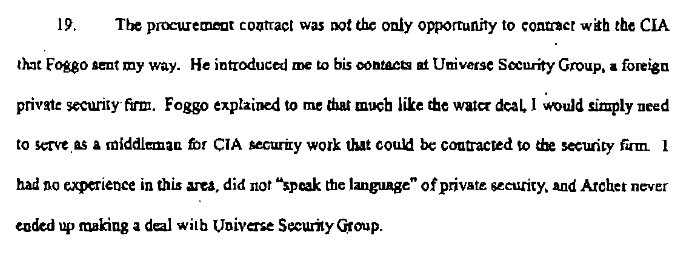
A sharp-eyed Twitter user, @brazencapital, pointed out something I had read many years ago and since forgotten. One of Universe Security Group’s contacts was Kyle “Dusty” Foggo, formerly the No. 3 at the CIA who went to prison in the scandal surrounding Congressman Randy “Duke” Cunningham. (Foggo was one of the subjects in my first book, Feasting on the Spoils.)
Buried in Foggo’s sentencing memorandum from 2008 is a statement from a CIA contractor named Joel Combs:
Universe Security’s reputation suffered a fatal blow in 2009 when one of its customers was robbed, according to an administrator’s report. (The client was not identified in the report but Israeli media reports named Graff diamonds in London.) Admoni, Sagi and Raes all resigned from the company en masse. The company went into liquidation; its assets were acquired by Soriano and Bird’s newly-formed USG Security.
There’s more. Soriano’s USG Security also surfaced in a dispute between wealthy London property developers the Candy brothers and British businessman Mark Holyoake.
“I have reliable information that USG Security has been hired by [Ed Candy] for (sic) investigate and monitor my family, my colleagues and myself,” Holyoake told a London court. He described USG as a “military-based ‘security consultancy and security services provider.'” (See Holyoake v Candy, Queen’s Bench Division)
Holyoake declined to reveal who passed him this information saying it related to security arrangements for his family and “could have consequences for the safety of my source if revealed.” Candy’s representative denied hiring USG.
During trial, Holyoake’s wife testified that among the men in the Candys’ “extended circle who have died mysteriously” is Boris Berezovsky, the exiled Russian oligarch in London who became a fierce critic of Vladimir Putin.
Berezovsky lost his high stakes London court battle with Roman Abramovich in 2012 over control over a major Russian oil company. Seven months later, Berezovsky was found dead in his shower with a scarf around his neck. A coroner could not reach a verdict on the death.
The mysterious Mr. Soriano is much than he seems. Connected to the prime minister, deeply tied to the Israeli security establishment, he adds to the intrigue surrounding Trump and Russia.
 Trump / Russia