
Category: Donald Trump
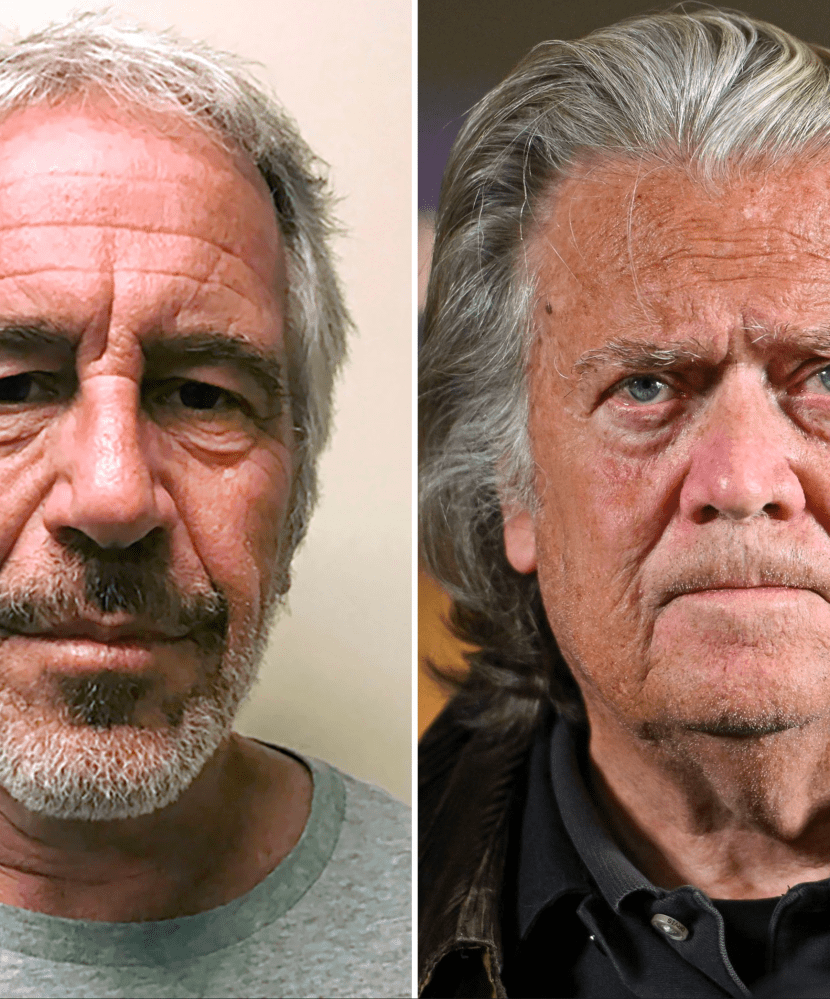
Senate’s Russia Inquiry Examined Trump’s Ties to Epstein
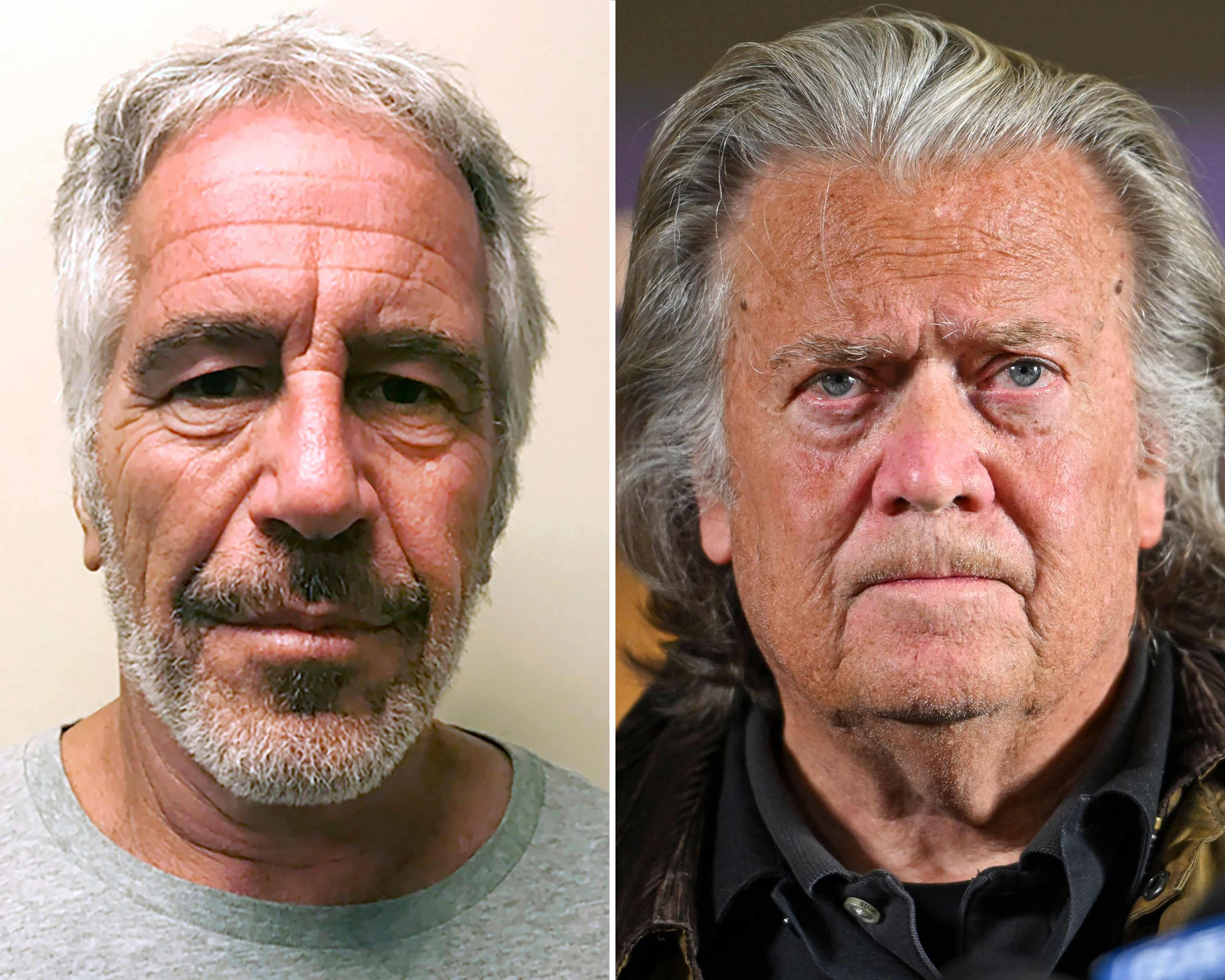
The House Oversight Committee released the following text exchange as part of its investigation into Jeffrey Epstein. It captures a conversation between Steve Bannon and Epstein after Bannon’s appearance before the Senate Intelligence Committee during its probe into Russian interference in the 2016 election. The messages span two days, November 19 and November 21.
For background, read my post on Jeffrey Epstein, Leon Black, and Russia.
November 19, 2018
EPSTEIN:
How was it
BANNON:
Dude: 8 and 1/2 hours
BANNON:
15 minutes on u
EPSTEIN:
Members or staff
EPSTEIN:
Was burke allowed in? Does he have clearance
Note: Epstein is referring to Bannon’s attorney William Burck.
BANNON:
Staff ::: took alex spiro— his NYC partner, stone cold killer
EPSTEIN:
Why me? Did they want bagels and coffee
EPSTEIN:
Or did they get your text s
BANNON:
Neither ::: went thru list of 50 names– Leon Black
BANNON:
Then u–grilled me when I said I knew u about relationship with djt
EPSTEIN:
Did they ask you if i had a silver bullet
EPSTEIN:
Toughest we’re republicans?
EPSTEIN:
Were
BANNON:
No democrats– spiro also big dem
EPSTEIN:
Oy
EPSTEIN:
So it begins
BANNON:
Somehow your name has come up in this thing; Leon’s about “Russia”
EPSTEIN:
Message: This thing being Russia or djt or .. play
EPSTEIN:
Is the somehow, my friendship with lucifer
EPSTEIN:
🙂
BANNON:
Leon about Russia; u about trump but they ask every witness these 50 names— 25+ Russian
November 21, 2018
EPSTEIN:
Do you recall any specific questions re me, and your interview?
EPSTEIN:
at
BANNON:
Yes ::: “what is his relationship with potus”; “does he talk about trump”;
“when was last time he saw trump”… etc etc etc
EPSTEIN:
Some reporters asking the same question ? Can figure out why?
EPSTEIN:
Can’t
BANNON:
Interview ends with 50 names — everybody gets the request — 25 Russian names; 25 American — u and Leon are #3 / #4 on american list
EPSTEIN:
Understood
EPSTEIN:
funny
BANNON:
“has Leon Black ever mentioned Russia”; “Do you know of any connections
Leon Black has with Russia” etc etc
EPSTEIN:
Other Americans? David geovanis? Ken lebow? Any other names you recall
EPSTEIN:
Nick ribs? Tom barrack?
BANNON:
Benton Lebow
BANNON:
Barrack
BANNON:
Geovanias
BANNON:
Ton other I didn’t know– and only Russian was Alexander Dugin
EPSTEIN:
Ha
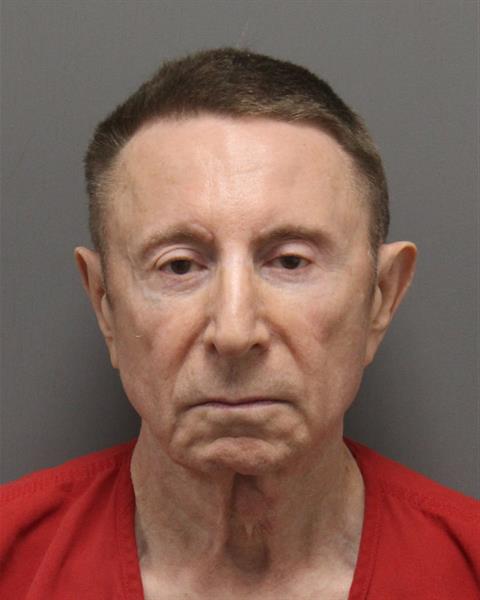
From Trump Tower to Arson
The long, strange fall of Jacob Bogatin, a onetime partner of the “Brainy Don” Semion Mogilevich, now accused of murder in Virginia.
Once upon a time, Semion Mogilevich was one of the biggest gangsters in the world. The “Brainy Don” had his fingers in virtually every criminal activity imaginable, including murder, extortion, sex trafficking, weapons trafficking, money laundering, and even a stock fraud occurring right under the FBI’s nose.
In 2003, federal prosecutors unsealed an indictment charging Mogilevich in a $150 million stock fraud scheme involving YBM Magnex, a purported manufacturer of bicycles and magnets based outside Philadelphia. Also indicted was the company’s CEO, Jacob Bogatin.
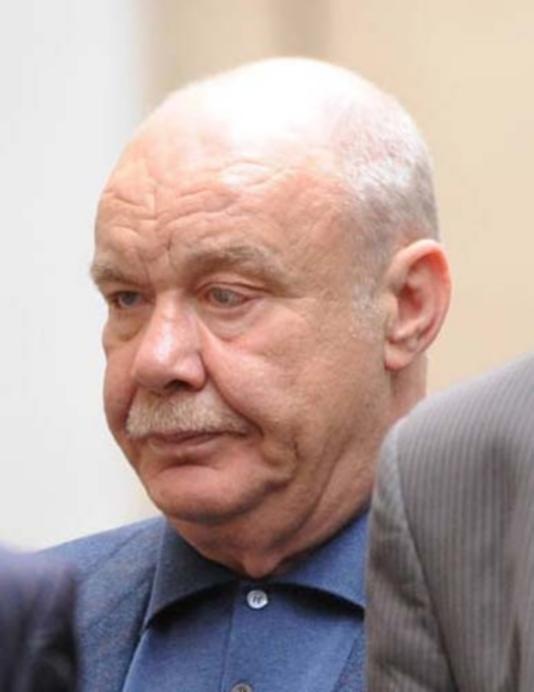
The case drew attention from those of us investigating Donald Trump’s Russia ties because Jacob’s brother, David Bogatin, had bought five apartments in the newly opened Trump Tower in 1984 for $5.8 million. The money came from a gasoline-tax scam he was running in Brooklyn with the Colombo crime family. According to one of Bogatin’s partners in that scheme, Trump himself persuaded Bogatin to purchase the apartments “as an investment.”
Trump didn’t merely broker the sale. As investigative reporter Wayne Barrett reported in Trump: The Deals and the Downfall, Trump personally attended the closing—an unusual move for a developer, and one that suggested this was no ordinary real-estate transaction.
The Bogatin deal carried classic money-laundering red flags. Of the five condos, only one was in David Bogatin’s name; the other four were held by shell companies created the same day by attorney Marvin E. Kramer, who specialized in forming shelf corporations from his Coney Island office. “We didn’t think he was living in five apartments,” former New York assistant attorney general Ronda Lustman told me. Prosecutors quickly concluded that the purchases were intended to launder cash and conceal assets.
Bogatin wasn’t alone. From its earliest days, Trump Tower attracted Russian organized crime figures. Roughly a third of its units were owned by foreign corporations, many of which were registered in Panama or the Netherlands Antilles. It was one of only two buildings in New York that allowed anonymous buyers. “Trump Tower allowed people who wanted to hide their money to buy there because their names were never really published,” said Jim E. Moody, former deputy assistant director of the FBI.
Among its early residents was Vyacheslav Ivankov, one of Russia’s most feared vory v zakone—“thieves-in-law.” The FBI tracked him to a Trump Tower apartment while he directed Russian Mafia operations in the United States. Years later, another mobster, Vadim Trincher, ran a multimillion-dollar gambling ring from a Trump Tower apartment just floors below Trump’s own penthouse.
Another figure often mentioned in connection with Mogilevich is Felix Sater, a Russian-born stockbroker-turned-government-informant and real estate developer who became one of Donald Trump’s more controversial business partners, scouting property deals in Moscow. While some have speculated about ties between Sater and Mogilevich’s network, any link appears to run through Sater’s father, Michael Sheferofsky. In Putin’s People, journalist Catherine Belton reported that two former Mogilevich associates said Sheferofsky had “become an ‘enforcer’ for some of Mogilevich’s interests” in Brighton Beach, where he ran protection rackets with the Genovese crime family.
Whether Trump knew about the Bogatins’ mob ties in 1984 remains unclear. The FBI never questioned him about David Bogatin. “In retrospect, we should have been looking in that direction,” said Ronald Noel, a former FBI agent on the case. What’s certain is that Trump was eager to make the sale, so eager he showed up in person at the closing.
David Bogatin fled the country, settling first in Austria and later in Poland, where he launched one of the country’s first private banking chains. When a Warsaw newspaper exposed his past in 1992, he was arrested and extradited to New York, where he served eight years in Attica.
His brother was more fortunate. The YBM case never reached trial. Mogilevich remains a fugitive despite years on the FBI’s Ten Most Wanted list and a $5 million reward for his capture. Jacob Bogatin remained free on bail ever since.
Until this week.
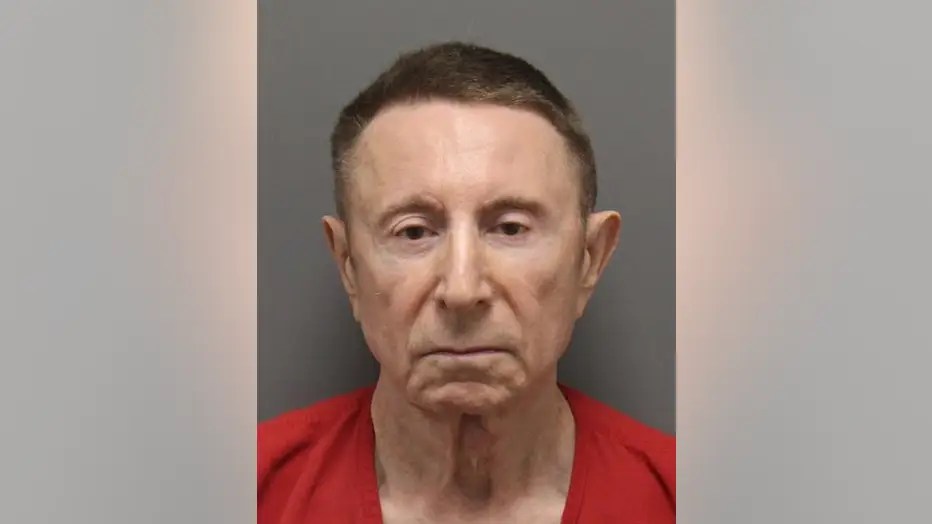
On October 28, Jacob Bogatin, now 78, was arrested and charged with murder and arson for a blaze that killed a 36-year-old woman and destroyed three townhomes in Sterling, Virginia.
According to the Loudoun Times-Mirror, Bogatin lived in the complex with his girlfriend, Valeria Gunkova, the listed owner, in a unit under foreclosure. One day after the October 24 fire, Bogatin filed an insurance claim for more than twice what was owed on the property.
Investigators say surveillance footage showed a man resembling Bogatin walking away from the scene moments after the fire began. A search of his car turned up a bottle of lighter fluid and a grill lighter.
Bogatin had been free on a $1 million bond since 2003 in the YBM Magnex case. His home-monitoring restrictions were lifted a year later, and he was permitted to travel abroad on the condition that he not commit any crime.
After the Loudoun County fire, pretrial-services officer Keri Foster asked the court to revoke Bogatin’s bail. In her report, Foster noted that Bogatin had dutifully called in to report his home had burned down—without mentioning that he might have been the one who struck the match.
Another Russian gangster who did business with Trump
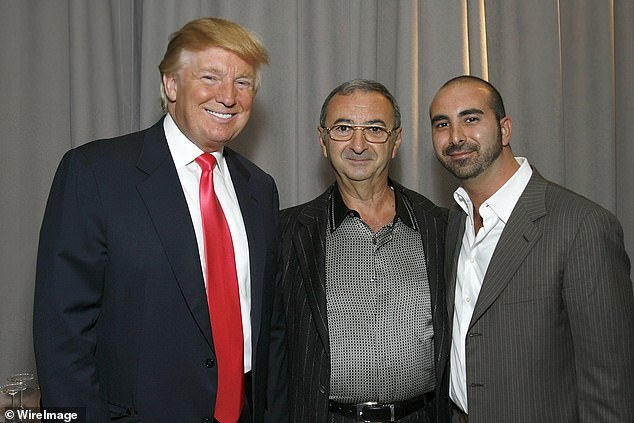
It will never cease to amaze me that America elected a president with so many links to Russian organized crime.
There was Vyacheslav Ivankov whose FBI file contained numerous references to Donald Trump that the bureau refused to release to me. There was David Bogatin who spent $6 million to buy five separate units in Trump Tower. There was Anatoly Golubchik and Vadim Trincher, who went to prison for running an illegal sports betting ring in Trump Tower that catered primarily to Russian oligarchs.
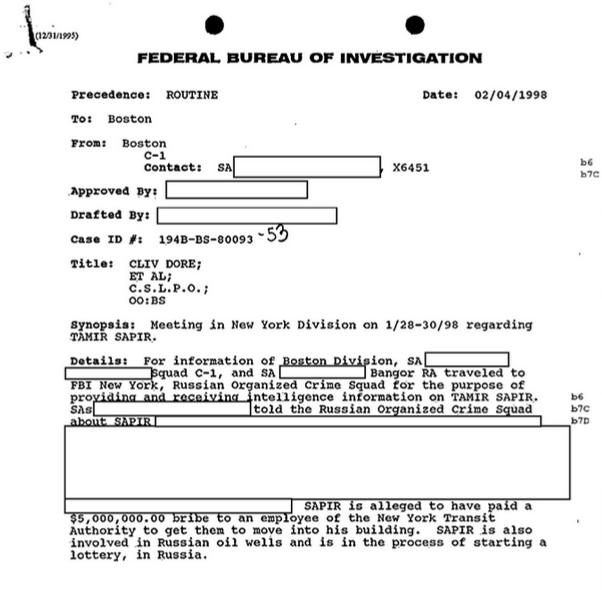
Add another name to the list: The FBI’s file on Tamir Sapir, a Georgian developer who financed the construction of Trump Soho in Manhattan in 2008, shows he was under investigation for links to Russian organized crime.
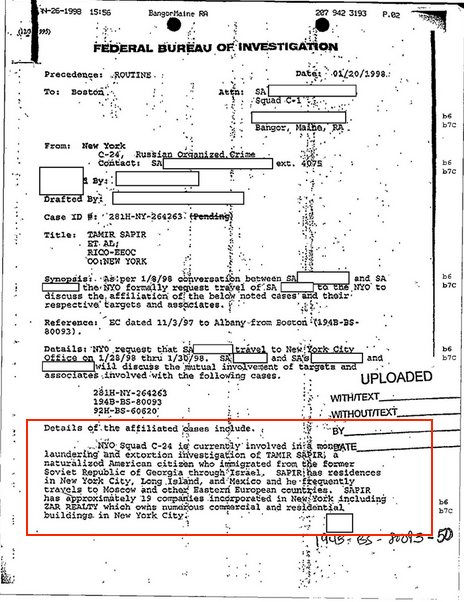
A memo in the FBI file states that C-24, the FBI’s Russian Organized Crime squad in New York, was investigating Sapir for money laundering and extortion:
“NYO squad C-24 is currently involved in a money laundering and extortion investigation of TAMIR SAPIR, a naturalized Armenian citizen who immigrated from the former Soviet Republic of Georgia through Israel. SAPIR has residences in New York City, Long Island, and Mexico and he frequently travels to Moscow and other Eastern European countries.”
“SAPIR has approximately 12 companies incorporated in New York including ZAR REALTY which owns commercial and residential buildings in New York City. [Note: One of those residences was a condo on the 58th floor of Trump Tower.]”
“Additionally, SAPIR is believed to own a 150-foot pleasure yacht, the MYSTERE, registered in the Cayman Islands and three private jets, one being a Boeing 727 also registered in the Cayman Islands.”
“It is believed that SAPIR is a front for Russian organized crime money including activity for the President of Tartarstan.
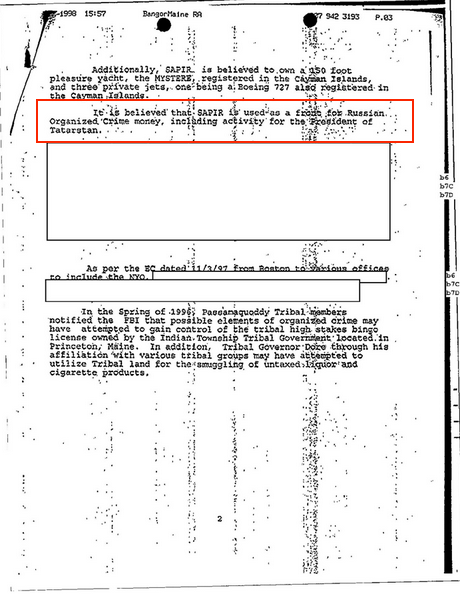
Another FBI notes that Sapir allegedly paid a $5 million bribe to an employee of the New York Transit Authority to get employees to move into a building he owned.
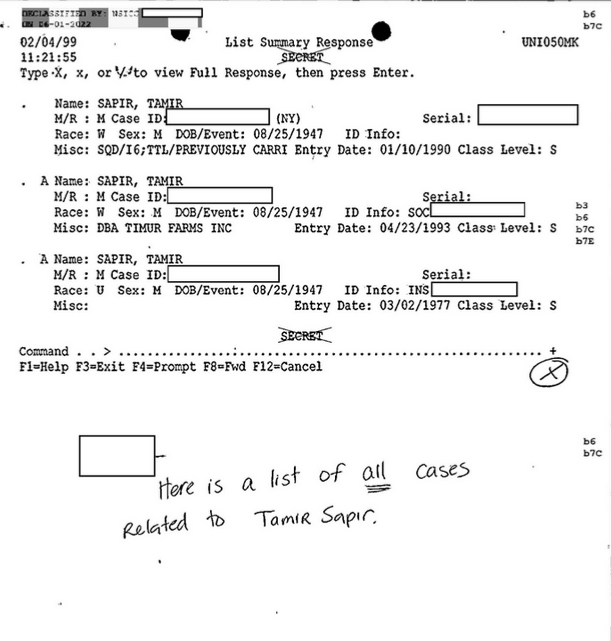
The file lists numerous FBI investigations involving Sapir, some dating back to 1977.
Another FBI investigation involved Joy-Lud, a Manhattan electronics store that Sapir ran with Sam Kislin, a Ukrainian immigrant who was a major donor to Rudy Giuliani’s mayoral campaigns.
Joy-Lud catered to a Soviet clientele—with one notable exception. Donald Trump purchased 200 televisions on credit from Sapir and Kislin’s electronics store in the 1970s for his newly acquired Commodore Hotel.
I’ve asked the FBI to process these other files and will post them here when I receive them.
Jeffrey Epstein, Leon Black, and Russia

Leon Black, co-founder of the private equity giant Apollo Global Management, has agreed to step down from his duties as CEO after an independent review found he had paid $148 million to the convicted pedophile Jeffrey Epstein over a period of four years.
The New York Times notes that Black’s millions bankrolled Epstein after he pleaded guilty in 2008 to a prostitution charge involving a teenage girl. Black’s payments to Epstein were made between 2013 and 2017.
Why would a sophisticated man like Leon Black, a billionaire with a reputation to protect, associate with and pay millions to Epstein?
The independent report commissioned by Apollo from the law firm, Dechert, provides an answer:
Black viewed Epstein as a confirmed bachelor with eclectic tastes, who often employed attractive women. However, Black did not believe that any of the women in Epstein’s employ were underage. Black has no recollection of ever seeing Epstein with an underage woman at any time.
“A confirmed bachelor with eclectic tastes.” OK, sure. And Hannibal Lecter is a erudite psychiatrist with unusual appetites.
The Dechert report notes that Black trusted Epstein and confided in him on “personal matters.” Epstein had intimate knowledge of Black’s personal finances. Black regularly visited Epstein to discuss business or meet “well known businessmen, political figures, diplomats, scientists and celebrities” who gathered at Epstein’s enormous New York townhouse.
For the conspiracy-minded, the connections between the two men are interesting in light of reports that Epstein collected dirt on powerful men and had cameras in his house monitoring private moments.
And let’s not forget Epstein’s ties to intelligence services. Alex Acosta, Trump’s former labor secretary who led the prosecution of Epstein in Florida said he had been told “Epstein ‘belonged to intelligence’ and to leave it alone,” according to Vicky Ward’s report in The Daily Beast.
No one has yet noted something I pointed out more than a year ago, namely, Black’s numerous ties to Russia, Donald Trump, and Russian money.
Both Black and Trump were friends of Epstein’s at different times. Black also socialized with Trump and Jared Kushner, as the photo at the top shows. Apollo loaned $187 million to Jared Kushner’s family real estate firm.
Volume 5 of the Senate Intelligence Committee’s Russia report establishes that Leon Black accompanied Trump during his 1996 visit to Moscow to pursue real estate deals.
Trump’s trip to Moscow was organized by investor Bennett LeBow, who was trying to get Trump to develop a site he owned in Moscow. Not only did he serve up a site for Trump, LeBow lined up financing from Apollo Group, a then six-year-old private equity firm.
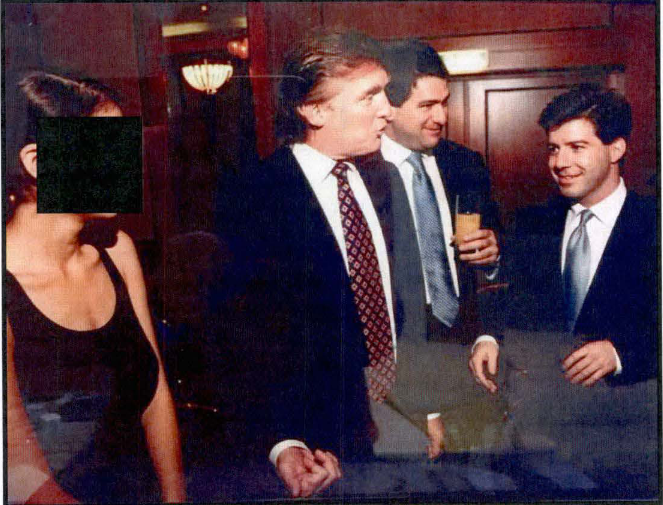
Black told the Senate Intelligence Committee that he did not recall any compromising behavior during the trip. He also did not recall the event in the photograph above.
Black did recall going to a concert with Trump, followed by a “discotheque.” Black later added that he and Trump “might have been in a strip club together.”
Moscow strip clubs were well-known as a potential source of kompromat or blackmail.
For years in Russia there were a number of Russian government officials or others who were exposed in these strip clubs doing not very nice things that their wives, if they have wives, probably didn’t know about. I think most of us appreciated that there was that risk in these types of clubs.
Peter O’Brien, CFO of the Russian-government controlled oil firm Rosneft, as quoted in Vol. 5 of the Senate intelligence committee’ Russia report.
It’s worth noting that the Moscow trip was not part of Dechert’s investigation into Black’s dealings with Epstein. The report says it reviewed documents dating back to 1998.
In 2011, Black was back in Russia, this time for a one-on-one meeting with Russian President Vladimir Putin.
Black committed to help Russia set up a $10 billion sovereign wealth fund, the Russian Direct Investment Fund (RDIF).
It was a privilege to help the fund, Black told Reuters, and described Russia’s “strong political leadership” as an advantage for investors at a time of global economic and financial difficulty. Black was named to the advisory board of the RDIF in 2011.
Four years later, after Russia invaded Crimea, the U.S. Treasury imposed sanctions on the RDIF. `
Kirill Dmitriev, CEO of the RDIF, makes numerous appearances in the Mueller Report. After Trump’s election, it was Dmitriev who wrote received an email that read, “Putin has won.” It was also Dmitirev who met in the Seychelles island with Erik Prince after Trump’s election.
Black also knows many Russian oligarchs. He met with the notorious aluminum tycoon Oleg Deripaska in Russia and the United States prior to Deripaska being sanctioned by the United States in 2018. Black knows Allen Vine, whom Black described as “consigliere” to the Russian oligarch Suleiman Kerimov, who was sanctioned by the United States in 2018.
And he does business with Vladimir Potanin, one of the world’s richest men. Unlike Deripaska and Kerimov, Potanin has not been sanctioned the U.S. government.
Potanin is a large investor in U.S. companies, including Apollo Global. In a 2014 court filing in her divorce, Potanin’s wife, Natalia, listed Apollo Global Management LLC as one of the companies in which her husband has had a financial interest.
Why did Black have such close connections to Russia? Did Epstein, who had an intimate knowledge of Black’s personal affairs, know the answer?
Sammy “The Bull” Gravano and Donald Trump
You can’t always fit everything into a story. This was one of the loose ends that didn’t make it into my recent Rolling Stone piece on Donald Trump’s connections to the world depicted in the Martin Scorsese film, The Irishman. You can read it here.
Sammy “The Bull” Gravano was an underboss in the Gambino crime family, who admitted a role in 19 murders.
After his arrest in 1991, Gravano agreed to testify against his boss, John Gotti, and dozens of other Mafia stalwarts. In exchange, he received a sweetheart deal from prosecutors: five years in prison.
On March 10, 1993, Gravano testified before the Senate as part of the Permanent Subcommittee on Investigation’s probe into corruption in professional boxing. Trump, who owned several casinos in Atlantic City that staged big fights, comes up several times in Gravano’s testimony.
Here, Gravano tells the Senate how he would “reach” Donald Trump.
 Trump / Russia