Long slog for US Marines in Afghanistan

Afghan General Mahaiuddin Ghori visited Camp Pendleton and held a press conference today thanking Marines and their families.

Ghori commands the British-trained Afghan National Army’s 3rd Kandak, 205 Hero Corps (3/205) brigade in Afghanistan’s Helmand province — the world’s largest poppy growing region.

By April, Camp Pendleton units are expected to lead about 20,000 Marines serving in Helmand, and Ghori and his men are here to help the U.S. troops train them. Here they are at the Marine’s “combat town”

Ghori has been fighting for years. He was a former officer in the 1980s pro-Soviet Afghan army fighting the mujehadin. His 3/205 brigade fires Soviet D-30s, 122mm howitzers. Ghori himself trained at Moscow’s Frunze Academy.

Asked about President Barack Obama’s timeline for withdrawing American forces from Afghanistan starting around July 2011, Ghori said his army needs a longer partnership: “I’m hoping for more time in order to properly train our forces.”

How much time?

Last month, Ghori said he expected it would take 5-6 years for Afghan troops to take over the country’s security, and they would need to depend on foreigners for many years after. He said “a long time, 10-15 years are needed for mentoring in new equipment, new airplanes, education, pilots engineers and commanders..”

More on San Diego's Relational Investors

A friend who works for a placement firm called me up to point out that I managed to malign the entire placement agent industry in my last post.

There are placement agents who register and disclose everything to regulators — only to see their reputations undermined by folks who don’t play by the same rules.

A company in Yorktown Heights, N.Y. called Tullig Inc. was paid nearly $17 million for helping San Diego’s Relational Investors LLC line up a big investment from CalPERS, the giant California pension fund.

What magic strings did Tullig pull on from Yorktown Heights? What’s the connection between Relational and Tullig?  And why is it so hard to get answers to these questions?

Neither Tullig nor its head, Donal J. Murphy is registered with the SEC or the industry’s own regulatory body, FINRA.

Neither is another of Murphy’s companies, DJ Murphy Associates Inc., described as a company that sells investment services to public pension funds in this 1998 story in The New York Times.

Murphy, a native of Queens, New York, spent two decades at Bankers Trust before branching out on his own in 1992. Relational hired him the following year, according to the Wall Street Journal.

In 2003, DJ Murphy Associates was fined $400 by the California Fair Political Practices Commission for failing to register as a major donor. (.pdf)

Mount Kisco, NY-based DJ Murphy wrote a check for $10,000 to Democrat Steve Westly’s campaign for California controller on Aug. 14, 2002.

The same day, Aug. 14, 2002, something called the E-Celerator Fund LLC wrote Westly a $12,500 check. E-Celerator is a little-known private fund that’s run by Whitworth and his partner, David Batchelder.

E-Celerator gave another $15,000 to Westly’s campaign on Dec. 6, 2002, more than a month after his close election victory.

Perhaps these contributions had something to do with the seat California’s controller automatically holds on CalPERS’ board.

On the CalPERS board, Westly took up the cause excessive executive compensation, which happened to be Whitworth’s signature issue as well, and the pension fund nominated Whitworth for a spot on the New York Stock Exchange.

Not bad for a guy from Winnemucca, Nevada who started out as an aide to hometown Sen. Paul Laxalt. Laxalt is now a $20,000-a-month lobbyist who worked for Whitworth on issues such as “Legislation/policies relating to the tax treatment of carried interest received by investment fund managers.”

This is in the same vein as the top CalPERS middleman ARVCO Financial Venture’s Al Villalobos, a former member of the pension fund’s board who grossed nearly $60 million in fees. Villalobos chose to incorporate in tax-free Nevada.

Middlemen, however, are stuck in the middle. The real money is with investment managers like Whitworth, who made $16 million in a single year, according to court documents filed by his ex-wife.

Whitworth owes his wealth in part to the corporate public disclosures that Relational’s team scours to find undervalued companies like Mattel and J.C. Penney. Relational then buys up a stake in the company and tries to turn things around.

Fair enough, but Whitworth is throwing his weight around the corporate boardroom courtesy of giant pension funds like CalPERS, which has put $1.5 billion in Relational to date.

If only Whitworth were as transparent as he expects corporate executives to be.

San Diego's Relational Investors and CalPERS

CalPERS, the giant California state pension fund, is taking a close look at its investment with Ralph Whitworth, who heads Relational Investors, a shareholder activist firm based in San Diego.

A law firm hired by CalPERS is examining the nearly $17 million Relational paid an obscure middleman who helped secure business from the pension fund, The Wall Street Journal reports today.

Relational Investors is headed by Ralph V. Whitworth and David Batchelder, who met while working in the 1980s for Texas oilman and corporate raider T. Boone Pickens.

Relational buys up stakes in underperforming companies like Mattel and J.C. Penney for a turnaround directed by Whitworth.

CalPERS is Relational’s biggest investor. The pension fund has about $1.5 billion in Relational.

Huge fees are standard for middlemen who successfully line up investments from CalPERS, but Relational’s payment to Tullig Inc. stands out. No one earned more from a single client.

Tullig Inc. is an obscure New York firm headed by an obscure man named Donal Murphy. What he did to earn his rich paycheck is as clear as mud.

Essentially, these middlemen are lobbyists and operators. It’s a shady business — money buying more money — that is finally getting some attention following a massive kickback and bribery scheme at New York State’s public pension fund.

Whitworth is perhaps best known for paying Paul McCartney $1 million in 2003 to perform at his wife’s private birthday party at a restaurant Rancho Santa Fe. The couple filed for divorce less than a year later.

The Arrest of El Teo

In The Politics of Heroin, Alfred McCoy notes that we capture a drug lord only when he is no longer a drug lord.

So it is with news of the arrest of El Teo, a vicious Tijuana drug baron who is accused of having the bodies of his enemies beheaded or dissolved in caustic soda.

McCoy reminds us that a man like El Teo, or rather, the man authorities accuse him of being, can only be arrested when the drug traffic shifts, stripping him of the power, profits and protection he needs to stay in business. In other words, the arrest of El Teo was only possible because he was already irrelevant.

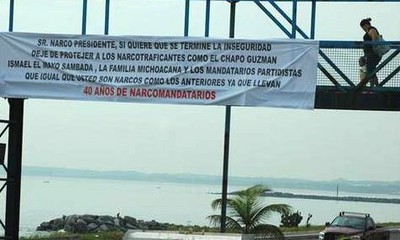
While the bloodbath in Tijuana attracts the attention, the Sinaloa carter and its leader, Joaquin El Chapo (“Shorty”) Guzman, quietly prospers, as The Economist noted this week:

Sinaloa, by contrast, has stuck to drugs and money laundering and is smarter and more sophisticated. It prefers anonymity to the ostentation of others (Mr Beltrán was undone by inviting a famous accordionist to play at a Christmas party). It eschews jobless teenagers, its rivals’ rank and file, in favour of graduates, infiltration and intelligence. Although all the gangs have penetrated local governments, only Sinaloa and the Beltráns have been discovered to have bribed senior officials. Officials complain that Sinaloa operatives receive warning of pending raids. Sceptics wonder whether success against other gangs comes from tip-offs from Sinaloa.

Forbes reckons that Guzman, who bribed his way out of prison in 2001, is now the 701st richest man in the world.

Forbes on Tom Gores and the U-T

From the Forbes 400 issue I picked up last week:

Gores has his hands full with the San Diego Union-Tribune, which he bought in May for an estimated $30 million, based on current industry multiples. Three days after the deal closed, Platinum laid off 192 people; 112 additional cuts came in August. Gores saw no other way: The newspaper (average daily circulation: 300,000) had less than $10 million in EBITDA [earnings before taxes, depreciation, amortization] on revenue of less than $255 million, down from $100 million on revenue of roughly $360 million in 2005. “The outlook was for an unprofitable 2009,” says a Platinum spokesman.

What makes Gores think he can revive a near-dead enterprise? He likes the market. San Diego is still relatively affluent and culturally conservative; few denizens read the Los Angeles Times. He also prizes the assets — a 500,000 square-foot headquarters and warehouse in Mission Valley, plus 50,000 square feet of offices in La Jolla, San Marcos and Carlsbad.

But, oh, the challenges. The U-T was perhaps the last paper in the U.S. that relied on cut-and-paste layouts; Platinum has spent several million dollars on new publication software. To replace the loss of national advertisers, especially retailers and real estate firms, and classifieds, the paper is refocusing on small businesses. Gores has also updated the Web site with more social media, blogs and podcasts. He has reinstated 401(k) matching and reversed pay cuts by the previous owners, the Copley family. He expects a slight operating profit this year.

Gores plans to buy more distressed media companies. Lately his name has surfaced among potential buyers of the Boston Globe and BusinessWeek. Platinum’s response: “Don’t believe everything you read in the papers.”

For those keeping score at home, Gores is No. 147 with a $2.2 billion fortune.